α-Cyclodextrin: A Small Ring-Shaped Molecule for Light-Responsive, Membrane, and Regenerative Materials
キーワード / Keywords
-
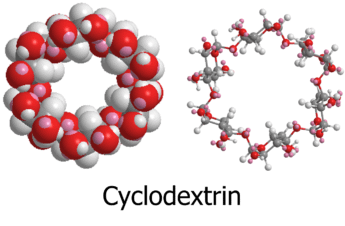
α-シクロデキストリン / α-Cyclodextrin
ブドウ糖6個からなる環状分子です。小さな空洞で分子を包み、光応答材料、分離膜、再生医療材料などの機能設計に使われます。
EN: A ring-shaped molecule made of six glucose units. Its small cavity can host molecules and support functional design in optical materials, membranes, and regenerative biomaterials. -
ホスト–ゲスト相互作用 / Host–Guest Interaction
環状分子の空洞に別の分子が入り込む現象です。分子の動き方、光り方、膜での通りやすさ、薬の放出を制御する基本原理になります。
EN: A phenomenon in which another molecule enters a ring-shaped cavity. It helps control molecular motion, light emission, membrane transport, and therapeutic release. -
超分子材料 / Supramolecular Materials
共有結合だけでなく、包接や水素結合などの弱い力で組み上がる材料です。壊れにくさ、応答性、再構成しやすさを持たせやすい特徴があります。
EN: Materials assembled through reversible interactions such as inclusion and hydrogen bonding. They can be tough, responsive, and reconfigurable. -
イオン分離膜 / Ion-Separation Membrane
水中のイオンを種類ごとに分ける膜です。α-シクロデキストリンを膜入口に配置すると、イオンを選びながら速く通す設計が可能になります。
EN: A membrane that separates ions in water. Placing α-cyclodextrin at channel entrances can help combine selective recognition with rapid ion transport. -
再生医療材料 / Regenerative Biomaterials
骨、皮膚、神経、眼などの組織修復を助ける材料です。シクロデキストリンは薬や生体分子を安定化し、必要な場所で放出する設計に使えます。
EN: Materials that support tissue repair in bone, skin, nerve, eye, and other tissues. Cyclodextrins can stabilize therapeutic molecules and regulate their release.
採用した3本 / Three Selected Papers
-
Nature Communications(JIF 18.1)
MXene membrane with directionally functionalized channel entrances for enhanced ion selectivity and permeability
DOI: 10.1038/s41467-026-71889-9 -
Advanced Science(JIF 14.1)
Tunable Reversible Photochromic Ultralong Organic Phosphorescence via a Universal Phenylpyridine Noncovalent Assembly Strategy
DOI: 10.1002/advs.76554 -
Journal of Materials Chemistry B(JIF 6.03)
Cyclodextrin-based biomaterials for tissue regeneration: design strategies, biomedical applications, and translational insights
DOI: 10.1039/d6tb01042c
日本語版
1. α-シクロデキストリンで膜の入口を設計し、イオンを選んで速く通す
論文: MXene membrane with directionally functionalized channel entrances for enhanced ion selectivity and permeability
掲載誌: Nature Communications
DOI: 10.1038/s41467-026-71889-9
- この研究は、二次元材料MXeneの層状膜に、α-シクロデキストリンを方向性をもって配置し、イオン分離性能を高めたものです。
- 通常、膜の選択性を高めようとすると、イオンの通りやすさが低下しやすいという課題があります。
- 研究では、膜の“通り道全体”ではなく、“入口”にα-シクロデキストリンを固定する設計を採用しています。
- 入口でイオンを見分け、内部の通路はできるだけ妨げないことで、高い選択性と高い透過性の両立を狙っています。
- 結果として、一価イオンと二価イオンを大きく選別しながら、一価イオンを速く通す膜が得られました。
- 実験とシミュレーションから、イオンの水和構造の違いが、膜内での通り道を変える重要な要因であることが示されました。
- 一般向けに言えば、「分子の小さな輪を膜の入口に置き、水の中のイオンを賢く仕分ける」研究です。
2. α-シクロデキストリンで、光で色と発光が切り替わる材料をつくる
論文: Tunable Reversible Photochromic Ultralong Organic Phosphorescence via a Universal Phenylpyridine Noncovalent Assembly Strategy
掲載誌: Advanced Science
DOI: 10.1002/advs.76554
- この研究は、フェニルピリジン誘導体とα-シクロデキストリンを組み合わせ、光で色や発光が可逆的に変わる超分子材料を作ったものです。
- α-シクロデキストリンは、ゲスト分子を包み込むだけでなく、水素結合などと協同して、分子が動きにくい安定なネットワークを作ります。
- この環境により、長く残る有機りん光が安定化され、最大0.96秒のりん光寿命と高い量子収率が示されました。
- 光照射によりラジカルが生成し、色変化と発光の切り替えが連動します。
- 分子の置換基やピリジン位置を変えることで、発光色やフォトクロミック応答を調整できます。
- 応用として、多段階情報暗号化や時間分解型の光パターンに利用できる可能性があります。
- 一般向けに言えば、「光を当てると色と光り方が変わり、情報を隠したり表示したりできる材料」の研究です。
3. シクロデキストリンを使った再生医療材料の設計を整理する総説
論文: Cyclodextrin-based biomaterials for tissue regeneration: design strategies, biomedical applications, and translational insights
掲載誌: Journal of Materials Chemistry B
DOI: 10.1039/d6tb01042c
- この総説は、α-シクロデキストリンを含むシクロデキストリン系材料が、再生医療でどのように使われるかを整理しています。
- シクロデキストリンは、薬を溶かす補助剤にとどまらず、治療分子の放出、安定化、細胞応答の制御に使える材料部品です。
- 対象となる材料には、ハイドロゲル、ナノ粒子、足場材料、複合材料、刺激応答性システムなどがあります。
- 応用範囲は、骨、軟骨、心臓、神経、肝臓、皮膚、眼など、幅広い組織修復に及びます。
- 一方で、臨床応用には安全性、規制、製造、再現性などの課題もあります。
- 将来の方向性として、3D/4Dバイオプリンティング、個別化医療、AIを使った材料設計が挙げられています。
- 一般向けに言えば、「小さな分子の輪を使って、傷んだ組織を治す材料をどう設計するか」をまとめた総説です。
まとめ
今回の3本から、α-シクロデキストリンは、単なる包接分子ではなく、光、膜、医療材料をつなぐ設計部品として使えることが見えてきます。膜ではイオンを選ぶ入口になり、光材料では発光と色変化を支え、再生医療では薬や生体分子を必要な場所へ届ける材料の基盤になります。小さな空洞を持つ環状分子が、社会課題に向けた材料科学へ広がっています。
English Version
1. Designing membrane entrances with α-cyclodextrin for fast and selective ion transport
Paper: MXene membrane with directionally functionalized channel entrances for enhanced ion selectivity and permeability
Journal: Nature Communications
DOI: 10.1038/s41467-026-71889-9
- This study uses α-cyclodextrin to functionalize the entrances of sub-nanochannels in MXene lamellar membranes.
- Ion-separation membranes often face a trade-off: improving selectivity can reduce permeability.
- Instead of modifying the whole channel, the researchers placed α-cyclodextrin at the channel entrances.
- This design provides selective recognition at the entrance while keeping the internal pathway relatively open for rapid ion transport.
- The membrane achieved high mono-/divalent cation selectivity while maintaining high monovalent-ion permeability.
- Experiments and simulations suggest that differences in ion hydration structures alter transport pathways inside the channels.
- In simple terms, this study uses α-cyclodextrin as a molecular gatekeeper that helps sort ions in water.
2. α-Cyclodextrin enables materials whose color and glow switch with light
Paper: Tunable Reversible Photochromic Ultralong Organic Phosphorescence via a Universal Phenylpyridine Noncovalent Assembly Strategy
Journal: Advanced Science
DOI: 10.1002/advs.76554
- This study combines phenylpyridine derivatives with α-cyclodextrin to create supramolecular materials with reversible photochromism and ultralong organic phosphorescence.
- α-Cyclodextrin helps build a robust noncovalent network through host–guest complexation and hydrogen bonding.
- This network stabilizes excited triplet states and supports long-lived phosphorescence.
- Light exposure generates radicals that control reversible color change and modulate phosphorescence.
- By changing aryl substituents or pyridine substitution sites, the researchers can tune emission behavior and multicolor photochromism.
- Potential applications include multistage information encryption and time-resolved photopatterning.
- For general readers, this is a light-responsive material that can change both its color and afterglow.
3. Cyclodextrin-based biomaterials for tissue regeneration
Paper: Cyclodextrin-based biomaterials for tissue regeneration: design strategies, biomedical applications, and translational insights
Journal: Journal of Materials Chemistry B
DOI: 10.1039/d6tb01042c
- This review summarizes how cyclodextrins, including α-cyclodextrin, are used in regenerative biomaterials.
- Cyclodextrins are not only pharmaceutical excipients; they can help control therapeutic release, stabilize biomolecules, and tune cell responses.
- The reviewed material forms include hydrogels, nanoparticles, scaffolds, composite systems, and stimuli-responsive platforms.
- Applications span bone, cartilage, cardiac, neural, hepatic, skin, and ocular tissue repair.
- The review also discusses safety, regulation, manufacturing, and translational challenges.
- Future directions include 3D/4D bioprinting, personalized regenerative medicine, and AI-assisted biomaterial design.
- In simple terms, this review explains how small ring-shaped molecules can help build materials that support tissue repair.
Overall Takeaway
The three selected papers show α-cyclodextrin as a practical design unit rather than just a molecular container. It can serve as a gatekeeper in ion-separation membranes, a structural organizer in light-responsive phosphorescent materials, and a building block for regenerative biomaterials. Across these areas, the key feature is the small cyclodextrin cavity, which turns molecular recognition into useful material function.
文献 / References
- Yu, H.; Xu, R.; Ren, J.; Yuan, L.; Cui, Z.; Zhang, W.; Wang, Z.; Lv, L.; Zhang, X.; Pan, B. MXene membrane with directionally functionalized channel entrances for enhanced ion selectivity and permeability. Nature Communications 17 (2026), 6282. DOI: 10.1038/s41467-026-71889-9.
- Bai, X.; Wang, R.; Xue, H.-J.; Jiang, Z.; Yang, S.; Li, C.; Ge, Y.; Liu, C.; Dai, X.-Y. Tunable Reversible Photochromic Ultralong Organic Phosphorescence via a Universal Phenylpyridine Noncovalent Assembly Strategy. Advanced Science (2026). DOI: 10.1002/advs.76554.
- Kanaujiya, S.; Pandey, G.; Kumar, A.; Arya, D. K.; Pandey, P.; Subhashchandra, G. K.; Verma, M.; Yadav, D.; Srivastava, S.; Rajinikanth, P. S. Cyclodextrin-based biomaterials for tissue regeneration: design strategies, biomedical applications, and translational insights. Journal of Materials Chemistry B (2026). DOI: 10.1039/d6tb01042c.
選定メモ / Selection Note
- Nature Communications:JIF 18.1(2025データ、2026更新値)
- Advanced Science:JIF 14.1(2025データ、2026更新値)
- Journal of Materials Chemistry B:JIF 6.03(2025データ)
添付ファイル内には、食品、土壌、理論化学、ポリロタキサン、蛍光色素、香料放出、β-CD系フォトクロミック材料などの関連研究も含まれていました。本稿では、ファイル名「α-cyclodextrin」との関連性が明確で、かつジャーナル指標が高い上位3本を優先しました。なお、Journal of Energy Chemistry の論文はジャーナル指標が高いものの、本文上の主対象がビオロゲン–β-シクロデキストリン複合体であるため、α-シクロデキストリン記事の主論文からは外しました。