キーワード / Keywords
1. 色素増感太陽電池(Dye-Sensitized Solar Cell, DSSC)
日本語:色素が光を吸収して電子を生み出す太陽電池です。低照度でも発電しやすく、材料や色を選べるため、室内機器や建材への応用が期待されています。
English: A solar cell in which dye molecules absorb light and generate electrons, offering flexible material choices and useful performance under low illumination.
2. 光電変換効率(Power Conversion Efficiency)
日本語:入射した光エネルギーのうち、どれだけを電気へ変換できたかを示す指標です。色素、電極、電解質、界面構造のすべてが性能に影響します。
English: The percentage of incident light energy converted into electricity, influenced by the dye, electrodes, electrolyte, and their interfaces.
3. 共吸着剤(Co-Adsorbent)
日本語:色素と一緒に半導体表面へ吸着し、色素の凝集や電子の逆流を抑える分子です。分子の長さや形によって、表面保護と色素量のバランスが変わります。
English: A molecule adsorbed alongside the dye to reduce aggregation and electron recombination while controlling surface coverage.
4. 白金フリー対極(Platinum-Free Counter Electrode)
日本語:高価で希少な白金を使わず、電解質の反応を進める電極です。炭素材料や金属化合物を利用し、低コスト化と高性能化を目指します。
English: A counter electrode made without scarce platinum, using alternative catalysts to reduce cost while maintaining efficient electrolyte reactions.
5. 機械学習(Machine Learning)
日本語:多数の実験データから、材料や装置条件と発電性能の関係を学ぶ手法です。候補を効率よく絞り込み、次の実験設計を支えることができます。
English: A data-driven method that learns relationships between molecular, device, and performance data to guide the selection of promising solar-cell designs.
日本語版
研究背景
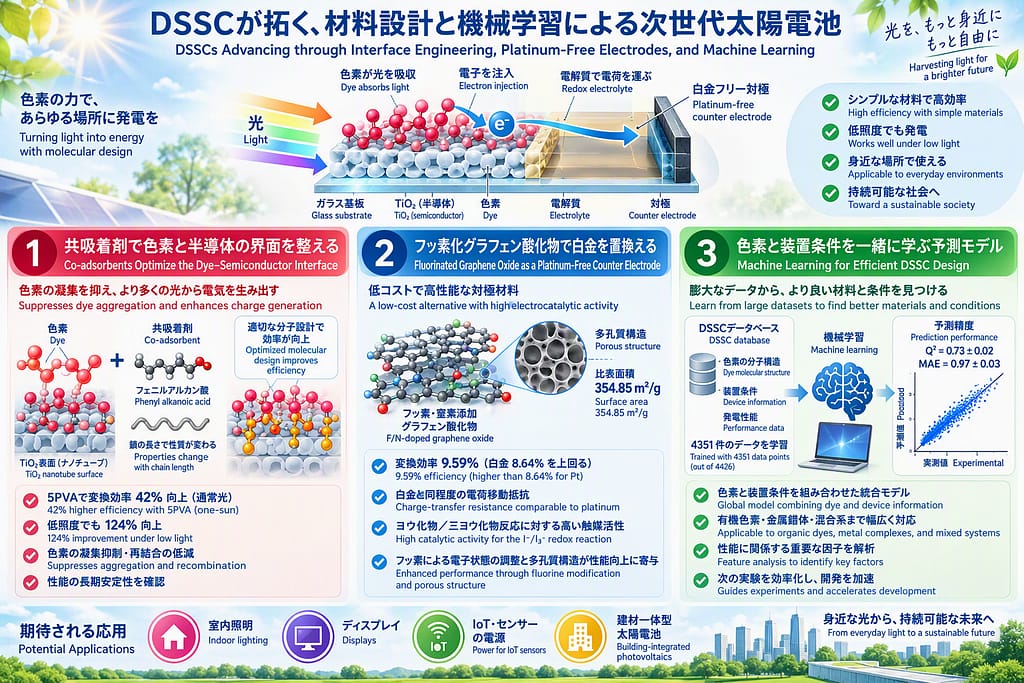
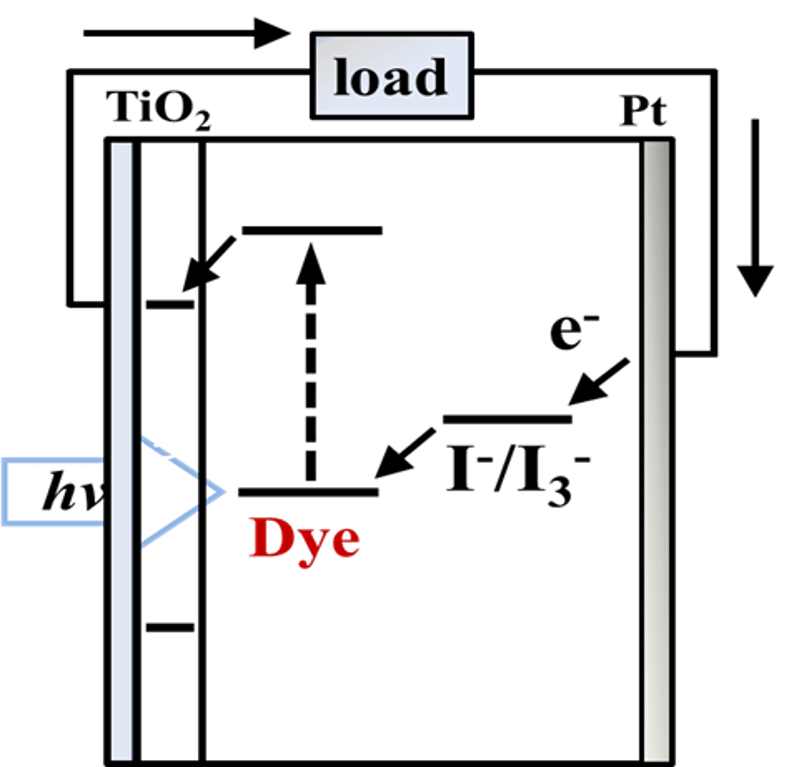
色素増感太陽電池(DSSC)は、色素が光を吸収し、半導体へ電子を渡すことで発電する仕組みです。比較的低コストで作製でき、室内光のような弱い光でも利用しやすいことから、センサーやIoT機器の電源としても注目されています。一方、性能は色素だけで決まるものではありません。色素が結合する半導体表面、電解質の反応を助ける対極、各層の厚さや作製条件などが相互に影響します。
今回紹介する研究は、半導体界面の分子設計、白金に代わる電極材料、膨大な実験データを扱う機械学習という三つの視点から、DSSCの効率、耐久性、開発速度を高めようとするものです。
研究内容
1. 共吸着剤で色素と半導体の界面を整える
The role of phenyl alkanoic acid as co-adsorbent on the efficiency of N719 sensitized TiO2 nanotube solar cell
- N719色素を用いた酸化チタンナノチューブ型DSSCに、鎖長の異なるフェニルアルカン酸を共吸着剤として加えました。
- 表面観察、分光分析、電気化学測定に加え、量子化学計算から分子レベルの吸着挙動を調べました。
- 共吸着剤は色素の凝集を抑え、電子が戻る再結合への抵抗を高めました。
- 短すぎる分子は色素と表面を奪い合い、長すぎる分子は立体的に色素の接近を妨げました。
- 5PVAは表面保護と色素保持のバランスに優れ、無添加の場合より変換効率が通常光で42%、低照度で124%向上しました。
- 5PVAを導入したセルは、対照よりも性能を維持しやすいことも確認されました。
2. フッ素化グラフェン酸化物で白金を置き換える
Enhanced electrocatalytic activity of fluorine and nitrogen-doped graphene oxide as counter electrodes in DSSCs
- グラフェン酸化物、フッ素添加材料、窒素・フッ素共添加材料をDSSCの対極として比較しました。
- フッ素添加グラフェン酸化物は、比表面積354.85 m²/gの多孔質構造を持ち、電解質と接触しやすい表面を形成しました。
- 電気化学測定では、白金と同程度の電荷移動抵抗を示し、ヨウ化物/三ヨウ化物反応に対する高い触媒活性が確認されました。
- 完成したDSSCの変換効率は9.59%で、同じ条件の白金対極セルの8.64%を上回りました。
- フッ素による電子状態の調整と、多孔質構造による反応面積の増加が性能向上に寄与したと考えられます。
3. 色素と装置条件を一緒に学ぶ予測モデル
Combining Device Information and Molecular Fingerprints into a Global Model for Reliable Prediction of Power Conversion Efficiency of Dye-Sensitized Solar Cells
- DSSCデータベースに収録された4426件のうち4351件を利用し、変換効率を予測する機械学習モデルを構築しました。
- 色素の分子構造を表すフィンガープリントだけでなく、セルの装置条件も一緒に入力しました。
- 色素と装置の組み合わせを扱うことで、同じ色素でも条件が異なるデータを区別し、性能への両者の影響を捉えました。
- テストデータに対する予測性能はQ² = 0.73 ± 0.02、平均絶対誤差は0.97 ± 0.03でした。
- 有機色素、金属錯体、複数色素の混合系まで広く扱い、特徴量解析によって性能に関係する要因も検討しました。
期待される応用
三つの研究は、DSSCの開発が一つの高性能材料を探すだけでは進まないことを示しています。共吸着剤は色素と半導体の接点を整え、フッ素化炭素材料は高価な白金を代替し、機械学習は色素と装置条件の膨大な組み合わせを整理します。これらを組み合わせれば、実験候補をデータから絞り込み、界面設計と電極設計を効率よく改善する研究につながります。
今後は、室内センサーやIoT機器、低照度環境で働く独立電源、意匠性を生かした発電部材などへの展開が考えられます。実用化には、大面積化した際の均一性、長期安定性、材料調達と製造コスト、異なる研究機関のデータでも予測できるモデルの検証が重要です。
English Version
DSSCs Advancing through Interface Engineering, Platinum-Free Electrodes, and Machine Learning
Research Background
Dye-sensitized solar cells generate electricity when dye molecules absorb light and inject electrons into a semiconductor. Their compatibility with low-light conditions and relatively flexible material design makes them attractive for indoor sensors and Internet of Things devices. Their performance, however, depends on an entire system that includes the dye, semiconductor surface, electrolyte, counter electrode, and fabrication conditions.
The three studies highlighted here address this system from complementary directions: molecular control of the dye–semiconductor interface, replacement of platinum counter electrodes, and machine-learning prediction using both molecular and device information.
Research Highlights
1. Co-Adsorbents Balance Surface Passivation and Dye Loading
- Phenyl alkanoic acids with different chain lengths were introduced into N719-sensitized TiO2 nanotube DSSCs.
- Surface, spectroscopic, electrochemical, and computational analyses were combined to examine adsorption at the molecular level.
- The co-adsorbents reduced dye aggregation and increased resistance to electron recombination.
- Short molecules competed strongly with the dye for surface sites, while longer molecules created steric barriers that limited dye access.
- 5PVA provided the best balance, improving efficiency by 42% under one-sun illumination and 124% under low light compared with the control.
- Devices modified with 5PVA also retained their performance better during stability testing.
2. Fluorinated Graphene Oxide Replaces Platinum
- Graphene oxide, fluorine-doped graphene oxide, and nitrogen/fluorine co-doped graphene oxide were evaluated as counter electrodes.
- Fluorine-doped graphene oxide formed a highly porous structure with a specific surface area of 354.85 m²/g.
- Its charge-transfer resistance was comparable to platinum, and it showed strong electrocatalytic activity for the iodide/triiodide redox reaction.
- Complete DSSCs reached 9.59% efficiency, compared with 8.64% for the platinum-based reference device.
- The improvement was associated with accessible porosity, fluorine-modified electronic structure, and favorable electrode–electrolyte charge transfer.
3. A Global Model Learns from Both Dye and Device Data
- A machine-learning model was constructed using 4351 of the 4426 entries in a DSSC database.
- Molecular fingerprints describing the dyes were combined with device features rather than analyzed separately.
- This dye–device representation distinguished repeated dye entries used under different conditions and captured the influence of both components.
- On the test set, the model achieved Q² = 0.73 ± 0.02 and a mean absolute error of 0.97 ± 0.03.
- Its applicability covered diverse organic structures, metal-organic compounds, and dye mixtures, while feature analysis helped interpret performance relationships.
Potential Applications
Together, these studies show that DSSC development requires coordinated optimization rather than a single improved component. Co-adsorbents regulate the dye–semiconductor interface, fluorinated carbon materials provide a platinum-free catalytic electrode, and machine learning helps navigate large molecular and device-design spaces.
This combination may accelerate the development of indoor power sources for sensors and IoT devices, low-light energy harvesters, and visually adaptable photovoltaic components. Further progress will require validation of long-term stability, uniform large-area fabrication, material and manufacturing costs, and predictive models that remain reliable across independent experimental datasets.
References / 文献
- Yuningrat, N. W.; Syauqi, M. I.; Wibowo, R.; et al. The role of phenyl alkanoic acid as co-adsorbent on the efficiency of N719 sensitized TiO2 nanotube solar cell. Solar Energy Materials and Solar Cells 307 (2026), 114659. DOI: 10.1016/j.solmat.2026.114659
- Marckwordt, A. M. J.; Clarke, P. F. A.; Senderowitz, H. Combining Device Information and Molecular Fingerprints into a Global Model for Reliable Prediction of Power Conversion Efficiency of Dye-Sensitized Solar Cells. Journal of Chemical Information and Modeling (2026), Early Access. DOI: 10.1021/acs.jcim.6c01826
- Shokraee, E.; Pasha, M. A.; Mohammadpour, F. Enhanced electrocatalytic activity of fluorine and nitrogen-doped graphene oxide as counter electrodes in DSSCs. Materials Science in Semiconductor Processing 217 (2027), 111112. DOI: 10.1016/j.mssp.2026.111112