キーワード / Keywords
1. γCDP(γ-シクロデキストリンプラットフォーム)
日本語:大きな分子空洞を持つγ-シクロデキストリンを、ゲルや高分子ネットワークの機能部品として利用する考え方です。分子を取り込み、材料の構造や動きを制御できます。
English: A material platform using the large molecular cavity of γ-cyclodextrin as a functional component in gels and polymer networks.
2. ホスト・ゲスト相互作用(Host–Guest Interaction)
日本語:空洞を持つホスト分子が、形や性質の合うゲスト分子を選択的に取り込む仕組みです。分子を可逆的につなぎ、材料に柔軟性や環境応答性を与えます。
English: A reversible interaction in which a host cavity selectively captures a compatible guest molecule, enabling adaptable material functions.
3. ロタキサン(Rotaxane)
日本語:ひも状分子に環状分子が通された、機械的に組み合わさった分子構造です。化学結合を切らずに環が動けるため、丈夫で柔軟な材料設計に役立ちます。
English: A mechanically interlocked structure in which ring molecules are threaded onto an axle-like molecule and can move without bond breakage.
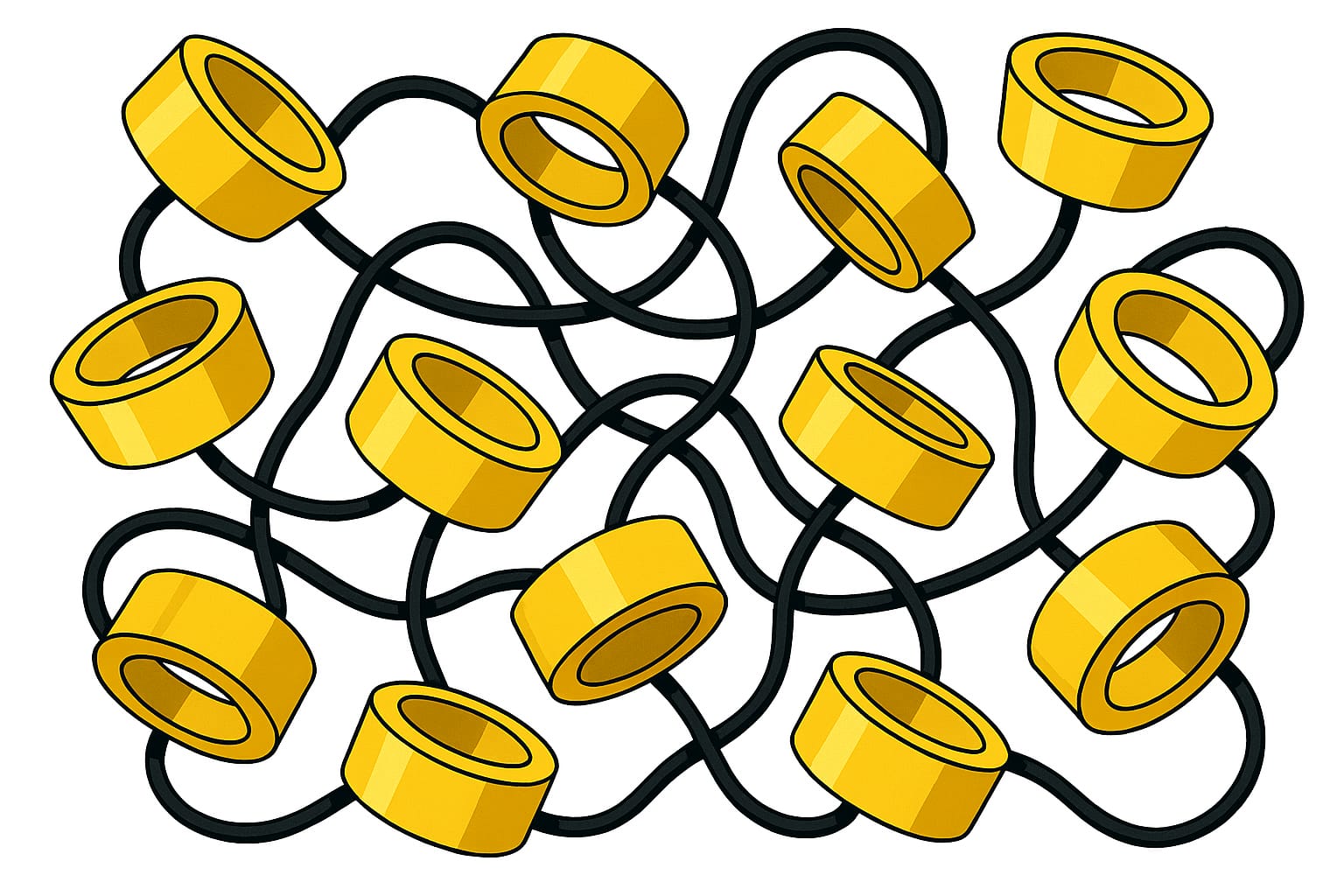
4. スライドリングネットワーク(Slide-Ring Network)
日本語:高分子をつなぐ接合点が鎖に沿って移動できる網目構造です。局所的な力を全体へ分散し、高い伸び、靭性、変形後の回復を支えることができます。
English: A polymer network with movable junctions that redistribute stress and help combine extensibility, toughness, and recovery.
5. 刺激応答性ゲル(Stimuli-Responsive Gel)
日本語:溶媒など周囲の環境に応じて、膨らみ方、硬さ、発光などが変化する柔らかい材料です。センサーや適応型デバイスへの応用が期待されています。
English: A soft material that changes its swelling, mechanics, or optical behavior in response to environmental conditions.
日本語版
研究背景
柔らかい高分子ゲルには、よく伸びて壊れにくいことと、周囲の環境に応じて性質を変えられることの両方が求められます。しかし、一般的な共有結合で高分子を強くつなぐと、材料は丈夫になる一方で分子の動きが抑えられます。反対に、弱く可逆的な分子間相互作用だけを使うと、環境には応答しやすくても、大きな力の下では構造が外れやすくなります。
そこで注目されるのが、γ-シクロデキストリンの環に別の分子を通して作る、機械的に組み合わさった接合点です。この研究では、材料の化学組成を変えるのではなく、環状分子がどのように通っているかという「糸通し状態」を変え、ゲルの強さ、伸び、発光、環境応答性との関係を調べました。
研究内容
Impact of Threading State on the Mechanics of γ-Cyclodextrin-Pyrene Gels
- γ-シクロデキストリンと、両端に反応基を持つピレン誘導体を組み合わせ、二重に糸通しされた擬似[4]ロタキサン型の架橋剤を形成しました。
- ゲル作製前の2-ヒドロキシエチルアクリレートと水の比率を調整し、二重糸通し型と一重糸通し型の集合状態を作り分けました。
- その結果、化学組成が同じでも、接合点が動けるスライドリング型ネットワークと、より固定的なポリロタキサン共有結合ネットワークを比較できました。
- 二重糸通し型ゲルは、溶媒に応じて発光、膨潤、粘弾性が変化しました。一重糸通し型や通常の共有結合ゲルでは、同じ応答は見られませんでした。
- 二重糸通し型ネットワークは、破断まで1050%を超えて伸びる高い伸長性を示しました。
- 変形速度に応じて硬さや破断挙動が変わり、高い靭性と、繰り返し変形時の比較的小さなエネルギー損失を両立しました。
- 分子の種類だけでなく、分子が通り合う構造そのものが、材料の力学性能と応答性を決める重要な設計要素であることが示されました。
期待される応用
この研究は、同じ成分からなるゲルでも、分子の組み合わさり方を変えることで、柔らかさ、伸び、力の吸収、発光応答を調整できる可能性を示しています。動く接合点が、力の集中する場所から別の場所へ負荷を分散するため、強さと柔軟性を両立した材料設計につながります。
将来は、身体の動きに追従するウェアラブル材料、変形や周囲の環境を光で知らせるセンサー、柔らかく動くロボット部材、状態に応じて性質を変えるコーティングなどへの展開が考えられます。実用化に向けては、繰り返し変形させた際の長期耐久性、さまざまな温度や溶媒中での安定性、大面積化や加工方法の検証が重要になります。
English Version
γCDP for Soft Materials Combining Mechanical Strength and Environmental Responsiveness
Research Background
Soft polymer gels are expected to combine large deformation, mechanical durability, and responsiveness to their surroundings. Strong covalent crosslinks improve structural integrity but restrict molecular motion. Reversible supramolecular crosslinks provide adaptability, yet they may dissociate under substantial mechanical stress.
Mechanically interlocked junctions based on γ-cyclodextrin offer another design route. In the featured study, the researchers changed the threading state of the molecular components rather than their overall chemical composition. They then examined how topology influenced the gel’s mechanical, swelling, and optical properties.
Research Highlights
Impact of Threading State on the Mechanics of γ-Cyclodextrin-Pyrene Gels
- γ-Cyclodextrin was complexed with acrylate-end-capped pyrene derivatives to form doubly threaded pseudo[4]rotaxane crosslinkers.
- Changing the ratio of 2-hydroxyethyl acrylate to water shifted the supramolecular assembly between doubly and singly threaded states.
- Gels with the same chemical composition but different architectures could therefore be compared: a movable slide-ring network and a more fixed polyrotaxane covalent network.
- The doubly threaded network showed solvent-dependent fluorescence, swelling, and viscoelasticity that were not observed in the singly threaded or conventional covalent control networks.
- It stretched to more than 1050% strain before breaking.
- The material displayed strain-rate-dependent stiffening and rupture, together with high toughness and comparatively low hysteresis during cyclic deformation.
- The results demonstrate that molecular threading topology can encode both mechanical performance and environmental responsiveness in a soft material.
Potential Applications
The study shows that extensibility, energy dissipation, and optical response can be adjusted through molecular architecture without changing the overall formulation. Movable junctions may redistribute local stress, providing a route toward materials that remain robust while adapting to deformation and environmental conditions.
Potential applications include wearable materials that follow body motion, luminescent deformation sensors, components for soft robotics, and environmentally responsive coatings. Further development will require long-term cyclic durability testing, evaluation under different temperatures and solvents, and scalable processing methods.
References / 文献
- Oh, J.; Liang, H.; Nitta, N.; Kim, J.; Tian, Y.; Liu, G.; Hertzog, J. E.; de Pablo, J. J.; Rowan, S. J. Impact of Threading State on the Mechanics of γ-Cyclodextrin-Pyrene Gels. Angewandte Chemie International Edition (2026), Early Access. DOI: 10.1002/anie.1958506