キーワード / Keywords
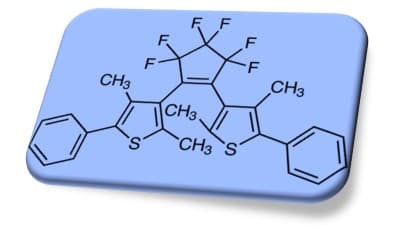
1. ジアリールエテン(Diarylethene)
日本語: 光を受けると分子内の環が開閉し、色や発光、電子状態を可逆的に変えられる分子です。繰り返し動作しやすく、光メモリーやセンサーに利用されます。
English: A molecular photoswitch that reversibly changes ring structure, color, emission, and electronic state under light irradiation.
2. フォトスイッチ(Molecular Photoswitch)
日本語: 光の波長を合図として、分子の構造や機能を切り替える仕組みです。非接触で狙った位置を操作でき、表示や暗号化、微細加工に役立ちます。
English: A molecule whose structure and function can be switched remotely with selected wavelengths of light.
3. 円偏光発光(Circularly Polarized Luminescence)
日本語: 電場がらせん状に回転しながら進む光です。右回りと左回りを区別できるため、通常の色や明るさに加え、新しい情報の表現手段になります。
English: Helically polarized emission with distinguishable right- and left-handed states, providing an additional optical information channel.
4. アップコンバージョン(Photon Upconversion)
日本語: エネルギーの低い近赤外光を、より短波長の光へ変換する現象です。材料内部の狙った場所だけで光反応を起こす微細加工に利用できます。
English: A process that converts lower-energy near-infrared light into shorter-wavelength light for localized photochemical control.
5. 情報暗号化(Information Encryption)
日本語: 特定の光や読み取り条件でのみ情報を表示する技術です。色、蛍光、偏光、立体形状を組み合わせることで、多段階の認証が可能になります。
English: A technology that reveals information only under selected optical conditions using color, fluorescence, polarization, or three-dimensional form.
日本語版
研究背景
ジアリールエテンは、紫外光や可視光によって分子構造を可逆的に切り替えられる代表的なフォトスイッチです。熱に対して安定で、繰り返し光を当てても性能が変わりにくいため、書き換え可能な表示、偽造防止、光記録、センサーへの利用が研究されています。
近年は、単に色を変えるだけでなく、円偏光発光のオン・オフ、三次元構造の書き込みと消去、複数の刺激を組み合わせた多段階暗号化へ機能が広がっています。ここでは、ジアリールエテンを含む光応答材料の設計指針、近赤外光による3Dパターニング、キラル発光の光制御を扱う研究を紹介します。
研究内容
1. 分子フォトスイッチによる次世代の偽造防止と暗号化
Harnessing molecular photoswitches for advanced anti-counterfeiting and high-level information encryption
- ジアリールエテンを含む代表的なフォトスイッチの反応機構と分子設計を体系的に整理しました。
- 材料への導入方法として、物理分散、高分子への共有結合、非共有結合による閉じ込め、超分子集合、金属配位構造を比較しました。
- 一つの光刺激だけでなく、複数の刺激や読み取り条件を組み合わせることで、情報を多層化できることを示しました。
- 実用材料には、繰り返し耐久性、可視光・近赤外光での動作、周囲環境に対する安定性が重要と整理しました。
- 光応答材料とデジタル復号技術を組み合わせることが、スマートな認証システムにつながると展望しています。
2. 近赤外レーザーで消去・再書き込みできる3D構造
Upconversion Laser Direct Writing Using NIR Light-Responsive Nanocomposites for Photopatterning and Reconfiguration of Dynamic 3D Microstructures
- アップコンバージョンナノ粒子と、ジアリールエテンなどのフォトスイッチを高分子中へ組み込みました。
- 連続波の近赤外レーザーを集光し、焦点位置だけで光異性化を起こしました。
- レーザー焦点を三次元的に動かすことで、材料内部へ立体パターンを書き込みました。
- 光反応が可逆的なため、形成した構造は消去、再書き込み、更新が可能でした。
- ジアリールエテンのほか、スピロピランやアゾベンゼンにも適用できる汎用的な方法を示しました。
- 書き換え可能な光記録、立体暗号、データセキュリティへの展開が期待されます。
3. 光で円偏光発光をオン・オフする超分子集合体
Cascaded Energy Transfer in Supramolecular Assemblies Enables Amplified and Photoswitchable Circularly Polarized Luminescence
- キラルなピラーアレーンと高分子ゲストを組み合わせ、らせん情報を増幅した発光性超分子ポリマーを形成しました。
- 中継色素を共集合させ、段階的なフェルスター共鳴エネルギー移動によって発光を長波長側へ変換しました。
- キラリティーも発光体へ伝わり、発光非対称性の大きさが10⁻²レベルの円偏光発光を得ました。
- 最終段にジアリールエテンを光応答ゲートとして導入しました。
- 紫外光でジアリールエテンを閉環するとエネルギー移動が作動して発光が消え、可視光で開環すると発光と円偏光が回復しました。
- 繰り返し切り替えても、キラルな骨格構造を保つ耐疲労性の高い制御を実現しました。
研究全体の意義
三つの研究は、ジアリールエテンが「光で色が変わる分子」から、情報の書き込み、消去、選択的な読み出しを担う分子部品へ発展していることを示しています。近赤外レーザーによる三次元加工は、材料内部へ情報を記録できます。円偏光発光の制御は、色や明るさだけではない新しい識別情報を加えます。さらに、材料設計とデジタル復号を組み合わせれば、複数条件を満たしたときだけ読める認証技術へ展開できます。
今後は、長期間の光照射に対する耐久性、書き込み速度と解像度、大面積加工、日常光の影響、読み取り装置との統合が重要になります。ジアリールエテンは、書き換え可能な光メモリー、立体的な偽造防止表示、高度な情報セキュリティを支える分子技術として期待されます。
English Version
Diarylethenes for Rewritable Optical Information Materials
Introduction
Diarylethenes are representative molecular photoswitches whose structures can be reversibly changed by ultraviolet or visible light. Their thermal stability and resistance to repeated switching make them attractive for rewritable displays, anti-counterfeiting, optical storage, and sensing.
Recent research extends their role beyond simple color switching. Diarylethene systems can gate circularly polarized luminescence, support three-dimensional writing and erasing, and contribute to multilevel encryption using multiple stimuli and readout channels.
Research Highlights
1. Molecular Photoswitches for Advanced Security Technologies
- The review organized the reaction mechanisms and structural-design principles of major photoswitch families, including diarylethenes.
- Fabrication strategies included physical dispersion, covalent polymer conjugation, noncovalent confinement, supramolecular assembly, and metal-coordinated architectures.
- Combining multiple stimuli and readout conditions was shown to increase information density and security.
- Fatigue resistance, visible or near-infrared operation, and environmental stability were identified as key practical requirements.
- Integration of photoresponsive materials with digital decoding algorithms was proposed as a route toward smart security systems.
2. Rewritable 3D Structures Written with Near-Infrared Light
- Upconversion nanoparticles and photoswitches, including diarylethene, were incorporated into a polymer matrix.
- A low-cost continuous-wave near-infrared laser induced localized photoisomerization at the focal point.
- Moving the laser focus in three dimensions generated patterns inside the material.
- Because photoswitching was reversible, the structures could be erased, rewritten, and reconfigured.
- The method was also applicable to spiropyran and azobenzene, demonstrating a broadly useful platform.
- Potential applications include rewritable optical storage, three-dimensional encryption, and data-security technologies.
3. Light-Gated Circularly Polarized Luminescence
- A chiral pillar[5]arene and a polymeric guest formed emissive supramolecular polymers with amplified chirality.
- A relay dye enabled cascaded Förster resonance energy transfer and red-shifted emission.
- Chirality was transferred to the emission, producing circularly polarized luminescence with dissymmetry values on the order of 10⁻².
- Diarylethene was incorporated as the final photoresponsive gatekeeper.
- Ultraviolet-induced ring closure activated an energy-transfer pathway and quenched the emission, while visible light restored both luminescence and circular polarization.
- Repeated switching preserved the chiral scaffold, providing robust and fatigue-resistant optical control.
Overall Significance
Together, these studies show that diarylethenes are evolving from color-changing molecules into functional components for writing, erasing, and selectively reading information. Near-infrared three-dimensional patterning enables information to be stored inside a material. Circularly polarized luminescence introduces an optical channel beyond color and intensity. Combining responsive materials with digital decoding may further enable authentication that is readable only under selected conditions.
Future development should address long-term switching durability, writing speed and resolution, large-area processing, interference from ambient light, and integration with practical readout devices. Diarylethenes are promising molecular tools for rewritable optical memory, three-dimensional anti-counterfeiting, and advanced information security.
References / 文献
- Wang, Y.; Shen, Y.; Zheng, Y.; et al. Harnessing molecular photoswitches for advanced anti-counterfeiting and high-level information encryption. Coordination Chemistry Reviews 569 (2026), 218481. DOI: 10.1016/j.ccr.2026.218481
- Liu, Y.; Cao, J.; Best, A.; et al. Upconversion Laser Direct Writing Using NIR Light-Responsive Nanocomposites for Photopatterning and Reconfiguration of Dynamic 3D Microstructures. Angewandte Chemie International Edition (2026), Early Access. DOI: 10.1002/anie.2735479
- Sheng, Y.; Wang, X.; Zuo, M.; Hu, X.-Y. Cascaded Energy Transfer in Supramolecular Assemblies Enables Amplified and Photoswitchable Circularly Polarized Luminescence. Angewandte Chemie International Edition (2026), Early Access. DOI: 10.1002/anie.1803367