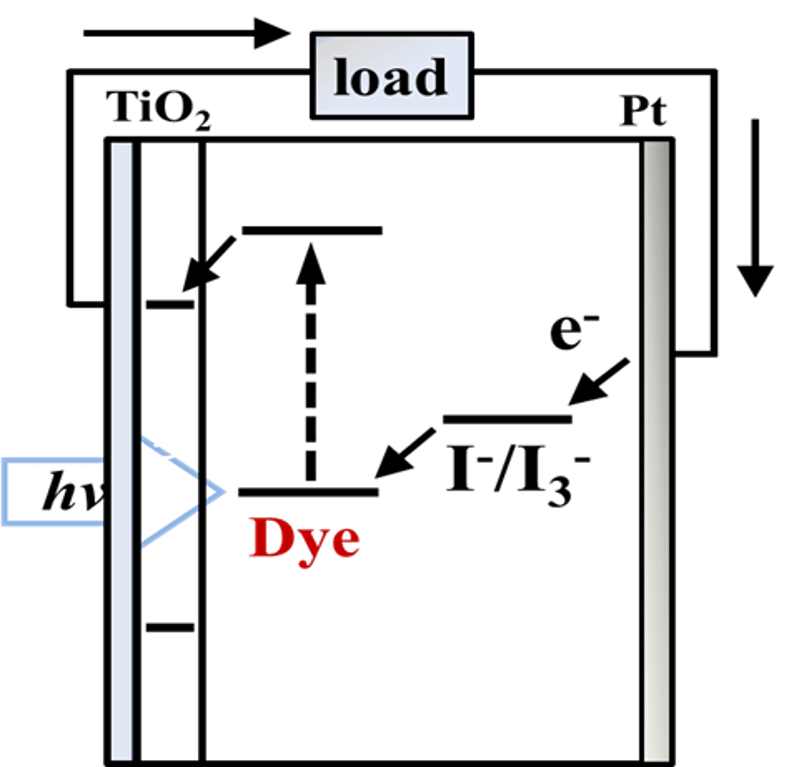
キーワード / Keywords
-
色素増感太陽電池(DSSC) / Dye-Sensitized Solar Cell (DSSC)
日本語: 光を吸収する色素、電子を運ぶ半導体、電解質、対向電極を組み合わせて発電する太陽電池です。材料の選択や界面のつくり方によって、光の利用効率、電荷の移動、耐久性が大きく変わります。
English: A DSSC combines a light-absorbing sensitizer, an electron-transporting semiconductor, an electrolyte, and a counter electrode. Its efficiency and stability depend strongly on material choice and on how the interfaces are engineered. -
光電極 / Photoanode
日本語: 色素が受け取った光エネルギーを電子の流れへ変換する中心部分です。一般に酸化チタンが使われ、表面積、細孔、光散乱、色素の吸着量をバランスよく設計することが重要になります。
English: The photoanode is the central component that converts light captured by the sensitizer into electron flow. Titanium dioxide is commonly used, and its surface area, pores, light scattering, and dye loading must be carefully balanced. -
界面工学 / Interfacial Engineering
日本語: 異なる材料が接する境界を調整し、電子や正孔を望ましい方向へ移動させる考え方です。再結合や欠陥による損失を抑え、光吸収と電荷輸送を同時に改善する鍵となります。
English: Interfacial engineering controls the boundaries between different materials so that electrons and holes move in useful directions. It is a key approach for reducing recombination and defect-related losses while improving light harvesting and charge transport. -
ナノ材料 / Nanomaterials
日本語: ナノメートルの大きさをもつ粒子や繊維は、大きな表面積や独特の光・電気特性を示します。DSSCでは、光を散乱させる、色素を保持する、電荷移動を助けるなど複数の役割を担います。
English: Nanometer-scale particles and fibers provide large surface areas and distinctive optical and electrical properties. In DSSCs, they can scatter light, retain sensitizers, assist charge transfer, and perform several functions at once. -
電力変換効率(PCE) / Power Conversion Efficiency (PCE)
日本語: 入射した光エネルギーのうち、電気エネルギーとして取り出せた割合です。数値だけでなく、測定条件、材料の安定性、製造コスト、環境負荷も実用性を判断するうえで重要です。
English: PCE is the percentage of incoming light energy converted into usable electrical energy. Practical value should be judged not only by this number but also by measurement conditions, stability, manufacturing cost, and environmental impact.
日本語版
はじめに
色素増感太陽電池(DSSC)は、光を吸収する材料と、そこで生じた電荷を運ぶ材料を分担させる太陽電池です。植物の光合成を思わせる仕組みを持ち、使う材料や作製方法の自由度が高い一方、光を十分に取り込むこと、電荷の損失を防ぐこと、低コスト化や環境調和を進めることが課題です。
ここでは、DSSCを構成する異なる場所に工夫を加えた3件の研究を紹介します。取り上げるのは、光電極へのナノ繊維導入、色素と電解質の間の界面制御、そして低白金・天然黒鉛を利用した対向電極です。発電性能を高めるには、一つの材料だけでなく、光吸収、電子移動、触媒反応を含むセル全体の設計が重要であることが見えてきます。
1. ペロブスカイトナノ結晶と色素の協働で高効率化
論文: “Synergistic Interplay between CsPbBr3 Nanocrystals and N719 Dye through Interfacial Engineering to Achieve High Efficiency in Dye-Sensitized Solar Cells”
この研究は、CsPbBr3ナノ結晶を色素と電解質の間に配置し、光の吸収と電荷の移動を同時に改善しようとしたものです。
-
研究のねらい
DSSC内部で起こる電荷の再結合や、ナノ結晶の欠陥による損失を抑えながら、より多くの光を発電に利用することを目指しました。 -
方法の特徴
CsPbBr3ナノ結晶を合成し、一般的なN719色素と組み合わせて界面層として利用しました。短絡電流密度、開放電圧、曲線因子、電力変換効率などを系統的に評価しています。 -
わかったこと
ナノ結晶は追加の光吸収体として働くだけでなく、正孔の移動も助けました。また、N719色素がナノ結晶と結びつくことで、電荷を捕まえてしまう欠陥と再結合損失が抑えられました。両材料を組み合わせたセルでは、電力変換効率14.21%が得られました。 -
研究の意義
光を吸収する材料を単に増やすのではなく、材料同士の接触面を整えることで、光吸収、電荷分離、電荷輸送を一体的に改善できることを示しています。
2. 複合ナノ繊維で光をセル内部にとどめる
論文: “Engineering ZnS-Co3O4/TiO2 Nanofibers Into Photoanodes as a Mesoporous Charge Transport Layer in Dye Sensitized Solar Cells”
この研究では、ZnS-Co3O4複合体を含むTiO2ナノ繊維を光電極に導入し、光の取り込みを増やす方法が検討されました。
-
研究のねらい
DSSCの光電極で光をより有効に散乱・吸収させ、発電に使える光の量を増やすことを目指しました。 -
方法の特徴
ナノ繊維を通常の塗布層の中へ混ぜる構造と、独立した追加層として重ねる構造の2方式を比較しました。 -
わかったこと
塗布層にナノ繊維を混ぜた場合は光の取り込みが向上し、未修飾セルより電力変換効率が約27%高くなりました。ただし、色素の吸着量が減るため、改善幅には限界がありました。一方、ナノ繊維を追加層として設ける方法では、色素が付着できる表面積を保ちながら光散乱を高め、効率は6.67%に達しました。これは未修飾セルより51%高い値です。 -
研究の意義
同じ材料を使っても、混ぜ込むのか別の層として配置するのかによって結果が変わります。光散乱を増やすことと、色素を十分に保持することの両立が重要だと示されました。
3. 天然黒鉛と微量白金による低コスト対向電極
論文: “Composite counter electrode for dye-sensitized solar cells engineered from trace amounts of platinum nanoparticles and Sri Lankan natural vein graphite”
この研究は、DSSCの対向電極で多く使われる白金の量を減らし、天然黒鉛と活性炭を組み合わせた代替電極を開発したものです。
-
研究のねらい
良好な触媒性能を保ちながら、白金の使用量を抑え、低コストで持続可能な対向電極をつくることを目指しました。 -
方法の特徴
スリランカ産の天然脈状黒鉛、活性炭、微量の白金ナノ粒子をステンレス基板上で複合化しました。ラマン分光、電子顕微鏡、元素分析で構造を確認し、複数の電気化学測定で触媒活性と電荷移動を調べました。 -
わかったこと
黒鉛の高い電気伝導性、活性炭の大きな表面積、白金ナノ粒子の触媒作用が組み合わさり、電解質中の反応と電荷移動が改善しました。複合電極を使ったセルの効率は6.87%で、白金を成膜した電極の7.24%に近い値でした。また、白金ナノ粒子を加える前の電極と比べて、効率は5.19%から32%向上しました。 -
研究の意義
白金を完全に置き換えるのではなく、必要量だけを効果的に使う現実的な材料設計です。地域で得られる天然黒鉛の活用は、材料コストと環境面の両方を考えるうえで注目されます。
研究全体から見えること
3件の研究は、DSSCの異なる構成要素に焦点を当てています。
- CsPbBr3ナノ結晶とN719色素の研究は、色素周辺の界面を整え、光吸収と電荷輸送を改善しました。
- ZnS-Co3O4/TiO2ナノ繊維の研究は、光電極の層構造を工夫し、光散乱と色素吸着の両立を図りました。
- 天然黒鉛・活性炭・微量白金の研究は、対向電極の材料構成を見直し、性能とコストのバランスを追求しました。
これらの成果から、DSSCの高性能化には、優れた材料を一つ選ぶだけでは不十分であることがわかります。光を取り込む場所、電子や正孔が移動する経路、電解質の反応を進める場所をそれぞれ整え、相互のつながりを設計することが重要です。同時に、効率だけでなく、使用する資源の量、作製方法、持続可能性を含めた評価が、今後の実用化に向けた大切な視点となります。
Materials and Interface Design for Better Dye-Sensitized Solar Cells
English Version
Introduction
A dye-sensitized solar cell, or DSSC, separates the task of absorbing light from the task of transporting electrical charge. This flexible design allows researchers to combine different sensitizers, semiconductors, electrolytes, and electrodes. Its main challenges include capturing more light, preventing charge loss, maintaining stability, and reducing material and manufacturing costs.
The three studies introduced here improve different parts of a DSSC: a nanofiber-enhanced photoanode, an engineered interface between the sensitizer and electrolyte, and a low-platinum counter electrode made with natural graphite. Together, they show that better performance depends on coordinated design across the whole device rather than on a single material alone.
1. Combining Perovskite Nanocrystals with a Molecular Dye
Paper: “Synergistic Interplay between CsPbBr3 Nanocrystals and N719 Dye through Interfacial Engineering to Achieve High Efficiency in Dye-Sensitized Solar Cells”
This study placed CsPbBr3 nanocrystals between the dye and electrolyte to improve both light harvesting and charge movement.
-
Research aim
The researchers sought to use more of the incoming light while reducing losses caused by charge recombination and defects in the nanocrystals. -
Approach
Synthesized CsPbBr3 nanocrystals were combined with the widely used N719 dye as an interfacial layer. Key photovoltaic properties, including current density, open-circuit voltage, fill factor, and power conversion efficiency, were evaluated systematically. -
Main findings
The nanocrystals acted not only as additional sensitizers but also as materials that assisted hole transport. Bonding with the N719 dye helped suppress nanocrystal defects and reduced recombination losses. The combined device reached a power conversion efficiency of 14.21%. -
Why it matters
The study shows that an interface can be designed to improve several processes at once: light absorption, charge separation, and charge transport. This is more effective than simply adding another light-absorbing material without controlling its contact with neighboring layers.
2. Using Composite Nanofibers to Manage Light Inside the Cell
Paper: “Engineering ZnS-Co3O4/TiO2 Nanofibers Into Photoanodes as a Mesoporous Charge Transport Layer in Dye Sensitized Solar Cells”
This study introduced TiO2 nanofibers containing a ZnS-Co3O4 composite into the photoanode to increase the amount of light used by the cell.
-
Research aim
The goal was to improve light scattering and harvesting in the DSSC photoanode and thereby raise photovoltaic performance. -
Approach
Two structures were compared. In one, nanofibers were incorporated into the doctor-bladed layer. In the other, a separate nanofiber layer was added to the photoanode. -
Main findings
Mixing the nanofibers into the coated layer improved light harvesting and produced an efficiency approximately 27% higher than that of the unmodified cell. However, reduced dye adsorption limited the gain. Adding a separate nanofiber layer improved light scattering without sacrificing the surface available for dye attachment. This structure reached 6.67% efficiency, 51% above the unmodified cell. -
Why it matters
Performance depended not only on the nanofiber composition but also on where the fibers were placed. The work highlights the need to improve light scattering without blocking the surface needed to hold the dye.
3. A Low-Cost Counter Electrode Using Natural Graphite and Trace Platinum
Paper: “Composite counter electrode for dye-sensitized solar cells engineered from trace amounts of platinum nanoparticles and Sri Lankan natural vein graphite”
This study developed an alternative to a conventional platinum counter electrode by combining natural graphite, activated carbon, and a very small amount of platinum nanoparticles.
-
Research aim
The objective was to preserve useful catalytic performance while reducing platinum use and improving the cost and sustainability of the counter electrode. -
Approach
Sri Lankan natural vein graphite, activated carbon, and trace platinum nanoparticles were assembled on a stainless-steel substrate. Raman spectroscopy, microscopy, elemental analysis, and several electrochemical methods were used to examine the material and its catalytic charge-transfer behavior. -
Main findings
The electrical conductivity of graphite, the large surface area of activated carbon, and the catalytic activity of platinum nanoparticles worked together to promote the electrolyte reaction and charge transfer. The composite-electrode DSSC reached 6.87% efficiency, compared with 7.24% for a sputtered platinum electrode. Adding trace platinum nanoparticles raised efficiency from 5.19% for the unmodified activated-carbon/graphite electrode, an improvement of 32%. -
Why it matters
Rather than eliminating platinum completely, the design uses a small amount where it is most effective. The use of locally sourced natural graphite also offers a practical route toward balancing device performance, material cost, and resource considerations.
Overall Significance
The three studies address different functional regions of a DSSC.
- The CsPbBr3 nanocrystal and N719 study improves the interface around the sensitizer, linking better light harvesting with improved charge transport.
- The ZnS-Co3O4/TiO2 nanofiber study redesigns the layer structure of the photoanode, balancing light scattering with dye adsorption.
- The natural graphite, activated carbon, and trace platinum study changes the material composition of the counter electrode, balancing catalytic performance with lower platinum use.
Taken together, these findings show that DSSC development is a system-design challenge. Light must be captured efficiently, charges must cross several interfaces without being lost, and the electrolyte reaction must proceed rapidly. Future progress will therefore depend on coordinating these functions while also considering material availability, processing, stability, cost, and environmental impact.
文献情報 / References
- Mandal, M. K.; Ghosh, S.; Chakraborty, J.; Ranjan, R. “Synergistic Interplay between CsPbBr3 Nanocrystals and N719 Dye through Interfacial Engineering to Achieve High Efficiency in Dye-Sensitized Solar Cells.” ACS Applied Electronic Materials, 2026. DOI: 10.1021/acsaelm.6c00956.
- Nien, Y.-H.; Zeng, J.-W.; Chou, J.-C.; Lai, C.-H.; Yang, P.-H.; Kuo, P.-Y.; Chen, W.-H.; Lee, M.-Y.; Liou, Y.-C. “Engineering ZnS-Co3O4/TiO2 Nanofibers Into Photoanodes as a Mesoporous Charge Transport Layer in Dye Sensitized Solar Cells.” IEEE Transactions on Nanotechnology, 25, 320–329, 2026. DOI: 10.1109/TNANO.2026.3728599.
- Dissanayake, M. A. K. L.; Sandunika, P. U.; Senadeera, G. K. R.; Kumari, J. M. K. W.; Vedraine, S.; Rougier, S.; Lakshan, K. L. A. C.; Sewwandi, G. G. S.; Senevirathna, M. D. D. S. “Composite counter electrode for dye-sensitized solar cells engineered from trace amounts of platinum nanoparticles and Sri Lankan natural vein graphite.” Ionics, 2026. DOI: 10.1007/s11581-026-07509-9.