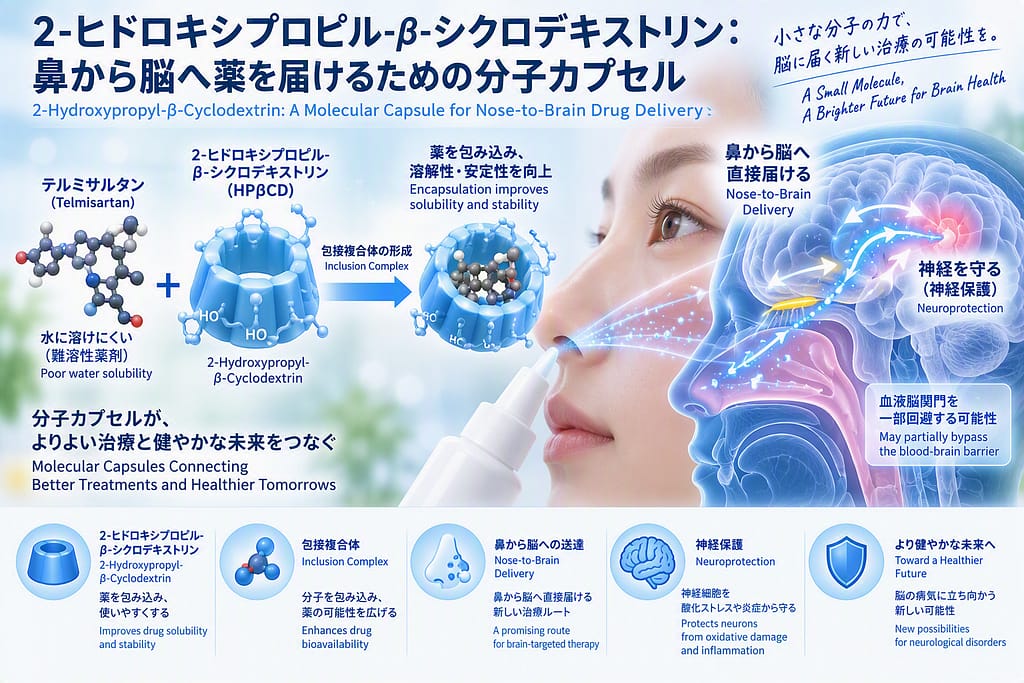
2-Hydroxypropyl-β-Cyclodextrin: A Molecular Capsule for Nose-to-Brain Drug Delivery
キーワード / Keywords
-
2-ヒドロキシプロピル-β-シクロデキストリン / 2-Hydroxypropyl-β-Cyclodextrin
β-シクロデキストリンを水に溶けやすく改良した分子です。薬を包み込み、溶解性や安定性を高める“分子カプセル”として使われます。
EN: A water-soluble β-cyclodextrin derivative that can encapsulate drugs and improve their solubility and stability. -
包接複合体 / Inclusion Complex
薬の一部がシクロデキストリンの空洞に入り込んだ状態です。水に溶けにくい薬を扱いやすくし、体内での利用を助けます。
EN: A structure in which part of a drug molecule enters the cyclodextrin cavity, improving handling and delivery. -
テルミサルタン / Telmisartan
本来は高血圧治療薬として知られる化合物です。神経保護作用の可能性もありますが、水に溶けにくいことが課題です。
EN: A drug known as an angiotensin II receptor blocker, with potential neuroprotective effects but poor water solubility. -
鼻から脳への送達 / Nose-to-Brain Delivery
鼻腔を通して薬を脳へ届ける方法です。血液脳関門を回避できる可能性があり、中枢神経疾患への応用が期待されます。
EN: A delivery route that may transport drugs from the nasal cavity to the brain while partly bypassing the blood-brain barrier. -
神経保護 / Neuroprotection
神経細胞を酸化ストレスや炎症などから守る働きです。外傷性脳損傷などで、細胞のダメージを減らす戦略として重要です。
EN: Protection of nerve cells from stressors such as oxidative damage and inflammation.
日本語版
鼻から脳へ届ける薬を、シクロデキストリンで使いやすくする
論文: Cyclodextrin-based nasal biocompatible inclusion complexes of telmisartan: Physicochemical characterization, in silico studies and biological assessment in SH-SY5Y cell line
掲載誌: Colloids and Surfaces A: Physicochemical and Engineering Aspects
DOI: 10.1016/j.colsurfa.2026.141419
- 外傷性脳損傷では、脳内で炎症や酸化ストレスなどが複雑に起こり、薬を十分に届けることが難しい点が課題です。
- テルミサルタンは神経保護作用が期待される薬ですが、水に溶けにくく、口から飲んでも脳へ届く薬の量が限られます。
- この研究では、2-ヒドロキシプロピル-β-シクロデキストリンと、ランダムメチル化β-シクロデキストリンを使い、テルミサルタンを包み込む包接複合体を作りました。
- 包接複合体は凍結乾燥法で調製され、薬とシクロデキストリンが1対1で結びつく形で安定化していることが示されています。
- 熱分析、赤外分光、粉末X線回折、電子顕微鏡、NMRなどにより、テルミサルタンがシクロデキストリンに包み込まれ、より非晶質な状態になったことが確認されました。
- 分子ドッキングや分子動力学シミュレーションでも、テルミサルタンとシクロデキストリンの安定な相互作用が支持されています。
- 特にランダムメチル化β-シクロデキストリンの複合体では、純粋なテルミサルタンよりも水、模擬鼻液、人工脳脊髄液中での溶解性が大きく高まりました。
- 包接複合体は、鼻粘膜を想定した透過性、湿潤性、安定性の面でも改善が見られています。
- 血液適合性や鼻腔繊毛への影響も評価され、鼻から投与する材料としての安全性に配慮されています。
- 神経芽細胞SH-SY5Yを用いた実験では、酸化ストレスによる細胞ダメージに対して、細胞生存率の改善、活性酸素の低下、ミトコンドリア機能の保護、アポトーシス抑制が示されました。
- 一般向けに言えば、「水に溶けにくい薬をシクロデキストリンの分子カプセルに入れ、鼻から脳へ届けやすくする」研究です。
ここがポイント
- 2-ヒドロキシプロピル-β-シクロデキストリンは、薬を包み込んで水に溶けやすくする働きを担います。
- 鼻腔からの投与は、脳に薬を届けるための新しいルートとして注目されています。
- 計算化学、材料分析、細胞評価を組み合わせて、複合体の“作れるか”“安定か”“細胞に役立つか”を多角的に調べています。
- 外傷性脳損傷の治療にすぐ使えるという段階ではありませんが、鼻から脳へ薬を届ける製剤設計の有望な方向性を示しています。
まとめ
2-ヒドロキシプロピル-β-シクロデキストリンは、水に溶けにくい薬を包み込むことで、薬の使いやすさを高める分子カプセルとして働きます。今回の研究では、テルミサルタンをシクロデキストリンに包接させることで、溶解性、鼻粘膜透過性、細胞レベルでの神経保護効果が改善されました。鼻から脳へ薬を届ける技術は、脳疾患や外傷性脳損傷に対する新しい製剤開発につながる可能性があります。
English Version
Making a nose-to-brain drug easier to use with cyclodextrins
Paper: Cyclodextrin-based nasal biocompatible inclusion complexes of telmisartan: Physicochemical characterization, in silico studies and biological assessment in SH-SY5Y cell line
Journal: Colloids and Surfaces A: Physicochemical and Engineering Aspects
DOI: 10.1016/j.colsurfa.2026.141419
- Traumatic brain injury involves complex inflammation and oxidative stress, while efficient drug delivery to the brain remains difficult.
- Telmisartan has potential neuroprotective activity, but its poor water solubility and limited free drug availability restrict its use for brain delivery.
- This study prepared inclusion complexes of telmisartan with 2-hydroxypropyl-β-cyclodextrin and randomly methylated β-cyclodextrin.
- The complexes were produced by lyophilization and showed stable 1:1 drug-cyclodextrin complex formation.
- Thermal analysis, infrared spectroscopy, powder X-ray diffraction, microscopy, and NMR supported successful inclusion and amorphization of the drug.
- Molecular docking and molecular dynamics simulations also supported stable interactions between telmisartan and the cyclodextrin hosts.
- The randomly methylated β-cyclodextrin complex showed especially strong solubility improvement in water, simulated nasal fluid, and artificial cerebrospinal fluid.
- The complexes also improved wettability, nasal permeation, and physical stability.
- Hemocompatibility and ciliotoxicity tests were included to evaluate suitability for nasal administration.
- In SH-SY5Y neuroblastoma cells exposed to oxidative stress, the complexes improved cell viability, reduced reactive oxygen species, lowered nitrite levels, restored mitochondrial membrane potential, and reduced apoptosis.
- In simple terms, this study uses cyclodextrin molecular capsules to make a poorly soluble drug more suitable for nose-to-brain delivery.
Key Points
- 2-Hydroxypropyl-β-cyclodextrin helps encapsulate poorly soluble drugs and improve their aqueous behavior.
- Nasal delivery is a promising route for transporting therapeutics toward the brain.
- The study combines computational modeling, physicochemical characterization, permeability testing, and cell-based biological assessment.
- The findings do not yet mean immediate clinical use, but they provide a promising formulation strategy for future brain-targeted therapies.
Overall Takeaway
2-Hydroxypropyl-β-cyclodextrin acts as a molecular capsule that can improve the usability of poorly soluble drugs. In this study, cyclodextrin-based telmisartan complexes improved solubility, nasal permeation, and neuroprotective effects in a cell model. Nose-to-brain delivery using cyclodextrin inclusion complexes may become a useful strategy for developing future treatments for brain injury and neurological disorders.
文献 / References
- Bahuguna, D.; Chandanapalli, D. K.; Kumar, J.; Kumar, R.; Madan, J. Cyclodextrin-based nasal biocompatible inclusion complexes of telmisartan: Physicochemical characterization, in silico studies and biological assessment in SH-SY5Y cell line. Colloids and Surfaces A: Physicochemical and Engineering Aspects 750 (2026), Article 141419. DOI: 10.1016/j.colsurfa.2026.141419.