キーワード / Keywords
1. 2-Hydroxypropyl-β-Cyclodextrin (HPβCD)
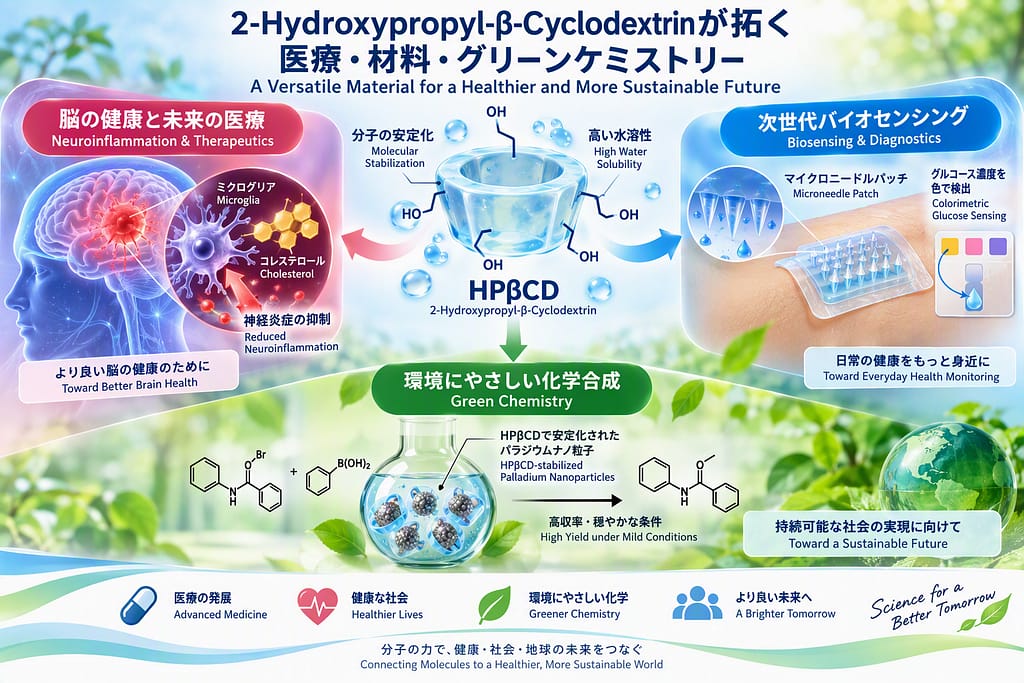
日本語: シクロデキストリンを改良した材料で、水に溶けやすく、薬剤や機能性分子を安定化できる特徴があります。医療、診断、材料開発など幅広い分野で活用されています。
English: A modified cyclodextrin with improved water solubility that can stabilize functional molecules and support applications in medicine, sensing, and materials science.
2. 分子安定化 (Molecular Stabilization)
日本語: 不安定な分子や反応物を保護し、より長く機能を維持させる技術です。薬剤やセンサー材料の性能向上に重要な役割を果たします。
English: A strategy used to protect unstable molecules and maintain their functionality, improving the performance of drugs and sensing systems.
3. バイオセンシング (Biosensing)
日本語: 生体情報を検出する技術です。血糖値などを簡便に測定できる新しい診断デバイスの開発につながります。
English: Technologies that detect biological information and support the development of next-generation diagnostic devices.
4. 神経炎症 (Neuroinflammation)
日本語: 脳内で起こる炎症反応で、脳卒中などの神経疾患と深く関係しています。制御技術の開発が重要視されています。
English: An inflammatory response in the nervous system associated with neurological disorders such as stroke.
5. グリーンケミストリー (Green Chemistry)
日本語: 環境負荷を減らしながら化学反応を行う考え方です。安全で効率的な化学製造技術の実現を目指します。
English: An approach to chemical synthesis that reduces environmental impact while maintaining efficiency and productivity.
日本語版
はじめに
2-Hydroxypropyl-β-Cyclodextrin(HPβCD)は、生体材料、医療技術、化学合成など多様な研究分野で利用される機能性材料です。本記事では、添付ファイルに収録された研究の中から代表的な3報を紹介します。
論文1
Cholesterol Drives IFITM3+ Microglia Activation and Induces STING Mediated Neuroinflammation After Ischemic Stroke
- 脳卒中後の神経炎症とコレステロール代謝の関係を調べた研究。
- 特定のミクログリア集団がコレステロールを蓄積し、炎症反応を強めることを明らかにした。
- HPβCDを用いてコレステロール負荷を低減すると、炎症や脳損傷が抑えられた。
- 運動機能の改善も確認された。
- 脳卒中後の治療法開発につながる可能性を示している。
論文2
Structure-Regulated Silk Fibroin Microneedle Patches for Minimally Invasive Glucose-Responsive Colorimetric Sensing
- 微小な針を使って体液を利用する血糖センシング技術を開発。
- シルクフィブロイン製マイクロニードルにHPβCDを導入した。
- 色の変化によってグルコース濃度を視覚的に確認できる。
- センサー材料の安定性向上にHPβCDが役立った。
- 負担の少ない次世代健康モニタリング技術として期待される。
論文3
A Green Suzuki-Miyaura Cross-coupling Reaction of N-(4-Bromophenyl) Ureas with Phenylboronic Acid using Palladium Nanoparticles as a Catalyst
- HPβCDを利用した環境配慮型の有機合成反応を報告。
- パラジウムナノ粒子の安定化剤としてHPβCDを活用した。
- 室温付近の穏やかな条件で高収率な反応を実現した。
- 医薬品候補となる化合物合成への応用が期待される。
- グリーンケミストリーの考え方に沿った研究例である。
研究全体の意義
これらの研究は、HPβCDが単なる補助材料ではなく、医療診断、脳疾患研究、化学プロセス開発を支える重要な機能材料として活用されていることを示しています。分子の安定化や機能制御を通じて、より安全で高性能な技術の実現に貢献しています。
English Version
2-Hydroxypropyl-β-Cyclodextrin for Healthcare, Biosensing, and Green Chemistry
Introduction
2-Hydroxypropyl-β-cyclodextrin (HPβCD) is a versatile functional material widely used in biomedical engineering, sensing technologies, and sustainable chemistry. The following studies illustrate its diverse applications.
Paper 1
Cholesterol Drives IFITM3+ Microglia Activation and Induces STING Mediated Neuroinflammation After Ischemic Stroke
- Investigated the relationship between cholesterol accumulation and post-stroke neuroinflammation.
- Identified a cholesterol-rich microglial population associated with inflammatory responses.
- HPβCD reduced cholesterol burden and suppressed inflammatory signaling.
- Brain injury severity was reduced and functional recovery improved.
- The findings suggest a potential therapeutic strategy for ischemic stroke.
Paper 2
Structure-Regulated Silk Fibroin Microneedle Patches for Minimally Invasive Glucose-Responsive Colorimetric Sensing
- Developed a minimally invasive glucose-sensing microneedle platform.
- HPβCD was incorporated to stabilize sensing components.
- Glucose levels could be evaluated through visible color changes.
- The device demonstrated suitable mechanical and sensing performance.
- The study highlights opportunities for next-generation health monitoring systems.
Paper 3
A Green Suzuki-Miyaura Cross-coupling Reaction of N-(4-Bromophenyl) Ureas with Phenylboronic Acid using Palladium Nanoparticles as a Catalyst
- Reported an environmentally friendly synthetic methodology.
- HPβCD was used as a stabilizer and reducing component for palladium nanoparticles.
- High product yields were achieved under mild reaction conditions.
- The approach is relevant to the synthesis of biologically active compounds.
- The work demonstrates the value of green chemistry principles.
Overall Significance
These studies demonstrate the versatility of HPβCD across multiple disciplines. Whether supporting biosensor development, reducing neuroinflammation, or enabling sustainable chemical synthesis, HPβCD contributes to the design of safer and more effective technologies.
References / 文献
- Cheng Y. et al. Cholesterol Drives IFITM3+ Microglia Activation and Induces STING Mediated Neuroinflammation After Ischemic Stroke. CNS Neuroscience & Therapeutics (2026). DOI: 10.1002/cns.71073
- Tan GHF. et al. Structure-Regulated Silk Fibroin Microneedle Patches for Minimally Invasive Glucose-Responsive Colorimetric Sensing. ACS Biomaterials Science & Engineering (2026). DOI: 10.1021/acsbiomaterials.6c00863
- da Cunha Sindra H. et al. A Green Suzuki-Miyaura Cross-coupling Reaction of N-(4-Bromophenyl) Ureas with Phenylboronic Acid using Palladium Nanoparticles as a Catalyst. Current Organic Synthesis (2026). DOI: 10.2174/0115701794475343260706114403