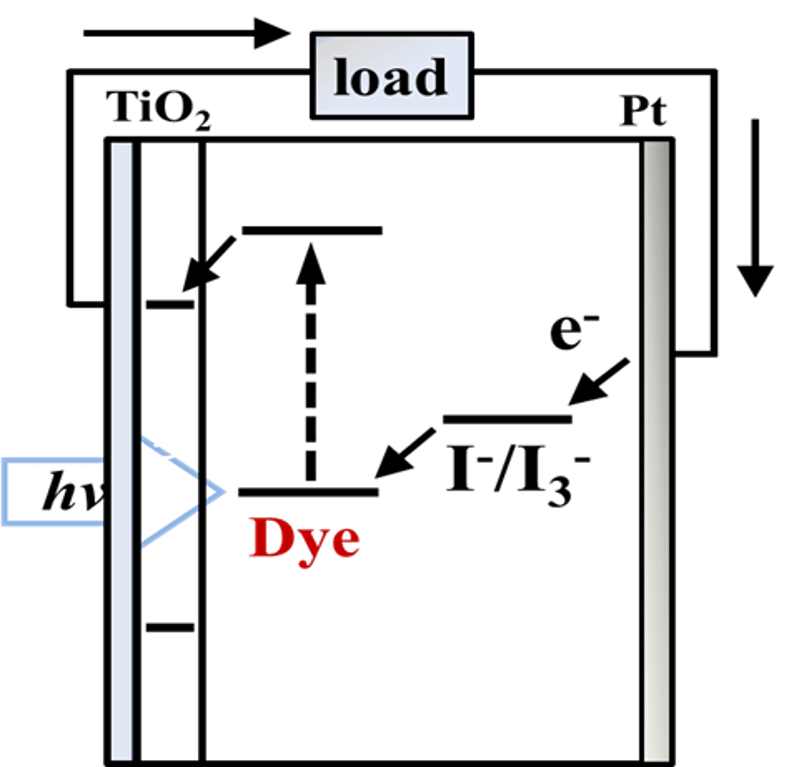
DSSC: Materials Design for Dye-Sensitized Solar Cells That Harvest Light with Dyes
キーワード / Keywords
-
DSSC / Dye-Sensitized Solar Cell
色素が光を吸収し、酸化チタンなどへ電子を渡して発電する太陽電池です。低コスト化や柔軟なデバイス化が期待されています。
EN: A solar cell in which dyes absorb light and inject electrons into materials such as TiO2, offering potential for low-cost and flexible photovoltaics. -
色素増感 / Dye Sensitization
光を吸収する色素を電極表面に固定し、太陽光を電気へ変える仕組みです。色素の吸収波長や電子移動性が性能を左右します。
EN: The process of attaching light-absorbing dyes to an electrode surface. Absorption range and electron transfer strongly affect device performance. -
光電極 / Photoanode
色素がついた半導体電極で、光を受けて電子を取り出すDSSCの中心部分です。酸化物や複合材料の設計が効率向上の鍵です。
EN: The dye-coated semiconductor electrode that extracts electrons after light absorption. Oxide and composite design is central to efficiency. -
対極 / Counter Electrode
電解質中の酸化還元反応を助ける電極です。白金の代替として、炭素材料、硫化物、ポリマー複合体などが研究されています。
EN: An electrode that catalyzes redox reactions in the electrolyte. Carbon materials, sulfides, and polymer composites are explored as Pt alternatives. -
電力変換効率 / Power Conversion Efficiency
入射した光エネルギーをどれだけ電力へ変えられるかを示す指標です。Jsc、Voc、FFが組み合わさって効率が決まります。
EN: A metric showing how much incoming light energy becomes electrical power. It depends on Jsc, Voc, and fill factor.
採用した3本 / Three Selected Papers
-
Journal of Alloys and Compounds(2024-2025 Impact Score: 6.61 / 2025 IF例: 6.7)
Gamma-irradiated chitosan with NiMoS2 on rGO layers as an efficient counter electrode for dye-sensitized solar cells
DOI: 10.1016/j.jallcom.2026.189934 -
Journal of Industrial and Engineering Chemistry(2024-2025 Impact Score: 6.38 / 2024-25 IF例: 6.0)
Earth-abundant metal oxides/layered double hydroxides-based dye-sensitized solar cells incorporating synthetic and natural dyes
DOI: 10.1016/j.jiec.2026.03.026 -
Journal of Photochemistry and Photobiology A: Chemistry(2024-2025 Impact Score: 4.87 / 2024-25 IF例: 4.7)
Derivative design from a high-performance dye: A theoretical investigation on ZS12-based sensitizers with modified π-spacers
DOI: 10.1016/j.jphotochem.2026.117320
日本語版
1. 照射キトサンとNiMoS2/rGOで、白金を使わない高性能対極へ
論文: Gamma-irradiated chitosan with NiMoS2 on rGO layers as an efficient counter electrode for dye-sensitized solar cells
掲載誌: Journal of Alloys and Compounds
DOI: 10.1016/j.jallcom.2026.189934
- この研究は、DSSCで高価な白金対極を置き換えるため、キトサン、NiMoS2、還元グラフェン酸化物を組み合わせた対極材料を開発したものです。
- キトサンは自然由来の高分子で、ガンマ線照射によって溶解性や反応性が高まり、無機材料やグラフェンと組み合わせやすくなります。
- NiMoS2は電解質の酸化還元反応を助け、rGOは電気を流しやすい導電ネットワークとして働きます。
- 7 wt%のグラフェン酸化物を加えた材料では、電荷移動抵抗が下がり、導電性と電荷移動が改善されました。
- その結果、7 wt% Gam-NMS@rGOを用いたDSSCは、最大8.101%の電力変換効率を示しました。
- 一般向けに言えば、「エビ殻などに由来するキトサンを放射線で加工し、グラフェンと金属硫化物を組み合わせて、白金を使わずに発電効率を高める」研究です。
2. 地球に豊富な金属酸化物と層状複水酸化物で、持続可能なDSSCへ
論文: Earth-abundant metal oxides/layered double hydroxides-based dye-sensitized solar cells incorporating synthetic and natural dyes
掲載誌: Journal of Industrial and Engineering Chemistry
DOI: 10.1016/j.jiec.2026.03.026
- この総説は、DSSCをより安価で持続可能な太陽電池にするため、地球に豊富に存在する金属酸化物や層状複水酸化物(LDH)に注目しています。
- DSSCは、光電極、対極、電解質、色素、導電性基板が協調して働くことで発電します。
- 金属酸化物や混合金属酸化物は、光電極材料として電子の取り出しや輸送に関わります。
- LDHは、光電極にも対極にも使える可能性があり、無機・有機半導体と複合化することで性能向上が期待されます。
- 合成色素だけでなく、天然色素を使う研究も整理されており、低コスト化や環境負荷低減につながります。
- Jsc、Voc、FF、効率といった指標が、材料の構造や界面設計と密接に関係することが示されています。
- 一般向けに言えば、「身近で豊富な元素と自然由来の色素を使って、環境にやさしいDSSCを作るための研究地図」です。
3. 高性能色素ZS12をもとに、計算でよりよいDSSC色素を設計する
論文: Derivative design from a high-performance dye: A theoretical investigation on ZS12-based sensitizers with modified π-spacers
掲載誌: Journal of Photochemistry and Photobiology A: Chemistry
DOI: 10.1016/j.jphotochem.2026.117320
- この研究は、すでに高い性能を示す色素ZS12をもとに、πスペーサーを変えた新しい色素候補を計算化学で設計したものです。
- DSSCでは、色素が広い波長の光を吸収し、TiO2へ電子を効率よく渡せることが重要です。
- DFTとTD-DFT計算により、分子構造、吸収スペクトル、蛍光、分子内電荷移動、TiO2との相互作用が調べられました。
- 設計された色素は、元の色素より赤方シフトした吸収、良好な光捕集効率、電子注入能の向上を示すと予測されました。
- 特にZS12-a、ZS12-c、ZS12-dは、元のZS12より高い電力変換効率が予測され、ZS12-aは最有力候補とされています。
- 実験前に計算で候補を絞り込めるため、材料開発の時間とコストを下げる可能性があります。
- 一般向けに言えば、「コンピューター上で色素の形を少しずつ変え、太陽光をよりよく集める分子を探す」研究です。
まとめ
今回の3本から、DSSCの性能向上には、色素だけでなく、光電極、対極、電解質、界面設計のすべてが重要であることがわかります。特に、白金を使わない対極、地球に豊富な材料、計算による色素設計は、低コストで持続可能な太陽電池へ向かうための大切な方向性です。
English Version
1. Gamma-irradiated chitosan and NiMoS2/rGO as a Pt-free counter electrode
Paper: Gamma-irradiated chitosan with NiMoS2 on rGO layers as an efficient counter electrode for dye-sensitized solar cells
Journal: Journal of Alloys and Compounds
DOI: 10.1016/j.jallcom.2026.189934
- This study develops a counter electrode made from gamma-irradiated chitosan, NiMoS2 nanoparticles, and reduced graphene oxide layers.
- The goal is to replace expensive platinum counter electrodes in DSSCs with a lower-cost and more sustainable alternative.
- Gamma irradiation improves the solubility and reactivity of chitosan, helping it interact with NiMoS2 and graphene.
- NiMoS2 supports redox catalysis, while rGO improves conductivity and charge transfer.
- The electrode containing 7 wt% graphene oxide lowered carrier resistance and improved charge-transfer behavior.
- The resulting DSSC reached a power conversion efficiency of 8.101%.
- In simple terms, this work uses a natural polymer, radiation processing, graphene, and metal sulfide chemistry to build a competitive Pt-free DSSC electrode.
2. Earth-abundant oxides and layered double hydroxides for sustainable DSSCs
Paper: Earth-abundant metal oxides/layered double hydroxides-based dye-sensitized solar cells incorporating synthetic and natural dyes
Journal: Journal of Industrial and Engineering Chemistry
DOI: 10.1016/j.jiec.2026.03.026
- This review discusses how earth-abundant metal oxides and layered double hydroxides can support more sustainable DSSC design.
- DSSCs work through the combined function of the photoelectrode, counter electrode, electrolyte, sensitizer, and conducting substrate.
- Metal oxides and mixed metal oxides are important photoelectrode materials for electron injection and transport.
- Layered double hydroxides can serve as photoelectrode or counter-electrode materials.
- Combining LDH-based materials with inorganic or organic semiconductors can improve photovoltaic performance.
- The review covers both synthetic and natural sensitizers, connecting material structure with Jsc, Voc, fill factor, and efficiency.
- In simple terms, this paper maps how abundant elements and natural or synthetic dyes can help make DSSCs cheaper and greener.
3. Computational design of ZS12-based sensitizers with modified π-spacers
Paper: Derivative design from a high-performance dye: A theoretical investigation on ZS12-based sensitizers with modified π-spacers
Journal: Journal of Photochemistry and Photobiology A: Chemistry
DOI: 10.1016/j.jphotochem.2026.117320
- This study uses computational chemistry to design new dye candidates based on the high-performance ZS12 sensitizer.
- In a DSSC, an effective dye must absorb light broadly and inject electrons efficiently into TiO2.
- DFT and TD-DFT calculations were used to study molecular structure, absorption, fluorescence, intramolecular charge transfer, and dye-TiO2 interactions.
- The designed dyes were predicted to show red-shifted absorption, high light-harvesting efficiency, improved electron injection, and enhanced open-circuit voltage.
- ZS12-a, ZS12-c, and ZS12-d were predicted to outperform the parent ZS12 dye, with ZS12-a identified as a particularly promising candidate.
- Computational screening can reduce the time and cost of experimental dye discovery.
- In simple terms, this work uses computer modeling to redesign dye molecules before making them in the lab.
Overall Takeaway
The three selected papers show that DSSC performance depends on the whole device architecture, not only the dye. Pt-free counter electrodes, earth-abundant photoelectrode materials, natural and synthetic sensitizers, and computational dye design are all important paths toward low-cost and sustainable solar energy devices.
文献 / References
- Areerob, Y.; Nachaithong, T.; Phumuen, P.; Wannabut, W.; Nijpanich, S.; Pattarith, K.; Zulfa, L. L.; Maharaniy, L. Z.; Widyastuti. Gamma-irradiated chitosan with NiMoS2 on rGO layers as an efficient counter electrode for dye-sensitized solar cells. Journal of Alloys and Compounds 1079 (2026), 189934. DOI: 10.1016/j.jallcom.2026.189934.
- Kumari, A.; Soni, S.; Sharma, A.; Bhatia, S. K.; Singh, R.; Singh, R.; Sharma, A. K.; Sharma, A. Earth-abundant metal oxides/layered double hydroxides-based dye-sensitized solar cells incorporating synthetic and natural dyes. Journal of Industrial and Engineering Chemistry 161 (2026), 139-168. DOI: 10.1016/j.jiec.2026.03.026.
- Xie, Y.; Liu, Q.; Sun, L.; Pang, M.; Xu, M. Derivative design from a high-performance dye: A theoretical investigation on ZS12-based sensitizers with modified π-spacers. Journal of Photochemistry and Photobiology A: Chemistry 480 (2026), 117320. DOI: 10.1016/j.jphotochem.2026.117320.
選定メモ / Selection Note
- Journal of Alloys and Compounds:2024-2025 Impact Score 6.61、2025 IF例 6.7。
- Journal of Industrial and Engineering Chemistry:2024-2025 Impact Score 6.38、2024-25 IF例 6.0。
- Journal of Photochemistry and Photobiology A: Chemistry:2024-2025 Impact Score 4.87、2024-25 IF例 4.7。