キーワード / Keywords
1. OLED(有機発光ダイオード)
日本語:有機材料へ電気を流して光を生み出す薄型の発光素子です。高い色表現力や柔軟な形状を生かし、ディスプレイからウェアラブル機器まで応用が広がっています。
English: A thin light-emitting device in which organic materials generate light electrically, enabling vivid displays and flexible wearable applications.
2. MR-TADF
日本語:分子内の多重共鳴と熱活性化遅延蛍光を利用し、発光に使いにくい励起状態も活用する技術です。高効率で色純度の高いOLED材料として注目されています。
English: Multi-resonance thermally activated delayed fluorescence uses excited-state control to achieve efficient emission with high color purity.
3. リン光増感蛍光(PSF)
日本語:リン光材料が受け取ったエネルギーを蛍光材料へ移し、最終的な発光を得る方式です。高効率、高色純度、長寿命の両立を目指して研究されています。
English: Phosphorescence-sensitized fluorescence transfers excitation energy from a phosphorescent sensitizer to a fluorescent terminal emitter.
4. 超深青色発光(Ultra-Deep-Blue Emission)
日本語:色度座標の青成分を厳しく制御した、非常に純度の高い青色発光です。広い色域を持つ高精細ディスプレイの実現に重要な要素となります。
English: Highly color-pure blue emission required for wide-gamut, high-resolution displays and accurate reproduction of other colors.
5. ガンマ波エントレインメント(Gamma Entrainment)
日本語:一定周期の光などで脳のガンマ帯域の活動を同調させる考え方です。認知機能への可能性が研究されていますが、医療応用にはさらなる検証が必要です。
English: The synchronization of gamma-band brain activity using rhythmic stimulation, investigated as a possible approach to cognitive intervention.
日本語版
研究背景
OLEDは、スマートフォンやテレビの表示技術として発展してきましたが、現在の研究対象は画面の高効率化だけではありません。より純度の高い色を、少ない電力で、長時間安定して出す材料設計に加え、透明性や薄さを利用して光を身につける技術も検討されています。
特に難しいのが青色OLEDです。青色は高いエネルギーを必要とするため、効率低下や材料劣化が起こりやすくなります。また、発光材料の性能だけでなく、材料間のエネルギー移動やデバイス内の電荷の流れも、明るさと寿命を左右します。ここでは、OLEDの発光効率、青色の純度、ウェアラブル応用を扱う研究を紹介します。
研究内容
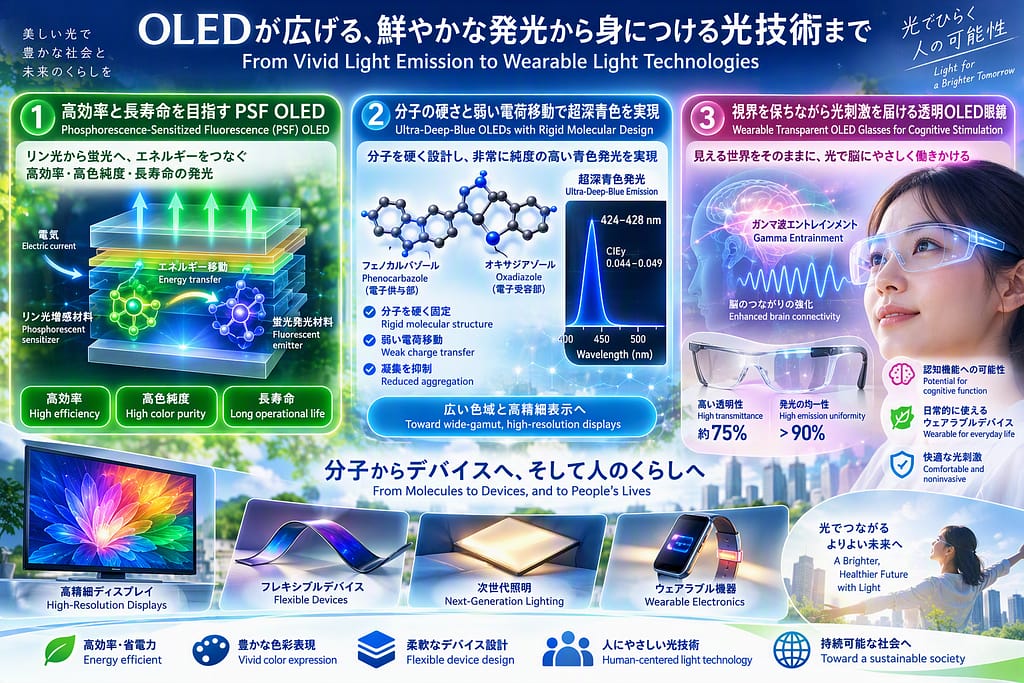
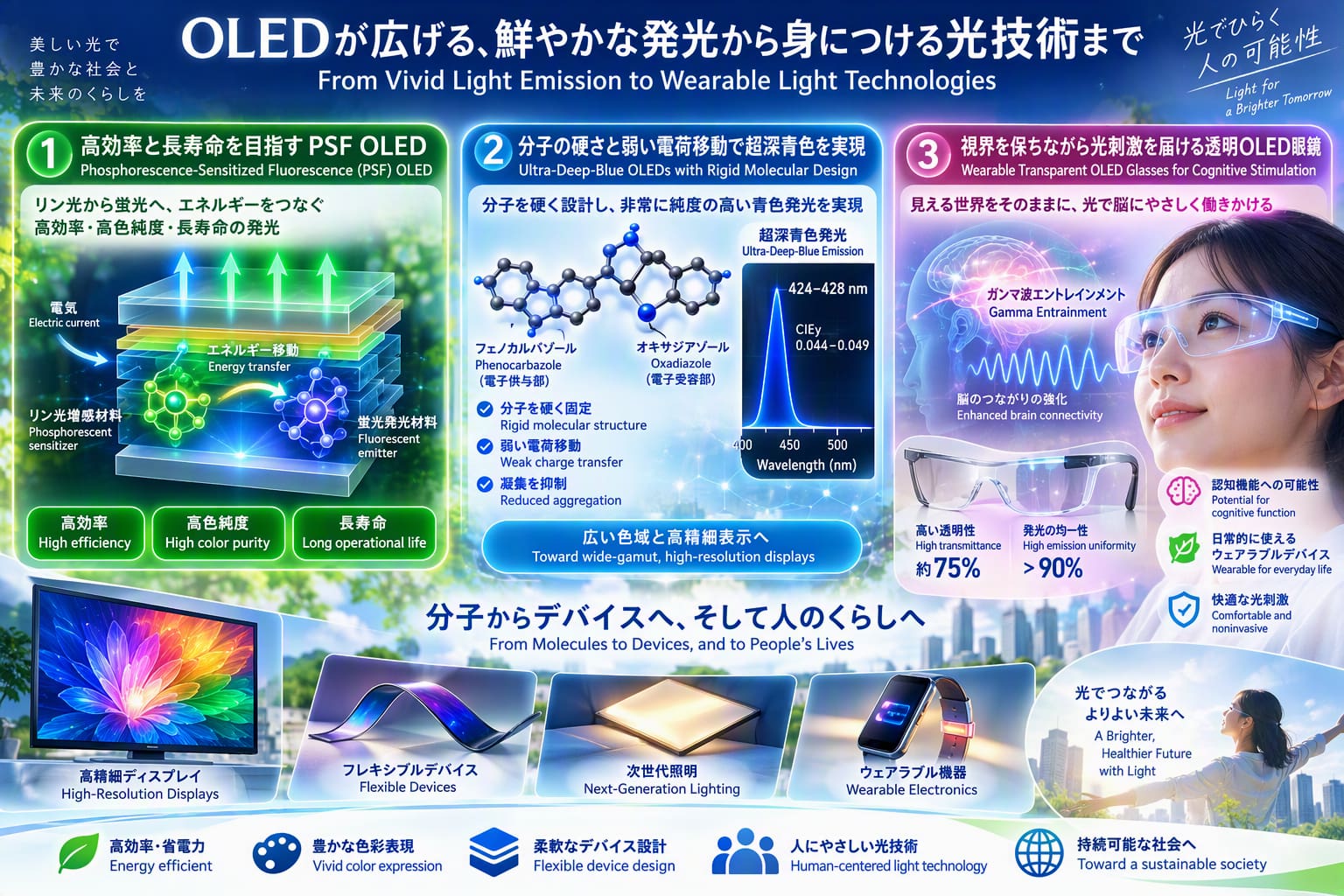
1. 高効率と長寿命を目指すPSF OLEDの設計
Strategies for Enhancing Efficiency and Operational Stability in Green Phosphorescence-Sensitized Fluorescence (PSF) Organic Light-Emitting Diode (OLED) Technology
- 色純度に優れるMR-TADF発光体では、励起エネルギーの変換が遅いことが、明るい領域での効率低下や寿命低下につながります。
- このレビューは、リン光増感材料から最終発光材料へエネルギーを移すPSF方式を整理しています。
- 発光スペクトルの重なりと、最終発光体が光を吸収する強さを高めることが、FRETと呼ばれるエネルギー移動の促進に重要です。
- 高い三重項エネルギーを持つエキシプレックス・ホストと二つの移動経路を利用することで、エネルギーの逆戻りを抑える設計が示されています。
- 安定なホスト材料と最終発光材料の選択が、効率だけでなく動作寿命にも重要であるとまとめています。
2. 分子の硬さと弱い電荷移動で超深青色を実現
Locked phenocarbazole/oxadiazole emitters for ultra-deep-blue OLEDs with CIEy below 0.05
- 硬く固定されたフェノカルバゾールを電子供与部、オキサジアゾールを穏やかな電子受容部とする青色蛍光分子を設計しました。
- 分子骨格を硬くすることで、励起後の構造変化を抑え、発光が長波長側へずれることを防ぎました。
- かさ高い置換基によって分子同士が密に重なることを抑え、凝集による発光低下を軽減しました。
- OLEDは424~428 nmで発光し、CIEyは0.044~0.049という超深青色を示しました。
- 最適化した素子は、色度座標(0.152, 0.046)を保ちながら最大外部量子効率7.15%を達成しました。
3. 視界を保ちながら光刺激を届ける透明OLED眼鏡
Wearable transparent OLED glasses for cognitive stimulation: Enhancing brain connectivity through gamma entrainment
- 日常的に装着できる光刺激装置を目指し、大面積の透明OLEDを組み込んだ眼鏡を開発しました。
- 封止層を含む全層を最適化し、75%の光透過率と90%を超える発光均一性を実現しました。
- 周囲の光があり、装着者が前方を見られる条件でも、ガンマ帯域の脳活動を同調させました。
- 後頭部と前頭部の間の脳接続性が高まり、非透明OLEDと比べて視覚的不快感が軽減されました。
- 快適な非侵襲型光刺激の可能性を示していますが、治療効果の確立には今後の臨床的検証が必要です。
期待される応用
これらの研究は、OLEDを構成する分子、発光層内のエネルギー移動、装着型デバイスという異なる階層を扱っています。PSFの研究は高効率と長寿命を両立する設計指針を示し、超深青色材料は高精細ディスプレイの色再現性向上につながります。透明OLED眼鏡は、ディスプレイ技術を人へ光を届けるインターフェースとして利用する新しい方向性を示しています。
将来は、省電力で広色域のディスプレイ、透明・ウェアラブル表示機器、生活環境になじむ光刺激装置などへの展開が考えられます。実用化には、明るい状態での長期安定性、量産時の均一性、装着時の安全性と有効性を用途ごとに検証することが重要です。
English Version
OLEDs Expanding from Color-Pure Emission to Wearable Light Technologies
Research Background
OLEDs are established display technologies, but current research extends beyond improving screen efficiency. Researchers are seeking materials that produce purer colors with lower power consumption and longer operational stability, while also using OLED transparency and thinness to create wearable light-delivery devices.
Blue emission remains particularly challenging because its high excitation energy can accelerate efficiency loss and material degradation. Performance also depends on energy transfer and charge flow across the entire device. The studies below address sensitized emission, ultra-deep-blue molecular design, and transparent wearable OLEDs.
Research Highlights
1. Designing PSF OLEDs for Efficiency and Stability
- MR-TADF emitters offer high color purity, but slow excited-state conversion can cause efficiency roll-off and reduced operational stability.
- The review examines phosphorescence-sensitized fluorescence, in which excitation energy is transferred to a terminal fluorescent emitter.
- Increasing spectral overlap and the terminal emitter’s absorption strength can accelerate Förster resonance energy transfer.
- Dual-channel energy transfer and high-triplet-energy exciplex hosts can suppress undesirable backward energy transfer.
- Stable host and terminal-emitter materials are essential for improving both efficiency and device lifetime.
2. Rigid Molecular Design Produces Ultra-Deep-Blue Light
- Blue fluorescent emitters were constructed from a rigid locked phenocarbazole donor and a moderately electron-withdrawing oxadiazole acceptor.
- The rigid framework limited excited-state structural relaxation and helped prevent red-shifted emission.
- Bulky terminal groups reduced close molecular packing and aggregation-related quenching.
- OLED emission peaks appeared at 424–428 nm, with CIEy values of 0.044–0.049.
- The optimized device reached a maximum external quantum efficiency of 7.15% with CIE coordinates of (0.152, 0.046).
3. Transparent OLED Glasses Deliver Wearable Light Stimulation
- Large-area transparent OLEDs were integrated into glasses designed for everyday visual stimulation.
- Optimization of all device layers, including encapsulation, achieved 75% luminous transmittance and more than 90% emission uniformity.
- Gamma-rhythm entrainment was observed under see-through, ambient-light conditions.
- Connectivity between occipital and frontal brain regions increased, while visual discomfort was reduced compared with nontransparent OLEDs.
- The system suggests a comfortable, noninvasive light-stimulation approach, although therapeutic efficacy requires further clinical validation.
Potential Applications
Together, these studies span molecular design, energy transfer within the emitting layer, and complete wearable devices. PSF strategies provide guidance for balancing efficiency and lifetime. Ultra-deep-blue emitters may improve the color gamut of high-resolution displays. Transparent OLED glasses illustrate how display technology may also function as a human-centered light interface.
Potential applications include energy-efficient wide-color-gamut displays, transparent and wearable electronics, and light-stimulation devices integrated into daily life. Further development requires long-term testing at practical brightness, manufacturing uniformity, and application-specific evaluation of safety and effectiveness.
References / 文献
- Chae, H.; Park, Y.; Kim, Y.; et al. Wearable transparent OLED glasses for cognitive stimulation: Enhancing brain connectivity through gamma entrainment. Science Advances 12(33) (2026), eaee5504. DOI: 10.1126/sciadv.aee5504
- Kumar, O. P.; Vergineya, S. N.; Tirupati, M.; Rajput, A.; Kwon, J. H. Strategies for Enhancing Efficiency and Operational Stability in Green Phosphorescence-Sensitized Fluorescence (PSF) Organic Light-Emitting Diode (OLED) Technology. Small (2026), Early Access. DOI: 10.1002/smll.75361
- Zhang, D.; Yin, H.; Zhao, Y.; Zhao, B.; Yu, T. Locked phenocarbazole/oxadiazole emitters for ultra-deep-blue OLEDs with CIEy below 0.05. Dyes and Pigments 256 (2027), 114118. DOI: 10.1016/j.dyepig.2026.114118