キーワード / Keywords
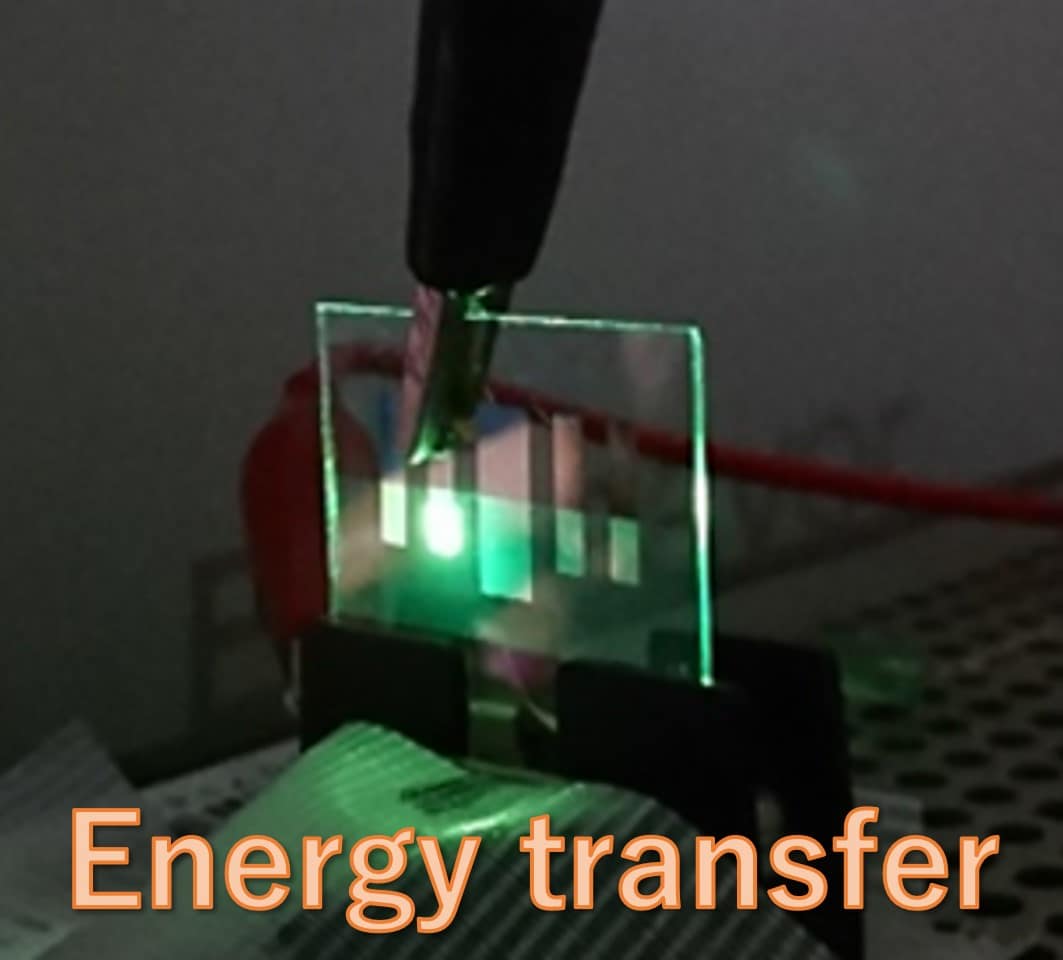
1. エネルギー移動(Energy Transfer)
日本語:OLED内部で生まれた励起エネルギーを、ホスト材料や増感材料から発光分子へ受け渡す仕組みです。移動の速さと方向が、発光効率や色純度、寿命を左右します。
English: The transfer of excitation energy from host or sensitizer materials to an emitter, strongly affecting OLED efficiency, color purity, and lifetime.
2. MR-TADF
日本語:多重共鳴と熱活性化遅延蛍光を利用し、狭い波長幅の発光と高い励起子利用率を目指す材料です。鮮やかな色を表示する次世代OLEDへの応用が期待されています。
English: Multi-resonance thermally activated delayed fluorescence combines efficient exciton harvesting with narrowband, color-pure emission.
3. 発光双極子配向(Emitting Dipole Orientation)
日本語:発光分子が光を放つ向きのそろい方を示します。分子を基板と平行に並べると、素子内に閉じ込められる光を減らし、外部へ効率よく取り出せます。
English: The directional alignment of molecular emitters, which can enhance light extraction when their dipoles lie mainly parallel to the substrate.
4. 逆項間交差(Reverse Intersystem Crossing)
日本語:発光しにくい三重項励起状態を、発光可能な一重項へ戻す過程です。この変換を速めることで、励起エネルギーの損失や高輝度時の効率低下を抑えられます。
English: The conversion of triplet excitons into emissive singlet states, enabling more complete use of electrically generated excitation energy.
5. リン光増感蛍光(Phosphorescence-Sensitized Fluorescence)
日本語:リン光増感材料で励起エネルギーを集め、最終的に蛍光材料へ渡して発光させる方式です。効率と色純度を両立するには、分子間のエネルギー移動設計が重要です。
English: A sensitized-emission approach in which a phosphorescent material harvests excitons and transfers energy to a fluorescent terminal emitter.
日本語版
研究背景
OLEDでは、電気によって生まれた電子と正孔が出会い、励起子と呼ばれる高エネルギー状態を形成します。このエネルギーを発光分子へ無駄なく渡し、素子外へ光として取り出すことが、高効率化の基本です。しかし実際には、エネルギーの移動が遅い、別の材料へ逆戻りする、長時間とどまって失活するなど、複数の損失経路があります。とりわけ色純度の高いMR-TADF材料では、狭帯域発光という長所を保ちながら、励起状態の変換と電荷輸送を速める必要があります。
ここで紹介する研究は、分子の向きをそろえて光を取り出す方法、MR-TADF発光体そのものの電荷移動とスピン変換を改善する方法、増感材料から最終発光体への移動を強める方法を示しています。
研究内容
1. 分子の平面化でエネルギーを安定化し、光の向きをそろえる
Spatial Planarization Controls Optical Anisotropy for Efficient and Stable Blue-Emitting OLEDs
- かさ高いカルバゾール部位をイリジウム錯体へ導入し、分子を平面性の高い形に固定しました。
- 平面化によって励起子の結合を強め、熱による解離を抑えながら発光までの時間を短縮しました。
- 発光双極子の約95%が水平方向に配向し、光を素子外へ取り出しやすくなりました。
- Hyper-OLEDでは、この配向効果が最終発光体にも伝わり、98%の水平配向を示しました。
- 470 nm、半値幅22 nmの狭帯域青色発光と、最大外部量子効率36.9%を達成しました。
- 1000 cd/m²における輝度半減寿命は446時間でした。
2. 分子内の電荷移動とスピン変換を同時に改善する
Benzimidazole functionalization enables efficient multi-resonance TADF with accelerated spin-flipping and balanced charge transport
- MR-TADF発光体へベンズイミダゾール部位を導入し、励起状態と電子輸送を同時に調整しました。
- 高い三重項状態とスピン軌道相互作用を変化させ、逆項間交差を高速化しました。
- 電子移動度を高め、正孔と電子の輸送差を小さくすることで、発光層内の再結合を整えました。
- 得られた材料は、狭帯域の緑色発光と、ほぼ100%のフォトルミネッセンス量子収率を示しました。
- 5~20 wt%という広い濃度範囲で安定した性能を維持しました。
- 最適化したOLEDは最大外部量子効率33.5%を示し、高輝度での効率低下も軽減されました。
3. 最終発光体の光吸収を強め、増感エネルギーを効率よく受け取る
Tetracyclic π-Extended Multi-Resonant TADF Emitters for Green PSF-OLEDs With 37.7% EQE and BT.2020-Compatible Top-Emitting Devices
- B/N系発光骨格の周辺へ四環性ナフトベンゾフラン構造を加え、剛直で平面的な緑色MR-TADF発光体を設計しました。
- 分子の硬さを高めることで、励起後の構造変化を抑え、半値幅23 nm未満の狭い発光を実現しました。
- 芳香環によるπ電子の広がりで吸収を強め、増感材料からエネルギーを受け取る能力を向上させました。
- ボトムエミッション型PSF-OLEDは最大外部量子効率37.7%を達成しました。
- 1000 cd/m²でも33.3%の外部量子効率を維持しました。
- トップエミッション型では色度座標(0.17, 0.79)の純緑色を示し、BT.2020の緑色基準に適合しました。
期待される応用
三つの研究は、OLEDのエネルギーを効率よく光へ変えるには、単一の材料性能だけでなく、励起子の安定性、電荷の流れ、分子間の受け渡し、発光方向を一体的に設計する必要があることを示しています。分子を水平に配向させる方法は光取り出しを高め、ベンズイミダゾール導入は励起状態と電荷輸送を整え、π共役を広げたMR-TADF発光体は増感エネルギーを受け取りやすくします。
これらの考え方は、低消費電力で明るいテレビやモバイル表示、高色純度の広色域ディスプレイ、高輝度でも性能を保つ次世代OLEDへつながります。今後は、大面積パネルでの均一性、長時間駆動時の材料劣化、製造工程における分子配向や濃度の再現性を検証することが重要です。
English Version
Engineering Energy Transfer in OLEDs for Efficiency, Color Purity, and Operational Stability
Research Background
In an OLED, injected electrons and holes combine to form excitons. High performance requires these excitons to reach the intended emitter without being lost and the resulting light to escape from the device efficiently. Energy can be wasted through slow transfer, backward transfer, nonradiative decay, or imbalanced charge transport. MR-TADF emitters add another challenge: their narrowband color purity must be preserved while excited-state conversion and carrier transport are accelerated.
The studies below address different stages of this process. One controls molecular orientation and exciton stability, another improves spin conversion and charge balance within an MR-TADF emitter, and the third strengthens energy transfer from a phosphorescent sensitizer to a terminal emitter.
Research Highlights
1. Spatial Planarization Stabilizes Excitons and Directs Emission
- Bulky carbazole groups confined an iridium complex into a more planar and anisotropic molecular geometry.
- Planarization increased exciton binding and shortened the radiative lifetime, reducing thermally activated exciton loss.
- Approximately 95% horizontal emitting-dipole orientation improved intrinsic light extraction.
- In a hyper-OLED, the alignment effect was transferred to the terminal emitter, producing 98% horizontal orientation.
- The device achieved 470 nm emission with a 22 nm bandwidth and a maximum external quantum efficiency of 36.9%.
- Its LT50 lifetime reached 446 hours at 1000 cd/m².
2. Benzimidazole Functionalization Improves Spin Conversion and Charge Balance
- A benzimidazole fragment was incorporated into an MR-TADF emitter to tune excited states and electron transport simultaneously.
- Modified high-lying triplet states and enhanced spin-orbit coupling accelerated reverse intersystem crossing.
- Higher electron mobility reduced the mismatch between electron and hole transport in the emitting layer.
- The emitters showed narrowband green emission and near-unity photoluminescence quantum yields.
- Stable performance was maintained across a broad 5–20 wt% doping range.
- The optimized OLED reached 33.5% maximum external quantum efficiency with reduced efficiency roll-off.
3. Stronger Absorption Enhances Sensitized Energy Transfer
- Tetracyclic naphthobenzofuran structures expanded the peripheral planarity of B/N-based MR-TADF emitters.
- Greater rigidity suppressed excited-state distortion and produced emission bandwidths below 23 nm.
- Extended π-delocalization strengthened absorption, improving the terminal emitter’s ability to receive sensitized excitation energy.
- Bottom-emitting PSF-OLEDs achieved a maximum external quantum efficiency of 37.7%.
- Efficiency remained 33.3% at 1000 cd/m².
- Top-emitting devices produced pure green emission at CIE coordinates of (0.17, 0.79), meeting the BT.2020 green standard.
Potential Applications
Together, these studies show that efficient OLED energy management requires coordinated control of exciton stability, carrier transport, intermolecular transfer, and emission direction. Horizontal molecular alignment improves light extraction, benzimidazole functionalization balances carrier and exciton utilization, and π-extended terminal emitters receive sensitized energy more effectively.
These strategies may support brighter and lower-power televisions and mobile displays, wide-color-gamut panels with high color purity, and OLEDs that retain efficiency at practical brightness. Future development will require validation of large-area uniformity, long-term material stability, and reproducible control of molecular orientation and doping concentration during manufacturing.
References / 文献
- Wu, C.; Tong, K.-N.; Li, Y.; et al. Spatial Planarization Controls Optical Anisotropy for Efficient and Stable Blue-Emitting OLEDs. Advanced Materials (2026), Early Access. DOI: 10.1002/adma.74617
- Jeon, E. J.; Thuy, T. T.; Abitkar, N.; et al. Tetracyclic π-Extended Multi-Resonant TADF Emitters for Green PSF-OLEDs With 37.7% EQE and BT.2020-Compatible Top-Emitting Devices. Advanced Functional Materials (2026), Early Access. DOI: 10.1002/adfm.78000
- Tan, J.-H.; Chen, S.-W.; Li, X.-L.; et al. Benzimidazole functionalization enables efficient multi-resonance TADF with accelerated spin-flipping and balanced charge transport. Chemical Engineering Journal 547 (2026), 181047. DOI: 10.1016/j.cej.2026.181047