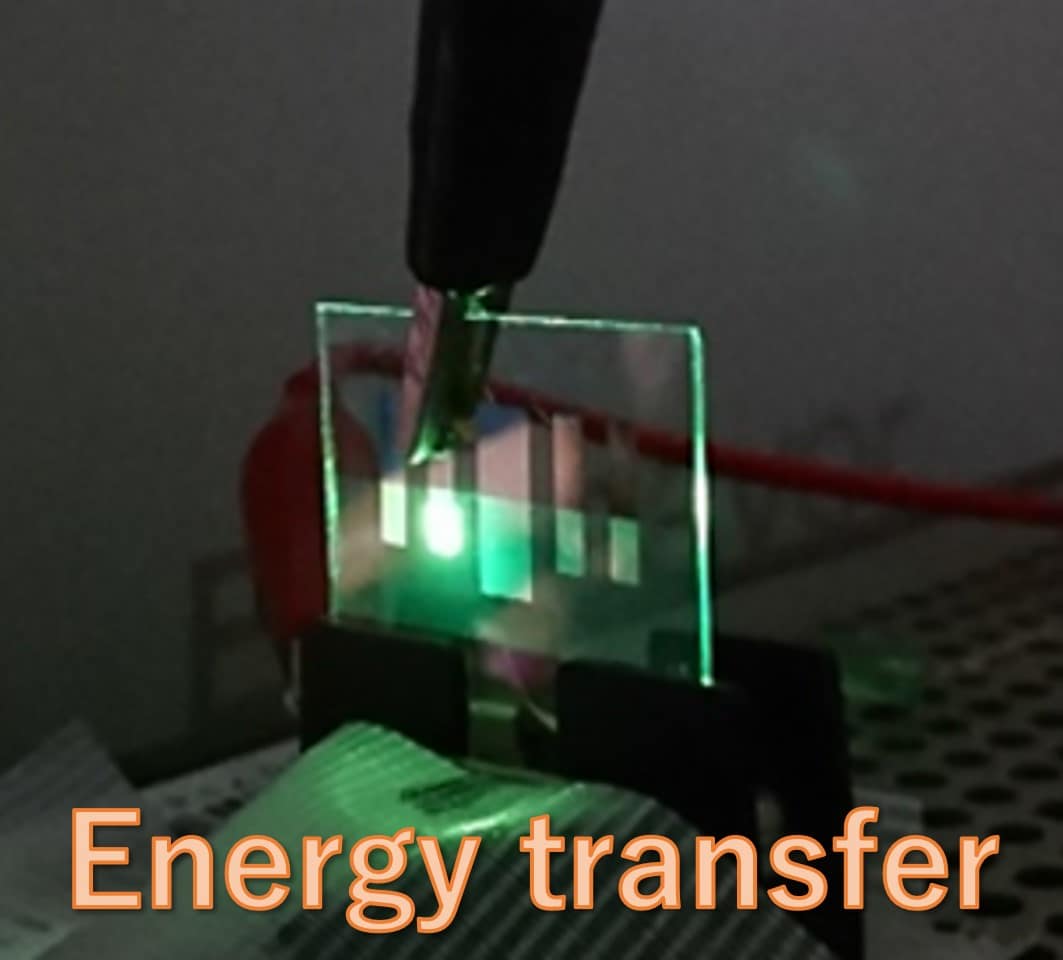
OLED Energy Transfer: Molecular Design for Brighter, Deep-Red, and Near-Infrared Emission
キーワード / Keywords
-
エネルギー移動 / Energy Transfer
ある分子が受け取った励起エネルギーを、別の分子へ渡す現象です。OLEDでは発光を強め、省電力化や高効率化を進める重要な仕組みです。
EN: Energy transfer moves excitation energy from one molecule to another, helping OLEDs emit more efficiently. -
OLED / 有機EL
有機分子に電気を流して光らせる薄型発光デバイスです。ディスプレイや照明だけでなく、医療、センサー、近赤外発光にも応用が広がっています。
EN: OLEDs are thin light-emitting devices based on organic molecules, used in displays, lighting, sensors, and emerging near-infrared technologies. -
フェルスター共鳴エネルギー移動 / Förster Resonance Energy Transfer
近くにある分子どうしの間で、光を出さずに励起エネルギーが移る現象です。距離やスペクトルの重なりが効率を左右します。
EN: Förster resonance energy transfer is a nonradiative energy transfer process between nearby molecules, strongly affected by distance and spectral overlap. -
狭帯域発光 / Narrowband Emission
発光の色幅が狭い状態です。表示では色がにごりにくく、広色域・高精細ディスプレイに必要な赤・緑・青の純度向上に役立ちます。
EN: Narrowband emission means light with a small spectral width, enabling purer colors for wide-gamut displays. -
近赤外OLED / Near-Infrared OLED
目に見える赤より長い波長で発光するOLEDです。生体観察、センシング、通信などに期待され、1000 nm付近の高効率発光が注目されています。
EN: Near-infrared OLEDs emit beyond visible red light and are promising for bioimaging, sensing, and optical communication.
日本語版
1. C字型の有機色素で、1000 nm付近の近赤外OLEDを明るくする
論文: Electron-Rich Cores Empower Organic C-Shaped Dyes With Emission Peaking Around 1000 nm, 14.3% PLQY, and >3% EQE in OLEDs
掲載誌: Advanced Materials
DOI: 10.1002/adma.74534
- 近赤外OLEDは、可視光ディスプレイを超えて、生体イメージングやセンシング、光通信などへの応用が期待されています。
- しかし、波長が長い発光ほどエネルギーが熱として失われやすく、明るく効率よく光らせることが難しくなります。
- この研究では、電子豊富なS,N-ヘテロアセン骨格をC字型分子構造に組み込み、近赤外でよく光る金属フリー有機色素を設計しています。
- 分子を硬くし、内部の構造変化に使われるエネルギーを減らすことで、発光効率を高めています。
- CT-Fは固体状態で970 nm付近に発光し、14.3%のフォトルミネッセンス量子収率を示しました。
- CT-Seを用いたハイパーフルオレッセントOLEDでは、1000 nm付近で3%を超える外部量子効率が得られています。
- さらにPM6バッファ層を入れることで、界面でのリレー型エネルギー移動が起こり、効率が向上しました。
- 一般向けに言えば、「分子の形と電子の流れを整え、見えない近赤外の光を有機材料で効率よく出す」研究です。
2. 二状態共鳴で、深赤色の色幅を細くするOLED発光体
論文: Two-state resonance deep-red narrowband OLED emitters
掲載誌: Chemical Science
DOI: 10.1039/d6sc03830a
- 高画質ディスプレイには、色が鮮やかで、発光スペクトルの幅が狭い材料が必要です。
- 深赤色発光では、色純度と発光効率を同時に高めることが難しい課題があります。
- この研究では、メロシアニン誘導体の中で起こる中性状態と双性イオン状態の「二状態共鳴」に注目しています。
- 二つの状態のエネルギーが近づくと、分子内の共鳴が強まり、基底状態でのエネルギー損失が抑えられます。
- キサンテン骨格とフェニルアミン供与体を使い、3種類の深赤色狭帯域発光分子を設計しました。
- 2EtN-O-Sと2EtN-O-OCNは、強い共鳴により高いモル吸光係数と非常に狭い発光幅を示しました。
- 2EtN-O-Sを使ったOLEDでは、712 nmの深赤色発光と0.16 eVの狭い発光幅が得られています。
- 一般向けに言えば、「分子内の電子の揺れ方を合わせ、にごりの少ない深赤色を出す」研究です。
3. 深青色にもホストにも使える広バンドギャップOLED材料
論文: Imidazole derivatives-based wide-bandgap material for efficient deep-blue electroluminescence and phosphorescent OLEDs
掲載誌: Dyes and Pigments
DOI: 10.1016/j.dyepig.2026.114056
- 深青色発光材料は、フルカラーOLEDディスプレイや固体照明に欠かせません。
- 一方で、深青色は広いバンドギャップが必要なため、電荷注入や発光効率のバランスを取ることが難しくなります。
- この研究では、ベンゾオキサゾールを受容体、メチル置換フェニル環をπブリッジ、イミダゾール誘導体を供与体とするD-π-A型分子を設計しています。
- MePBOPPIは、剛直で平面性のあるフェナントロイミダゾール供与体を持ち、分子全体は適度にねじれています。
- この構造により、凝集による発光の赤方シフトを避けながら、発光純度を高めることができます。
- MePBOPPI薄膜は100%のフォトルミネッセンス量子収率を示し、正孔と電子の移動も比較的バランスしています。
- 青色OLEDでは、Rec.709の青色標準に近い色度と5.63%の最大外部量子効率が得られました。
- さらに同じ材料は、緑、黄、赤のリン光OLEDのホスト材料としても機能し、高い外部量子効率を示しました。
- 一般向けに言えば、「青く光るだけでなく、他の発光材料を支える土台にもなる多機能なOLED材料」の研究です。
まとめ
OLEDの効率を高めるには、発光分子そのものの設計に加え、分子間や界面でのエネルギー移動をうまく使うことが重要です。C字型近赤外色素は、エネルギー移動を利用して1000 nm付近の発光効率を高めます。二状態共鳴型の深赤色発光体は、色純度と強い吸収を両立させる設計を示しています。イミダゾール誘導体の広バンドギャップ材料は、深青色発光とリン光OLED用ホストの両方で機能します。これらの研究は、OLEDがより明るく、色鮮やかで、省エネルギーな発光技術へ進むための分子設計を示しています。
English Version
1. C-shaped organic dyes for bright near-infrared OLEDs around 1000 nm
Paper: Electron-Rich Cores Empower Organic C-Shaped Dyes With Emission Peaking Around 1000 nm, 14.3% PLQY, and >3% EQE in OLEDs
Journal: Advanced Materials
DOI: 10.1002/adma.74534
- Near-infrared OLEDs are promising for bioimaging, sensing, optical communication, and technologies beyond visible displays.
- Long-wavelength emission is difficult because energy is more easily lost as heat.
- This study designs metal-free organic NIR emitters by integrating an electron-rich S,N-heteroacene core into a C-shaped architecture.
- The molecular framework enhances intramolecular charge transfer while reducing internal reorganization energy through increased rigidity.
- CT-F shows solid-state emission around 970 nm with a photoluminescence quantum yield of 14.3%.
- A hyperfluorescent OLED using CT-Se achieves an external quantum efficiency above 3% near 1000 nm.
- Adding a PM6 buffer layer enables relay-type interfacial energy transfer and further improves efficiency.
- In simple terms, this work shapes molecules and directs energy flow to create efficient near-infrared organic light.
2. Two-state resonance emitters for narrow deep-red OLEDs
Paper: Two-state resonance deep-red narrowband OLED emitters
Journal: Chemical Science
DOI: 10.1039/d6sc03830a
- Wide-gamut OLED displays require emitters with narrow spectral width and high color purity.
- Deep-red OLED emitters face a trade-off between color purity and luminescence efficiency.
- This study focuses on two-state resonance between neutral and zwitterionic states in merocyanine derivatives.
- When the two states become nearly balanced, resonance suppresses ground-state energy loss and supports strong emission.
- The researchers use a xanthene chromophore and a phenylamine donor to design three narrowband deep-red molecules.
- 2EtN-O-S and 2EtN-O-OCN show high molar extinction coefficients and very small emission widths.
- An OLED based on 2EtN-O-S emits deep red light at 712 nm with a narrow full width of 0.16 eV.
- In simple terms, this work tunes how electrons resonate inside a molecule to produce cleaner deep-red light.
3. Wide-bandgap imidazole derivatives for deep-blue and phosphorescent OLEDs
Paper: Imidazole derivatives-based wide-bandgap material for efficient deep-blue electroluminescence and phosphorescent OLEDs
Journal: Dyes and Pigments
DOI: 10.1016/j.dyepig.2026.114056
- Deep-blue emitters are essential for full-color OLED displays and solid-state lighting.
- Their wide bandgap makes balanced charge injection and high color purity difficult.
- This study designs D-π-A molecules using benzoxazole as the acceptor, a methyl-substituted phenyl bridge, and imidazole-based donor units.
- MePBOPPI combines a rigid planar phenanthroimidazole donor with a twisted molecular skeleton.
- This structure helps avoid aggregation-induced red shifts and supports pure blue emission.
- MePBOPPI films show 100% photoluminescence quantum yield and relatively balanced carrier mobilities.
- A doped blue OLED based on MePBOPPI reaches a maximum external quantum efficiency of 5.63% with blue coordinates close to the Rec.709 standard.
- The same molecule also acts as a host for green, yellow, and red phosphorescent OLEDs with high external quantum efficiencies.
- In simple terms, this material can both emit deep-blue light and support other high-efficiency OLED emitters.
Overall Takeaway
Improving OLEDs depends not only on making bright molecules, but also on controlling how excitation energy moves between molecules and interfaces. C-shaped near-infrared dyes use interfacial energy transfer to enhance emission around 1000 nm. Two-state resonance emitters provide narrow and clean deep-red light. Imidazole-based wide-bandgap materials offer both deep-blue emission and host capability for phosphorescent OLEDs. Together, these studies point toward OLEDs that are brighter, more color-pure, and more energy-efficient.
文献 / References
- Hung, C.-M.; Wu, C.-C.; Chang, Y.-Y.; Chao, W.-C.; Wang, S.-F.; Lin, C.-Y.; Ho, F.-C.; Su, Z.-H.; Xue, Y.-J.; Huang, K.-H.; Hung, W.-Y.; Cheng, Y.-J.; Chou, P.-T. Electron-Rich Cores Empower Organic C-Shaped Dyes With Emission Peaking Around 1000 nm, 14.3% PLQY, and >3% EQE in OLEDs. Advanced Materials (2026). DOI: 10.1002/adma.74534.
- Wang, X.; Gan, H.; Lai, Y.; Lei, J.; Lin, L.; Liu, J.; Wen, D.; Tan, W.; Wang, B.; Yu, Y.; Ma, Y. Two-state resonance deep-red narrowband OLED emitters. Chemical Science (2026). DOI: 10.1039/d6sc03830a.
- Zhu, K.; Zhou, Y.; Ma, C.; Ma, H.; Xie, J.; Zhou, S.; Song, J.; Sun, Q.; Yang, W.; Xue, S. Imidazole derivatives-based wide-bandgap material for efficient deep-blue electroluminescence and phosphorescent OLEDs. Dyes and Pigments 255 (2026), Article 114056. DOI: 10.1016/j.dyepig.2026.114056.