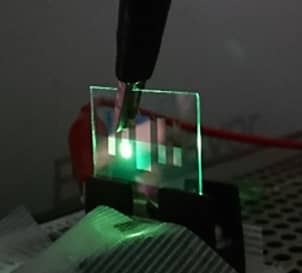
202060503: Frontiers in OLED Research (Emitters & Device Performance) — Plain-language overview
キーワード(Keywords)
- 多重共鳴TADF(MR‑TADF):分子内の電子分布を精密に設計し、狭い発光帯域と高効率を狙う次世代発光材料。
EN: Multi‑resonance TADF designs enable narrowband emission with high efficiency. - 狭帯域発光(Narrowband emission):発光スペクトルの幅(FWHM)を小さくして、色純度の高い表示を実現する考え方。
EN: Smaller FWHM means purer colors and sharper displays. - RISC(逆項間交差):三重項励起子を一重項へ戻して光に変える過程。速いほど損失が減り、効率が上がる。
EN: Reverse intersystem crossing converts triplets to singlets; faster RISC reduces losses. - ハイパーフルオレッセンス(Hyperfluorescence):感光(増感)役と最終発光役を分担し、高効率と色純度を両立する手法。
EN: A sensitizer + terminal emitter scheme to combine high efficiency and color purity. - 効率ロールオフ(Efficiency roll‑off):明るくすると効率が落ちる現象。実用輝度でも高効率を保つ設計が重要。
EN: Efficiency drop at high luminance; suppressing roll‑off is crucial for real devices.
1) 赤色MR発光体の「ロールオフ」を抑え、1万 cd/m²でも高効率を維持
Red OLED with efficiency of 25.6% at 10,000 cd m−2 based on selenium embedding multiple resonance framework
- Journal: Light‑Science & Applications(2026)
- DOI: https://doi.org/10.1038/s41377-026-02220-w
日本語
- 赤色のMR‑TADF材料は高色純度が期待される一方、RISCが遅く効率ロールオフが課題とされます。
- セレンを組み込んだ赤色MR枠組み(tFSeBN)で、RISC速度 7.5×10⁵ s⁻¹ を達成したと述べています。
- OLEDは 最大EQE 34.7%、さらに 10,000 cd/m²で 25.6% を維持し、ロールオフが小さい点を強調しています。
- さらに tFSeBN を増感剤として用いるハイパーフルオレッセンス型(純赤色)にも展開できるとしています。
English (Plain‑language points)
- Red MR emitters often suffer strong efficiency roll‑off due to intrinsically slow RISC.
- A selenium‑embedded MR framework (tFSeBN) is reported with a fast RISC rate of 7.5×10⁵ s⁻¹.
- The OLED reaches EQEmax 34.7%, and still 25.6% at 10,000 cd m⁻², indicating ultra‑low roll‑off.
- The emitter can also act as a sensitizer for hyperfluorescent, pure‑red OLEDs.
2) CT(電荷移動)強度を精密に調整し、青色MR‑TADFで高効率×狭帯域を両立
Rational Charge‑Transfer Modulation for High‑Performance Narrowband Blue Thermally Activated Delayed Fluorophores
- Journal: Advanced Functional Materials(2026, Early Access)
- DOI: https://doi.org/10.1002/adfm.75208
日本語
- 青色MR‑TADFでは「効率」と「狭帯域(色純度)」のトレードオフが課題だと述べています。
- 4種の分子(SB‑DOP, DB‑DOP, DB‑DFN, DB‑DFNP)を設計し、CT強度を調整する戦略を提示しています。
- DB‑DFNは RISC速度 3.824×10⁶ s⁻¹、PLQYほぼ100%、FWHM 20 nm を示すとされています。
- DB‑DFNを用いたOLEDで EQE 42.12%、かつ高輝度でもロールオフを抑えたと報告しています。
English (Plain‑language points)
- Blue MR‑TADF materials face a trade‑off between high efficiency and narrow emission.
- Four emitters are designed with controlled charge‑transfer strength.
- DB‑DFN is reported with kr,RISC = 3.824×10⁶ s⁻¹, PLQY ~100%, and FWHM 20 nm.
- An OLED using DB‑DFN achieves EQE 42.12% with mitigated efficiency roll‑off.
3) AIE型の深青色「部品(building block)」を作り、深青色OLEDで実証
A novel lactam‑based AIE building block for high‑performance deep‑blue electroluminescent materials
- Journal: Chemical Science(2026, Early Access)
- DOI: https://doi.org/10.1039/d6sc00940a
日本語
- 深青色OLEDでは、色(青さ)・励起子利用・固体発光効率(PLQY)の両立が重要だと述べています。
- 新しいAIE性のbuilding block(PADP)を提案し、固体状態の発光ピークが 408 nm と記載されています。
- 6位の置換基で励起状態(HLCTやホット励起子経路)を調整できることを示す、としています。
- 誘導体 PADP‑TPA により、深青色OLEDで 最大EQE 9.2%、CIE座標 (0.154, 0.049) を報告しています。
English (Plain‑language points)
- Deep‑blue OLED emitters must balance color, exciton utilization, and solid‑state PLQY.
- A new AIE building block (PADP) is reported with a solid‑state emission peak at 408 nm.
- Substitution tuning is used to modulate excited‑state character (e.g., HLCT / hot‑exciton channels).
- PADP‑TPA delivers EQE 9.2% in a deep‑blue OLED with CIE (0.154, 0.049).
文献(References)
- Pu, Y. et al. Red OLED with efficiency of 25.6% at 10,000 cd m−2 based on selenium embedding multiple resonance framework. Light‑Science & Applications (2026). https://doi.org/10.1038/s41377-026-02220-w
- Chen, G.‑W. et al. Rational Charge‑Transfer Modulation for High‑Performance Narrowband Blue Thermally Activated Delayed Fluorophores. Advanced Functional Materials (2026). https://doi.org/10.1002/adfm.75208
- Liu, L. et al. A novel lactam‑based AIE building block for high‑performance deep‑blue electroluminescent materials. Chemical Science (2026). https://doi.org/10.1039/d6sc00940a