キーワード / Keywords
- OLED(有機EL) / organic light-emitting diode
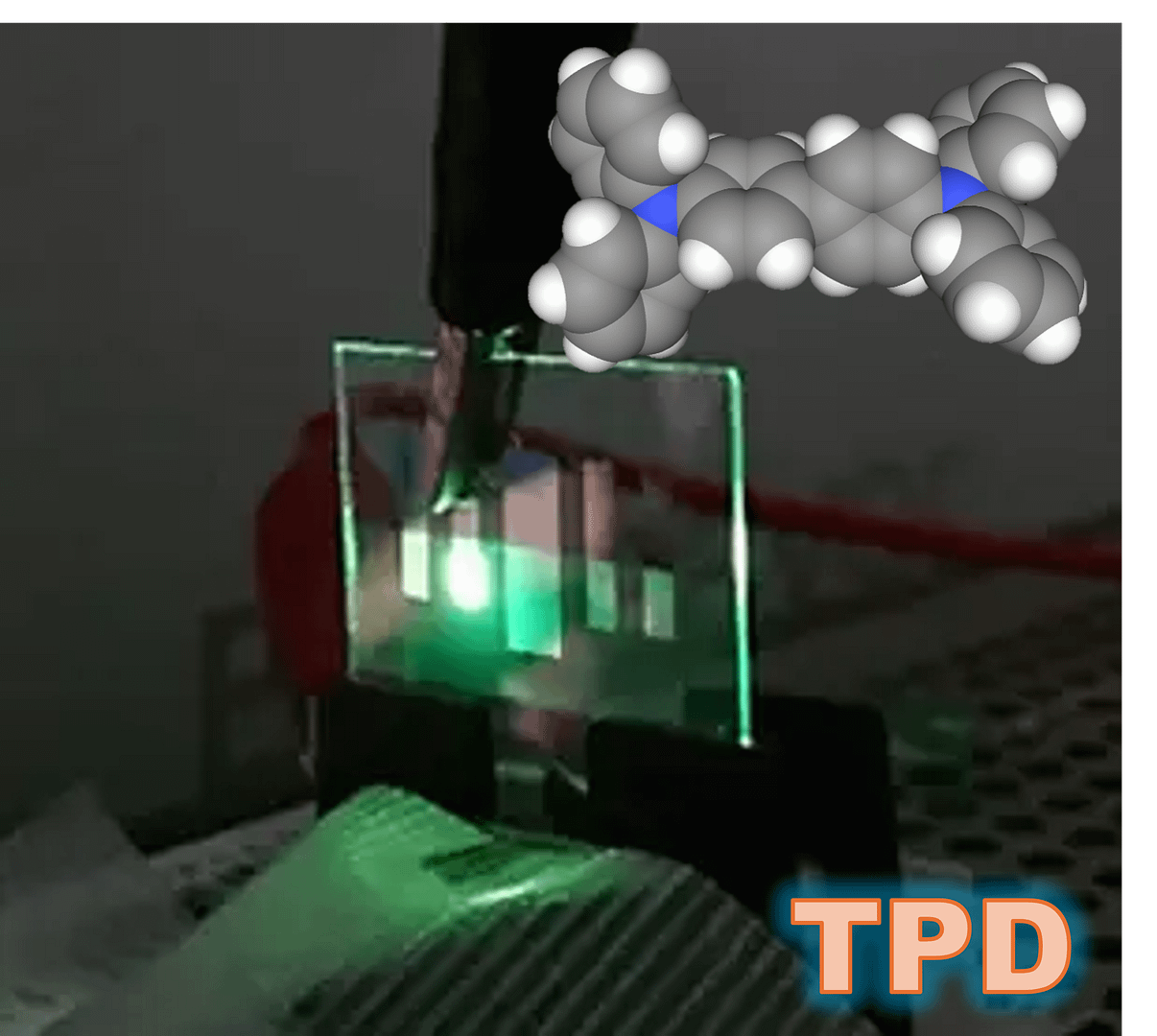
- TPD(N,N’-bis(3-methylphenyl)-N,N’-diphenylbenzidine) / TPD
- 偏光エレクトロルミネッセンス / polarized electroluminescence
- 分子配向 / molecular alignment
- りん光発光材料 / phosphorescent emitter
- 励起子結合エネルギー / exciton binding energy
- ホスト–ゲスト系 / host–guest system
- 発光効率 / electroluminescence efficiency
- デバイス寿命 / device lifetime
日本語版
OLEDとTPDとは?
OLED(有機EL)は、スマートフォンやテレビなどのディスプレイで広く使われている自発光デバイスです。TPD は初期からよく使われてきた正孔輸送材料の一つで、発光層やホスト材料と組み合わせてデバイス性能を支える重要な有機分子です。
今回は、TPDに関連して、光の偏光性を高める研究と、発光分子の基礎物性を調べる研究が確認されました。
1. TPD薄膜の分子配向をそろえて、偏光した光を強める研究
論文
Kapustiaynyk V, Turko B, Eliyashevskyy Y, Bovgyra O, Vasil’yev V, Kolomiets V, Karbovnyk I, Kushnir O, Adamiv V, Pokora R.
POLARIZED ELECTROLUMINESCENCE FROM OLED BASED ON ALQ3 AS ACTIVE LAYER
Ukrainian Journal of Physical Optics (2026)
DOI: 10.3116/16091833/Ukr.J.Phys.Opt.2026.03033
わかりやすいポイント
– この研究では、ITO/TPD/Alq3/Al 構造の OLED を作り、発光の偏光性を調べています。
– ポイントは、薄膜を斜め方向から蒸着する方法(oblique-angle deposition)を使い、TPD分子の並び方をよりそろえることです。
– その結果、TPD薄膜の偏光フォトルミネッセンスは約 3倍、OLEDの偏光エレクトロルミネッセンスは約 69倍 に高められたと報告されています。
– つまり、分子配向を整えると、OLEDから出る光の向きをそろえやすくなることが示されています。
– これは、将来的に表示の見え方の制御や光取り出しの改善につながる可能性があります。
一般向けに言うと…
「有機ELから出る光を、より“そろった向き”で出せるようにする研究」 です。
2. 発光分子の励起子結合エネルギーを明らかにする研究
論文
Tomita H, Norg LRL, Diederen P, van Hoesel C, Weijtens CHL, Bobbert PA, Coehoorn R.
Exciton Binding Energy of Phosphorescent Emitter Molecules in Organic Light-Emitting Diodes
Advanced Functional Materials (2026)
DOI: 10.1002/adfm.75896
わかりやすいポイント
– OLEDでは、光を出す分子(発光材料)がホスト材料の中に少量混ぜられて使われることがよくあります。
– そのとき重要なのが、電子と正孔が引き合ってできる 励起子(exciton) の結びつきの強さです。
– 結びつきが強すぎたり弱すぎたりすると、発光効率やデバイス寿命に影響が出ます。
– この研究では、電場による励起子解離の測定と シミュレーション を組み合わせて、イリジウム系りん光発光材料の励起子結合エネルギーを評価しています。
– その結果、代表的な材料では およそ 1.0〜1.3 eV の範囲にあることが示されました。
– これは、OLED材料を選ぶときや、新しい高性能材料を設計するときの重要な目安になります。
一般向けに言うと…
「有機ELがより明るく、長持ちするようにするために、発光分子の“光り方の基本”を数値で調べた研究」 です。
まとめ
- 今回のファイルでは、TPD関連のOLED研究として 2本 の論文が確認されました。
- 1本目は、TPD薄膜の分子配向をそろえて、偏光発光を強める研究でした。
- 2本目は、発光分子の励起子結合エネルギーを明らかにして、高効率・長寿命OLED設計につなげる研究でした。
- 共通しているのは、単に「光るデバイス」を作るだけでなく、分子の並び方や内部で起こる励起状態まで丁寧に設計・理解しようとしている点です。
- これらは、将来の高性能OLEDや高精細ディスプレイ技術に関わる重要な基礎研究です。
English Version
What are OLEDs and TPD?
OLEDs (organic light-emitting diodes) are self-emissive devices widely used in displays such as smartphones and televisions. TPD is one of the classic hole-transporting materials used in OLEDs and plays an important supporting role together with emitter and host materials.
In the uploaded file, two TPD-related OLED studies were identified: one focused on enhancing polarized emission, and the other on understanding a key fundamental property of emitter molecules.
1. Enhancing polarized light by aligning TPD molecules in thin films
Paper
Kapustiaynyk V, Turko B, Eliyashevskyy Y, Bovgyra O, Vasil’yev V, Kolomiets V, Karbovnyk I, Kushnir O, Adamiv V, Pokora R.
POLARIZED ELECTROLUMINESCENCE FROM OLED BASED ON ALQ3 AS ACTIVE LAYER
Ukrainian Journal of Physical Optics (2026)
DOI: 10.3116/16091833/Ukr.J.Phys.Opt.2026.03033
Easy-to-understand points
– This study investigated the polarization of light emitted from an OLED with the structure ITO/TPD/Alq3/Al.
– The key idea was to use oblique-angle deposition so that the TPD molecules become more orderly aligned in the thin film.
– As a result, the degree of linear polarization increased by about 3 times for TPD photoluminescence and by about 69 times for OLED electroluminescence.
– In other words, controlling molecular alignment can make the emitted light more directionally ordered.
– This may be useful in the future for display control and better light extraction.
In simple words…
This is a study on making OLED light come out in a more organized direction.
2. Clarifying the exciton binding energy of phosphorescent emitters
Paper
Tomita H, Norg LRL, Diederen P, van Hoesel C, Weijtens CHL, Bobbert PA, Coehoorn R.
Exciton Binding Energy of Phosphorescent Emitter Molecules in Organic Light-Emitting Diodes
Advanced Functional Materials (2026)
DOI: 10.1002/adfm.75896
Easy-to-understand points
– In OLEDs, light-emitting molecules are often used at low concentration inside a host material.
– A key factor is how strongly an electron and a hole are bound together as an exciton.
– If that binding is too strong or too weak, it can affect emission efficiency and device lifetime.
– In this study, the researchers combined field-induced exciton dissociation experiments with simulation methods to estimate the exciton binding energy of iridium-based phosphorescent emitters.
– They found that typical triplet exciton binding energies lie in the range of about 1.0 to 1.3 eV.
– These values provide useful guidance for selecting and designing OLED materials with better performance.
In simple words…
This is a study on measuring a fundamental property of OLED emitter molecules so that devices can become brighter and longer-lasting.
Take-home message
- Only two papers related to TPD-based or TPD-relevant OLED systems were found in the uploaded file.
- One focused on enhancing polarized emission by improving molecular alignment in TPD thin films.
- The other focused on understanding exciton binding energy to support better OLED emitter design.
- Together, these studies show that OLED research is not just about making devices emit light, but also about understanding how molecules align and how excited states behave inside the device.
- Such knowledge is essential for future high-performance OLEDs and advanced display technologies.
参考文献 / References
- Tomita H, Norg LRL, Diederen P, van Hoesel C, Weijtens CHL, Bobbert PA, Coehoorn R. Exciton Binding Energy of Phosphorescent Emitter Molecules in Organic Light-Emitting Diodes. Advanced Functional Materials. 2026. DOI: 10.1002/adfm.75896
- Kapustiaynyk V, Turko B, Eliyashevskyy Y, Bovgyra O, Vasil’yev V, Kolomiets V, Karbovnyk I, Kushnir O, Adamiv V, Pokora R. POLARIZED ELECTROLUMINESCENCE FROM OLED BASED ON ALQ3 AS ACTIVE LAYER. Ukrainian Journal of Physical Optics. 2026. DOI: 10.3116/16091833/Ukr.J.Phys.Opt.2026.03033