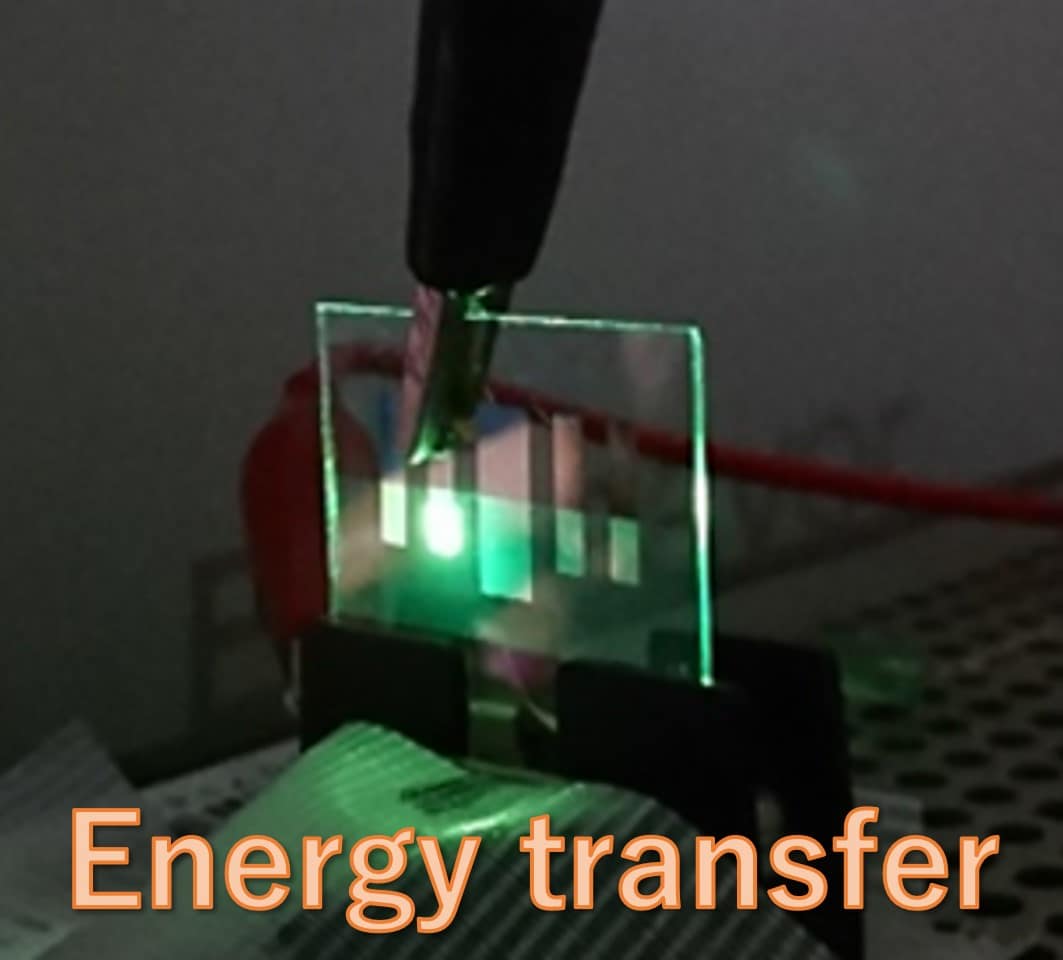
OLED Energy Transfer: How Exciton and Energy Flow Control Efficiency, Color, and Stability
キーワード / Keywords
-
OLED / Organic Light-Emitting Diode
有機分子に電気を流して光らせる発光素子です。ディスプレイや照明で使われ、発光効率、色純度、寿命の改善が重要課題です。
EN: An organic light-emitting device driven by electricity. Efficiency, color purity, and lifetime are key issues for displays and lighting. -
エネルギー移動 / Energy Transfer
ある分子や材料で生じた励起エネルギーが、別の分子へ移る現象です。OLEDでは発光層内のエネルギーの流れが性能を決めます。
EN: The movement of excitation energy from one molecule or material to another. In OLEDs, energy flow in the emitting layer controls device performance. -
FRET / Förster Resonance Energy Transfer
分子同士が離れていても起こる長距離型のエネルギー移動です。発光分子へ効率よくエネルギーを渡すための重要な仕組みです。
EN: A long-range energy-transfer process that can occur between separated molecules, useful for delivering excitation energy to emitters. -
励起子 / Exciton
電子と正孔が対になった、光を出す前のエネルギー状態です。励起子が発光へ使われるか、失活するかでOLEDの明るさが変わります。
EN: A bound electron-hole excited state formed before light emission. Whether excitons emit or are quenched strongly affects OLED brightness. -
効率ロールオフ・劣化 / Efficiency Roll-Off and Degradation
高輝度で効率が下がる現象や、使用中に性能が低下する問題です。エネルギー移動の乱れや失活経路の制御が対策になります。
EN: Efficiency loss at high brightness and performance decay during operation. Controlling energy-transfer disruption and quenching pathways is essential.
採用した3本 / Three Selected Papers
-
Light: Science & Applications(2025 JIF: 24.0)
Investigating degradation mechanisms in organic light-emitting diodes using operando electrically pumped spectroscopy
DOI: 10.1038/s41377-026-02373-8 -
npj Flexible Electronics(2025 JIF: 15.4)
High-performance full-color afterglow organic light-emitting diodes with tri-mode emission and efficient energy transfer
DOI: 10.1038/s41528-026-00568-y -
Journal of Materials Chemistry C(2025 JIF: 5.1)
Energy transfer from TSBPA:PO-T2T exciplex to rubrene: how FRET efficiency determines the optimal OLED device structure
DOI: 10.1039/d6tc01639a
日本語版
1. 動作中のOLEDを測り、劣化の原因を“励起子とエネルギー移動”から見る
論文: Investigating degradation mechanisms in organic light-emitting diodes using operando electrically pumped spectroscopy
掲載誌: Light: Science & Applications
DOI: 10.1038/s41377-026-02373-8
- この研究は、OLEDが使われている最中に、電気的な情報と光学的な情報を同時に調べ、劣化の原因を見分ける方法を示しています。
- 従来のインピーダンス分光だけでは、どの層や界面が効率低下の主因かを細かく特定しにくい課題がありました。
- 研究では、インピーダンス分光とoperando electrically pumped spectroscopyを組み合わせ、実際に電圧をかけた状態で発光や電気応答を解析しています。
- 劣化したOLEDでは、発光層内部や発光層と正孔輸送層の界面で、励起子散乱やエネルギー移動の乱れが起こることが示されました。
- 熱ストレスにより、超高速の励起子失活経路が生じ、発光効率を落とすことも明らかにされています。
- 一般向けに言えば、「OLEDが弱っていく理由を、動いている状態のまま観察し、光るエネルギーがどこで失われるかを探る」研究です。
2. 三つの発光モードとエネルギー移動で、フルカラー残光OLEDを実現する
論文: High-performance full-color afterglow organic light-emitting diodes with tri-mode emission and efficient energy transfer
掲載誌: npj Flexible Electronics
DOI: 10.1038/s41528-026-00568-y
- この研究は、電圧を切った後もしばらく光り続ける「残光OLED」を高性能化したものです。
- 発光層には、三つの発光モードをもつ残光分子が使われ、長寿命の超長寿命りん光を、りん光や蛍光へ変換して発光効率を高めています。
- 青からシアンの残光OLEDでは、最大253 msの残光寿命と7.4%の最大外部量子効率が得られました。
- さらに、りん光性錯体をドープすると、残光ホストからドーパントへ効率的にエネルギーが移動し、緑、黄、赤の残光OLEDが実現しました。
- ドープ型デバイスでは、最大132 msの寿命、総外部量子効率24%、残光外部量子効率3.6%が報告されています。
- 一般向けに言えば、「発光分子から別の発光分子へエネルギーを上手に渡し、電気を切った後も色つきで光るOLEDを作る」研究です。
3. FRET効率から、ハイパーフルオレッセンスOLEDの最適構造を決める
論文: Energy transfer from TSBPA:PO-T2T exciplex to rubrene: how FRET efficiency determines the optimal OLED device structure
掲載誌: Journal of Materials Chemistry C
DOI: 10.1039/d6tc01639a
- この研究は、TADFエキシプレックスから蛍光ドーパントへのFRETを利用するハイパーフルオレッセンスOLEDの構造を検討したものです。
- ハイパーフルオレッセンスは、TADF材料で三重項励起子を回収し、蛍光分子で鋭い発光を得る仕組みです。
- 対象は、TSBPAとPO-T2Tがつくるエキシプレックスで、そこへrubreneをドープしてエネルギー移動を調べています。
- バルク型と界面型のエキシプレックス構造を比較し、FRETがどの配置で効率よく働くかを確認しています。
- FRET効率が高いほど、励起エネルギーを発光ドーパントへうまく渡せるため、OLED構造の最適化に直結します。
- 一般向けに言えば、「発光のバトンをどの分子配置で一番うまく渡せるかを調べ、OLEDの作り方を決める」研究です。
まとめ
今回の3本は、OLEDの性能を上げる鍵が、単に“よく光る分子”を選ぶことだけではないことを示しています。動作中の劣化解析では、発光層や界面でのエネルギー移動の乱れが重要でした。残光OLEDでは、ホストからドーパントへのエネルギー移動がフルカラー化と高効率化を支えました。ハイパーフルオレッセンスOLEDでは、FRET効率が最適なデバイス構造を決める指標になりました。つまり、OLED energy transferとは、光る前のエネルギーを「どこで作り、どこへ渡し、どこで失わないか」を設計する科学です。
English Version
1. Watching OLED degradation through excitons and energy-transfer disruption
Paper: Investigating degradation mechanisms in organic light-emitting diodes using operando electrically pumped spectroscopy
Journal: Light: Science & Applications
DOI: 10.1038/s41377-026-02373-8
- This study analyzes OLED degradation while the devices are operating under electrical bias.
- Conventional impedance spectroscopy can capture electrical trends, but it is difficult to identify which layer or interface is responsible for efficiency loss.
- The researchers combine impedance spectroscopy with operando electrically pumped spectroscopy, enabling simultaneous electrical and optical probing.
- The analysis shows that degraded devices suffer from exciton scattering and disrupted energy transfer in the emitting layer and at the emitting-layer/hole-transport-layer interface.
- Thermal stress creates ultrafast exciton-quenching pathways that reduce emission efficiency.
- In simple terms, this work observes OLEDs while they are working and identifies where light-producing energy is lost.
2. Full-color afterglow OLEDs through tri-mode emission and efficient energy transfer
Paper: High-performance full-color afterglow organic light-emitting diodes with tri-mode emission and efficient energy transfer
Journal: npj Flexible Electronics
DOI: 10.1038/s41528-026-00568-y
- This study develops afterglow OLEDs that continue emitting light after the applied voltage is switched off.
- The emitting layer uses a tri-mode afterglow molecule that converts long-lived ultralong phosphorescence into phosphorescence and fluorescence through thermally activated exciton release and reverse intersystem crossing.
- Blue-to-cyan afterglow OLEDs show lifetimes up to 253 ms and a maximum external quantum efficiency of 7.4%.
- By doping phosphorescent complexes, energy is efficiently transferred from the tri-mode host to phosphor dopants.
- This enables bright green, yellow, and red afterglow OLEDs with a maximum lifetime of 132 ms, total EQE of 24%, and afterglow EQE of 3.6%.
- For general readers, this work makes OLEDs that can keep glowing in different colors by passing energy from one molecular system to another.
3. FRET efficiency as a guide for hyperfluorescence OLED structure
Paper: Energy transfer from TSBPA:PO-T2T exciplex to rubrene: how FRET efficiency determines the optimal OLED device structure
Journal: Journal of Materials Chemistry C
DOI: 10.1039/d6tc01639a
- This study focuses on hyperfluorescence OLEDs that use FRET from a TADF exciplex to a fluorescent dopant.
- Hyperfluorescence aims to combine triplet harvesting from TADF systems with narrow and efficient fluorescence from a dopant.
- The studied exciplex is formed between TSBPA and PO-T2T, and the fluorescent dopant is rubrene.
- OLED devices were fabricated with both bulk and interfacial TSBPA:PO-T2T exciplex architectures.
- The study compares different FRET scenarios to determine which architecture transfers energy most effectively to rubrene.
- In simple terms, the paper asks which molecular arrangement best passes the excitation-energy “baton” to the molecule that emits light.
Overall Takeaway
These three papers show that OLED performance depends on managing energy before it becomes light. Degradation studies reveal where exciton energy is lost. Afterglow OLEDs use energy transfer from a host to colored dopants to create full-color persistent emission. Hyperfluorescence OLEDs use FRET efficiency to decide the best device structure. In short, OLED energy transfer is the science of controlling where excitation energy is generated, where it moves, and how it avoids being wasted.
文献 / References
- Lee, C. M.; Lee, H. J.; Ha, I.; Fu, M.; Waheed, M.; Lee, G.; Patil, D. R.; P, J. J.; Lee, J. W.; Kim, C. H.; Ryu, S. Y. Investigating degradation mechanisms in organic light-emitting diodes using operando electrically pumped spectroscopy. Light: Science & Applications 15 (2026), 304. DOI: 10.1038/s41377-026-02373-8.
- Cui, D.; Xu, Z.; Zhang, J.; Guo, Z.; Zhang, P.; Zeng, C.; Li, S.; Liu, Y.; Wang, W.; Qiu, H.; Zheng, C.; Huang, W.; Chen, R. High-performance full-color afterglow organic light-emitting diodes with tri-mode emission and efficient energy transfer. npj Flexible Electronics 10 (2026), 81. DOI: 10.1038/s41528-026-00568-y.
- Weatherill, L. A.; Bowd-Griffin, L. W.; Groves, C.; Mackenzie, R.; Pander, P.; Dias, F. B. Energy transfer from TSBPA:PO-T2T exciplex to rubrene: how FRET efficiency determines the optimal OLED device structure. Journal of Materials Chemistry C (2026). DOI: 10.1039/d6tc01639a.
選定メモ / Selection Note
- Light: Science & Applications:2025 JIF 24.0。
- npj Flexible Electronics:2025 JIF 15.4。
- Journal of Materials Chemistry C:2025 JIF 5.1。
- 添付ファイル内には、RSC Advances、Chemistry of Materials、Journal of Inorganic and Organometallic Polymers and Materials、IEEE Accessなどの関連・周辺論文も含まれていました。本稿では、添付ファイル内限定を守りつつ、OLED energy transferとの関連性が明確で、かつジャーナル指標が高い3本を優先しました。