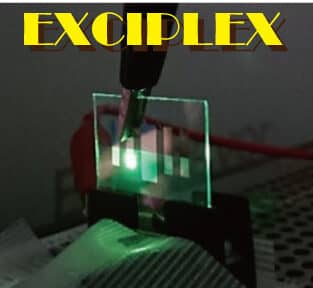
OLED Exciplex: Emissive Materials Design That Uses Donor–Acceptor Excited States
キーワード / Keywords
-
エキシプレックス / Exciplex
電子を与えやすい分子と受け取りやすい分子が、励起状態で一時的につくる発光性のペアです。OLEDでは三重項励起子の活用や発光色の調整に役立ちます。
EN: An excited-state pair formed between electron-donating and electron-accepting units. In OLEDs, it helps use triplet excitons and tune emission color. -
TADF / Thermally Activated Delayed Fluorescence
三重項励起子を熱で一重項へ戻し、蛍光として使う仕組みです。希少金属を使わず高効率OLEDを作る重要な発光原理です。
EN: A mechanism that thermally converts triplet excitons back to emissive singlets, enabling efficient OLEDs without relying on rare-metal emitters. -
FRET / Förster Resonance Energy Transfer
分子間で比較的長距離に起こるエネルギー移動です。エキシプレックスから蛍光ドーパントへエネルギーを渡し、発光効率を高めます。
EN: A relatively long-range energy-transfer process between molecules. It can pass energy from an exciplex to a fluorescent dopant to improve emission. -
単一分子エキシプレックスホスト / Single-Molecule Exciplex Host
ドナーとアクセプターを1つの分子に組み込んだホスト材料です。混合型エキシプレックスで問題になる相分離を抑え、溶液プロセスに向きます。
EN: A host material that integrates donor and acceptor units in one molecule, reducing phase separation and supporting solution-processable OLEDs. -
ハイパーフルオレッセンス / Hyperfluorescence
TADF材料で三重項励起子を回収し、蛍光分子で鋭い発光を得る方式です。高効率と高色純度を両立するOLED設計として注目されます。
EN: A strategy that harvests triplet excitons with TADF materials and emits through a fluorescent dopant, combining efficiency and color purity.
採用した3本 / Three Selected Papers
-
Chemical Engineering Journal(2025 JIF: 12.5)
Green TADF emitters: Photophysical properties and implications for OLED and NIR device engineering
DOI: 10.1016/j.cej.2026.179114 -
Journal of Materials Chemistry C(2025 JIF: 5.1)
Energy transfer from TSBPA:PO-T2T exciplex to rubrene: how FRET efficiency determines the optimal OLED device structure
DOI: 10.1039/d6tc01639a -
Dyes and Pigments(2025 JIF: 3.9)
Silane-bridged donor-σ-acceptor dyads as exciplex host for efficient TADF OLEDs
DOI: 10.1016/j.dyepig.2026.113975
日本語版
1. 緑色TADF材料を、OLEDと近赤外発光デバイスへ展開する
論文: Green TADF emitters: Photophysical properties and implications for OLED and NIR device engineering
掲載誌: Chemical Engineering Journal
DOI: 10.1016/j.cej.2026.179114
- この研究は、貴金属を使わずに高効率発光をめざすTADF材料を設計し、OLEDと近赤外発光デバイスへの応用を調べたものです。
- CzDPA-5Py2CNとCzDPA-2Py4CNという2種類の分子は、カルバゾール系ドナーとシアノピリジン系アクセプターを組み合わせています。
- 分子内でドナーとアクセプターが電荷移動状態をつくり、TADFに必要な小さな一重項–三重項エネルギー差を実現します。
- とくにCzDPA-5Py2CNを用いた緑色TADF OLEDでは、最大外部量子効率17.9%が得られました。
- さらに、これらの材料はTADF-TADF増感方式にも使われ、760.5 nmの近赤外発光で外部量子効率4.13%を示しています。
- 一般向けに言えば、「三重項励起子も無駄にせず発光へ戻す分子を作り、緑色OLEDだけでなく近赤外発光にも使った」研究です。
2. エキシプレックスからルブレンへのFRETで、最適なOLED構造を探る
論文: Energy transfer from TSBPA:PO-T2T exciplex to rubrene: how FRET efficiency determines the optimal OLED device structure
掲載誌: Journal of Materials Chemistry C
DOI: 10.1039/d6tc01639a
- この研究は、TADFエキシプレックスから蛍光ドーパントへエネルギーを渡すハイパーフルオレッセンスOLEDの構造を調べたものです。
- 対象となるエキシプレックスは、TSBPAとPO-T2Tの組み合わせで形成されます。
- このエキシプレックスは、三重項励起子を効率よく回収し、速い逆項間交差を示す材料系として扱われています。
- 発光ドーパントにはルブレンが使われ、エキシプレックスからルブレンへFRETでエネルギーを渡す設計です。
- バルク型と界面型のエキシプレックス構造を比較し、どの配置でFRETが最も効率よく働くかを検討しています。
- 一般向けに言えば、「発光のバトンを、エキシプレックスからルブレンへどの並べ方で一番うまく渡せるかを調べた」研究です。
3. シラン架橋でドナーとアクセプターを1分子化し、溶液プロセスOLEDへ
論文: Silane-bridged donor-σ-acceptor dyads as exciplex host for efficient TADF OLEDs
掲載誌: Dyes and Pigments
DOI: 10.1016/j.dyepig.2026.113975
- この研究は、ドナーとアクセプターをシラン架橋で1つの分子に組み込んだ、単一分子型エキシプレックスホストを設計したものです。
- 従来の二成分混合エキシプレックスでは、ドナー材料とアクセプター材料が分離し、膜の均一性や安定性に課題が出る場合があります。
- Si-PN1とSi-PN2は、カルバゾール系ドナーとトリアジン系アクセプターを、硬いジフェニルシラン橋で空間的に分けています。
- σ結合の橋が電子的な切り離しを助け、薄膜中でHOMOとLUMOが分かれやすくなります。
- その結果、小さな一重項–三重項エネルギー差が生まれ、エキシプレックス由来のTADFが起こりやすくなります。
- Si-PN2は高いフォトルミネッセンス量子収率を示し、溶液プロセスの緑色TADF OLEDで約25%の外部量子効率を達成しました。
- 一般向けに言えば、「発光に必要な2種類の分子の役割を1つの分子にまとめ、混ざり方の問題を避けながら高効率OLEDを作る」研究です。
まとめ
今回の3本は、OLED exciplexの研究が、材料の組み合わせだけでなく、励起エネルギーの流れ、分子配置、膜の均一性まで含む設計へ進んでいることを示しています。TADF材料は三重項励起子を発光へ戻し、FRET設計はエキシプレックスから蛍光分子へエネルギーを渡し、シラン架橋単一分子ホストは相分離を抑えながらTADFエキシプレックスを作ります。共通する鍵は、ドナーとアクセプターの距離と相互作用を制御し、励起子を失わず光へ変えることです。
English Version
1. Green TADF emitters for OLED and near-infrared device engineering
Paper: Green TADF emitters: Photophysical properties and implications for OLED and NIR device engineering
Journal: Chemical Engineering Journal
DOI: 10.1016/j.cej.2026.179114
- This study designs TADF emitters for efficient OLEDs without relying on noble metals.
- The two molecules, CzDPA-5Py2CN and CzDPA-2Py4CN, combine a diphenylamino-substituted carbazole donor with cyanopyridine acceptors.
- Their donor–acceptor structures support charge-transfer excited states and small singlet–triplet energy gaps, both important for TADF.
- A green OLED using CzDPA-5Py2CN reaches a peak external quantum efficiency of 17.9%.
- The materials are also used as TADF sensitizers in a TADF–TADF strategy, improving near-infrared electroluminescence at 760.5 nm with an EQE of 4.13%.
- In simple terms, this work creates molecules that recycle otherwise wasted triplet excitons into light for both green OLEDs and near-infrared devices.
2. FRET from exciplex to rubrene guides OLED device structure
Paper: Energy transfer from TSBPA:PO-T2T exciplex to rubrene: how FRET efficiency determines the optimal OLED device structure
Journal: Journal of Materials Chemistry C
DOI: 10.1039/d6tc01639a
- This study investigates hyperfluorescence OLEDs that transfer energy from a TADF exciplex to a fluorescent dopant.
- The exciplex is formed between TSBPA and PO-T2T.
- This exciplex system is described as having efficient triplet harvesting and fast reverse intersystem crossing.
- Rubrene is used as the fluorescent molecule that receives energy through Förster resonance energy transfer.
- The researchers compare bulk and interfacial exciplex OLED architectures to identify which structure supports the most effective FRET pathway.
- For general readers, the study asks how to arrange molecules so the excitation-energy “baton” is passed most efficiently to the final light-emitting molecule.
3. Silane-bridged donor–σ–acceptor dyads as single-molecule exciplex hosts
Paper: Silane-bridged donor-σ-acceptor dyads as exciplex host for efficient TADF OLEDs
Journal: Dyes and Pigments
DOI: 10.1016/j.dyepig.2026.113975
- This study designs single-molecule exciplex hosts in which donor and acceptor units are connected through a silane σ-bridge.
- Conventional binary exciplex hosts can suffer from phase separation between donor and acceptor materials.
- Si-PN1 and Si-PN2 combine carbazole-based donors and triazine-based acceptors through a rigid diphenylsilane bridge.
- The σ-bridge electronically decouples the donor and acceptor units, helping separate HOMO and LUMO orbitals in thin films.
- This produces small singlet–triplet energy gaps and supports exciplex-state TADF.
- Si-PN2 shows higher photoluminescence quantum yield and achieves about 25% external quantum efficiency in solution-processed green TADF OLEDs.
- In simple terms, the work packs the donor and acceptor roles into one molecule, avoiding mixing problems while preserving efficient exciplex emission.
Overall Takeaway
These three papers show that OLED exciplex design now connects molecular design, energy-transfer control, and device architecture. TADF emitters recycle triplet excitons into light. FRET-based hyperfluorescence transfers exciton energy from an exciplex to a fluorescent dopant. Single-molecule silane-bridged hosts reduce phase separation while maintaining exciplex TADF. Together, they show that efficient OLEDs require precise control of donor–acceptor distance, orbital overlap, and energy flow.
文献 / References
- Tavgeniene, D.; Wang, S.-J.; Beresneviciute, R.; Yuan, Z.-Y.; Blazevicius, D.; Chang, C.-H.; Grigalevicius, S.; Chang, C.-H. Green TADF emitters: Photophysical properties and implications for OLED and NIR device engineering. Chemical Engineering Journal 544 (2026), 179114. DOI: 10.1016/j.cej.2026.179114.
- Weatherill, L. A.; Bowd-Griffin, L. W.; Groves, C.; Mackenzie, R.; Pander, P.; Dias, F. B. Energy transfer from TSBPA:PO-T2T exciplex to rubrene: how FRET efficiency determines the optimal OLED device structure. Journal of Materials Chemistry C (2026). DOI: 10.1039/d6tc01639a.
- Kwon, S.; Kim, H. Y.; Lee, Y.; Kim, S.; Lee, S.; Hong, C. S.; Park, S.; Cho, M. J.; Choi, D. H. Silane-bridged donor-σ-acceptor dyads as exciplex host for efficient TADF OLEDs. Dyes and Pigments 254 (2026), 113975. DOI: 10.1016/j.dyepig.2026.113975.
選定メモ / Selection Note
- Chemical Engineering Journal:2025 JIF 12.5。
- Journal of Materials Chemistry C:2025 JIF 5.1。
- Dyes and Pigments:2025 JIF 3.9。
- 添付ファイル内で確認できたOLED exciplex関連論文は3本でした。そのため、この3本をジャーナルIF順に並べています。