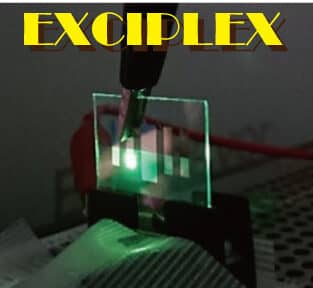
OLED Exciplex: Designing Light Emission and Stability through Donor–Acceptor Excited States
キーワード / Keywords
-
エキシプレックス / Exciplex
電子を与えやすい分子と受け取りやすい分子が、励起状態で一時的につくる発光性の組み合わせです。OLEDでは三重項励起子の利用や発光層設計に役立ちます。
EN: An excited-state complex formed between electron-donating and electron-accepting molecules. In OLEDs, it helps manage triplet excitons and emission-layer design. -
OLED / Organic Light-Emitting Diode
有機分子に電気を流して光らせる発光素子です。ディスプレイや照明に使われ、色純度、効率、寿命を同時に高めることが重要です。
EN: An organic light-emitting device driven by electricity. Displays and lighting require simultaneous improvement of color purity, efficiency, and lifetime. -
励起子リサイクル / Exciton Recycling
一度発光に使われにくい励起子を、別の経路で再び発光可能な状態へ戻す考え方です。青色OLEDの寿命や効率改善に重要です。
EN: A strategy that redirects otherwise wasted excitons back into emissive pathways. It is important for improving blue OLED efficiency and operational stability. -
TADF / 熱活性化遅延蛍光
三重項励起子を熱で一重項へ戻し、蛍光として利用する仕組みです。エキシプレックスは小さな一重項–三重項差を作りやすく、TADFと相性がよいです。
EN: Thermally activated delayed fluorescence converts triplet excitons back to emissive singlets. Exciplexes often have small singlet–triplet gaps suitable for TADF. -
効率ロールオフ・寿命 / Efficiency Roll-Off and Lifetime
高輝度で効率が落ちる現象や、使用中に発光性能が低下する問題です。励起子の移動、失活、相互作用を制御することが対策になります。
EN: Efficiency loss at high brightness and performance decay during operation. Controlling exciton transfer, quenching, and interactions helps mitigate these issues.
採用した3本 / Three Selected Papers
-
Advanced Functional Materials(2025 JIF: 19.9)
Unified Analytical Framework for Understanding the Operational Stability of Blue Phosphorescent OLEDs: Quantitative Insights Into Exciton Recycling and Bimolecular Interactions
DOI: 10.1002/adfm.76293 -
Angewandte Chemie International Edition(2025 JIF: 17.6)
Phosphor-Sensitized Deep Blue Narrowband OLED Devices With EQE Over 40% by Using a Horizontal-Oriented Host
DOI: 10.1002/anie.9859395 -
Advanced Optical Materials(2025 JIF: 7.2)
Naphthyridine-Based Donor-Acceptor Boron Difluoride Complexes Targeting Red Emission in Organic Light-Emitting Diodes
DOI: 10.1002/adom.71354
日本語版
1. 青色リン光OLEDの寿命を、励起子リサイクルと二分子相互作用から読み解く
論文: Unified Analytical Framework for Understanding the Operational Stability of Blue Phosphorescent OLEDs: Quantitative Insights Into Exciton Recycling and Bimolecular Interactions
掲載誌: Advanced Functional Materials
DOI: 10.1002/adfm.76293
- この研究は、青色リン光OLEDがなぜ劣化するのかを、材料レベルとデバイス動作中の両方から解析する枠組みを提案しています。
- 青色リン光OLEDは高効率化に有望ですが、長時間安定に動作させることが商用化の大きな壁になっています。
- 研究では、過渡フォトルミネッセンスと磁気電界発光を組み合わせ、励起子の作られ方、変換、失活を多面的に調べています。
- ホストやエキシプレックスを介した励起子リサイクル率を評価し、どの材料構造が三重項励起子の回収に有利かを定量的に示しています。
- 実際の電気駆動下では、超微細相互作用による項間交差や、Δg機構による逆項間交差の抑制などが、寿命に影響することが示されています。
- 高電界での二分子相互作用も、デバイス劣化に関わる重要な要因として整理されています。
- 一般向けに言えば、「OLEDの中で光になるはずのエネルギーが、どの道を通り、どこで失われるのかを詳しく診断する」研究です。
2. 横向きにそろうホストで、40%を超える深青色OLED効率を実現する
論文: Phosphor-Sensitized Deep Blue Narrowband OLED Devices With EQE Over 40% by Using a Horizontal-Oriented Host
掲載誌: Angewandte Chemie International Edition
DOI: 10.1002/anie.9859395
- この研究は、深青色OLEDで高効率と高色純度を同時に達成するため、ホスト分子の向きを制御したものです。
- 深青色OLEDでは、発光分子の双極子が基板に対して横向きにそろうほど、光を外へ取り出しやすくなります。
- 研究では、二つのビカルバゾール単位をテトラフェニルシラン中心につないだ4CzTPSというホスト分子を設計しています。
- 4CzTPSは、発光分子D1-DBNと静電的に相互作用し、発光分子の横方向配向比を94.5%まで高めました。
- その結果、リン光増感型の深青色MR-TADFデバイスで、外部量子効率40.5%が得られました。
- さらに、4CzTPSを用いたエキシプレックス型共ホストにより、電子注入障壁を下げ、電荷輸送のバランスを整えることで、外部量子効率42.0%が達成されています。
- 一般向けに言えば、「発光分子を光が外へ出やすい向きに並べ、エキシプレックス型ホストで電荷の流れも整えた」研究です。
3. ドナー–アクセプター型ボロン錯体で、赤色から遠赤色OLEDを設計する
論文: Naphthyridine-Based Donor-Acceptor Boron Difluoride Complexes Targeting Red Emission in Organic Light-Emitting Diodes
掲載誌: Advanced Optical Materials
DOI: 10.1002/adom.71354
- この研究は、ナフチリジン骨格をもつドナー–アクセプター型ジフルオロボロン錯体を合成し、OLED発光材料として評価したものです。
- 分子は、電子供与性のトリフェニルアミン部位と、電子受容性のボロン含有アクセプター部位を組み合わせています。
- 分光・電気化学測定から、分子内電荷移動性が強く、溶媒の極性に応じて発光色が変わることが示されています。
- 一部の分子は、PMMAやmCPマトリックス中で高いフォトルミネッセンス量子収率を示しました。
- これらの色素は、ドープなし、ホストあり、界面エキシプレックス形成型、複数の極薄発光層型など、多様なOLED構造に組み込まれました。
- 最良の条件では外部量子効率12.76%が得られ、CF3置換体を使うことで遠赤色OLEDも実現しています。
- 一般向けに言えば、「電子を押す部分と受け取る部分を組み合わせたボロン錯体で、赤色系OLEDの発光色とデバイス構造を調整する」研究です。
まとめ
今回の3本は、OLED exciplexの研究が、単に“新しい発光分子を作る”段階を超えて、励起子の流れ、発光分子の向き、ホスト–ゲストや界面での相互作用まで制御する領域に進んでいることを示しています。青色OLEDの寿命解析では、エキシプレックスを介した励起子リサイクルが重要でした。深青色OLEDでは、エキシプレックス型共ホストと分子配向制御が40%超の効率に貢献しました。赤色OLEDでは、ドナー–アクセプター型錯体と界面エキシプレックス形成型デバイス構造が発光色と効率を支えています。
English Version
1. Understanding blue phosphorescent OLED lifetime through exciton recycling and bimolecular interactions
Paper: Unified Analytical Framework for Understanding the Operational Stability of Blue Phosphorescent OLEDs: Quantitative Insights Into Exciton Recycling and Bimolecular Interactions
Journal: Advanced Functional Materials
DOI: 10.1002/adfm.76293
- This study proposes a unified framework for understanding why blue phosphorescent OLEDs degrade during operation.
- Blue phosphorescent OLEDs are promising for high efficiency, but operational stability remains a major commercialization barrier.
- The authors combine transient photoluminescence with magneto-electroluminescence to connect material-level photophysics with device-level degradation.
- They quantify host- and exciplex-mediated exciton recycling rates, clarifying how different material architectures harvest triplet excitons.
- Under electrical operation, the framework identifies exciton-conversion mechanisms such as hyperfine-driven intersystem crossing and Δg-related suppression of reverse intersystem crossing.
- High-field bimolecular interactions are also identified as important factors influencing device lifetime.
- In simple terms, this study diagnoses where light-producing energy travels inside an OLED and where it is lost during degradation.
2. Horizontally oriented hosts enable over-40% EQE in deep-blue OLEDs
Paper: Phosphor-Sensitized Deep Blue Narrowband OLED Devices With EQE Over 40% by Using a Horizontal-Oriented Host
Journal: Angewandte Chemie International Edition
DOI: 10.1002/anie.9859395
- This study designs a host molecule to improve both efficiency and color purity in deep-blue OLEDs.
- Deep-blue OLEDs can extract light more efficiently when the emitting dipoles are horizontally oriented relative to the substrate.
- The host 4CzTPS is designed by symmetrically connecting two bicarbazole units to a tetraphenylsilane core.
- Electrostatic interaction between 4CzTPS and the emitter D1-DBN promotes a very high horizontal dipole ratio of 94.5%.
- A phosphor-sensitized blue device reaches an external quantum efficiency of 40.5%.
- Using an exciplex-type co-host based on 4CzTPS further reduces electron injection barriers, balances charge transport, and raises EQE to 42.0%.
- For general readers, this work aligns light-emitting molecules so more light escapes from the OLED while using an exciplex-type host to improve charge flow.
3. Donor–acceptor boron difluoride complexes for red and far-red OLEDs
Paper: Naphthyridine-Based Donor-Acceptor Boron Difluoride Complexes Targeting Red Emission in Organic Light-Emitting Diodes
Journal: Advanced Optical Materials
DOI: 10.1002/adom.71354
- This study synthesizes donor–acceptor boron difluoride complexes based on a naphthyridine acceptor framework for OLED applications.
- The molecules combine a triphenylamine electron donor with a boron-containing acceptor unit.
- Spectroscopic and electrochemical data show strong intramolecular charge-transfer character and solvent-dependent emission behavior.
- Some compounds show near-unity photoluminescence quantum yields in PMMA or mCP matrices.
- The dyes are used in several OLED structures, including doping-free, host-containing, interface-exciplex-forming, and multiple ultrathin emissive-layer architectures.
- The best device achieves an external quantum efficiency of up to 12.76%, and CF3-substituted analogues enable far-red emission.
- In simple terms, this work uses donor–acceptor boron complexes to tune red OLED color and performance across different device architectures.
Overall Takeaway
The selected papers show that OLED exciplex research now spans stability diagnosis, molecular orientation, host engineering, and donor–acceptor emitter design. Exciplex-mediated exciton recycling helps explain blue OLED lifetime. Exciplex-type co-host structures can improve charge balance and light extraction in deep-blue OLEDs. Interface-exciplex-forming architectures can also support color-tunable red OLEDs. Together, these studies show that next-generation OLEDs depend on controlling not only the emitter molecule, but also how excitons, charges, and molecular interfaces interact.
文献 / References
- Lee, H.; Park, B. J.; Kim, T. Unified Analytical Framework for Understanding the Operational Stability of Blue Phosphorescent OLEDs: Quantitative Insights Into Exciton Recycling and Bimolecular Interactions. Advanced Functional Materials (2026). DOI: 10.1002/adfm.76293.
- Wang, M.; Wang, X.; Zhang, K.; Tian, X.; Zhao, L.; Wang, S.; Wang, L. Phosphor-Sensitized Deep Blue Narrowband OLED Devices With EQE Over 40% by Using a Horizontal-Oriented Host. Angewandte Chemie International Edition (2026). DOI: 10.1002/anie.9859395.
- Lahna, O.; Kutsiy, S.; Volyniuk, D.; Luboradzki, R.; Andresen, E.; Resch-Genger, U.; Grazulevicius, J. V.; Stakhira, P.; Potopnyk, M. A. Naphthyridine-Based Donor-Acceptor Boron Difluoride Complexes Targeting Red Emission in Organic Light-Emitting Diodes. Advanced Optical Materials 14 (2026). DOI: 10.1002/adom.71354.
選定メモ / Selection Note
- Advanced Functional Materials:2025 JIF 19.9。
- Angewandte Chemie International Edition:2025 JIF 17.6。
- Advanced Optical Materials:2025 JIF 7.2。
- 添付ファイル内には、Dyes and Pigments掲載の立体障害アクセプターを用いた黄色エキシプレックスOLED、Advanced Optical Materials掲載の深青色ハイパーフルオレッセンスOLEDなども含まれていました。本稿では、添付ファイル内限定を守りつつ、OLED exciplexとの関連性が明確で、かつジャーナルIFが高い3本を優先しました。