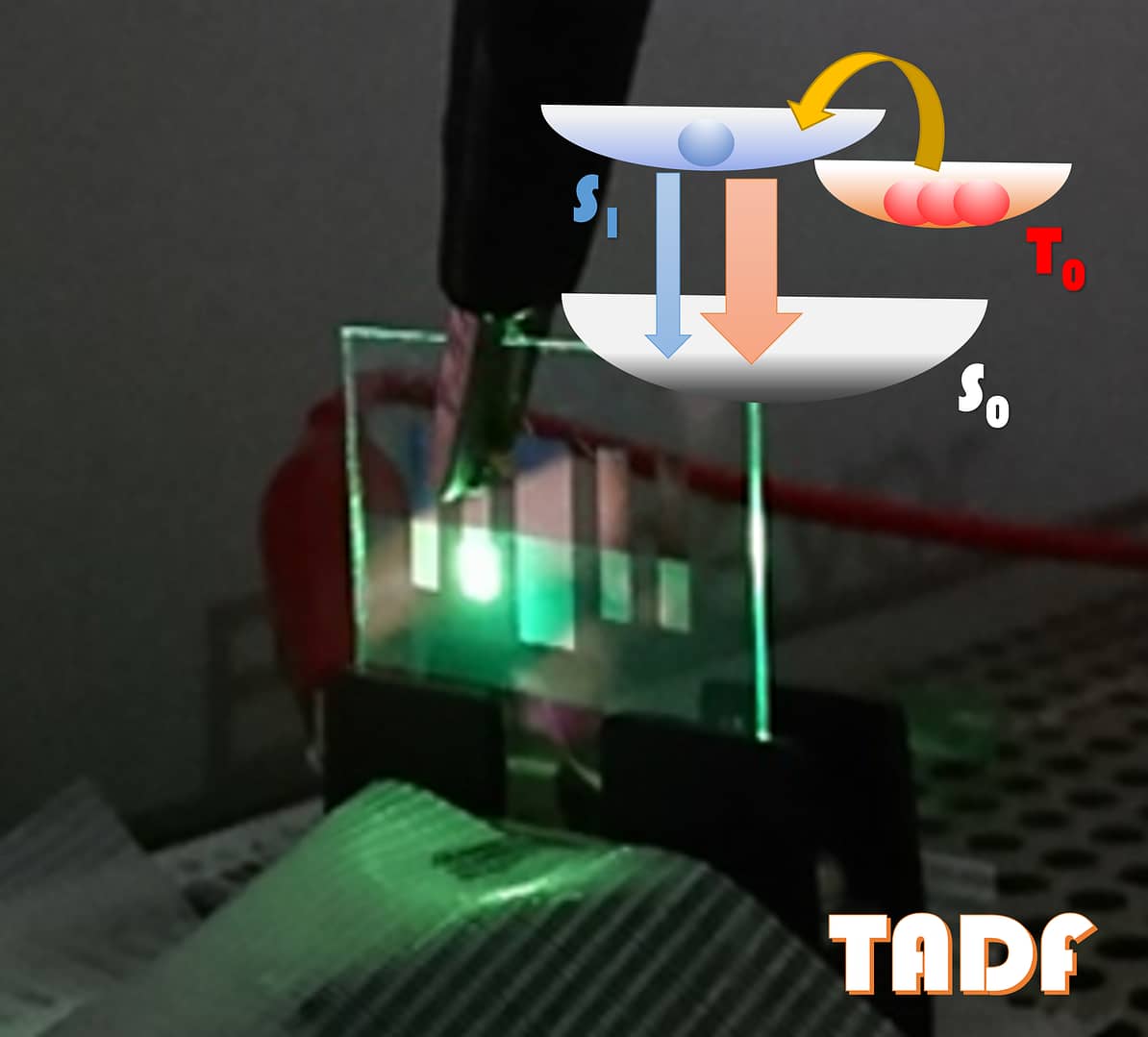
OLED TADF: Molecular and Device Design for Converting Excitons into Light
キーワード / Keywords
-
TADF / 熱活性化遅延蛍光
三重項励起子を熱で一重項へ戻し、蛍光として利用する仕組みです。希少金属に頼らずOLEDを高効率化できる重要な原理です。
EN: A mechanism that converts triplet excitons back to emissive singlets, enabling efficient OLEDs without relying only on rare metals. -
MR-TADF / 多重共鳴TADF
分子内の電子分布を精密に制御し、狭い波長幅で発光する材料です。高色純度の青色OLEDや高精細表示に重要です。
EN: A TADF design that controls intramolecular electron distribution to produce narrowband emission for high-color-purity displays. -
RISC / 逆項間交差
三重項励起子を一重項へ戻す過程です。RISCが速いほど、発光に使える励起子が増え、効率低下を抑えやすくなります。
EN: Reverse intersystem crossing returns triplet excitons to singlets. Faster RISC helps convert more excitons into light. -
ハイパーフルオレッセンス / Hyperfluorescence
TADF材料で励起子を集め、蛍光分子で色純度の高い光を出す方式です。高効率と狭帯域発光の両立に使われます。
EN: A strategy that uses TADF materials to harvest excitons and fluorescent emitters to provide narrow, high-purity emission. -
正孔輸送層 / Hole Transport Layer
正孔を発光層へ運ぶ層です。結晶性や界面の良さが、発光層の配向、電荷バランス、OLED寿命に影響します。
EN: A layer that transports holes to the emitting layer. Its crystallinity and interfaces affect orientation, charge balance, and lifetime.
採用した3本 / Three Selected Papers
-
Angewandte Chemie International Edition(2025 JIF: 17.6)
A Blue Emissive Heavy Atom-Free Multiresonant Thermally Activated Delayed Fluorescent Emitter Shows Ultra-Fast Reverse Intersystem Crossing
DOI: 10.1002/anie.9957319 -
Chemical Engineering Journal(2025 JIF: 12.5)
Green TADF emitters: Photophysical properties and implications for OLED and NIR device engineering
DOI: 10.1016/j.cej.2026.179114 -
Laser & Photonics Reviews(2025 JIF: 9.7)
High-Performance Narrowband Blue OLEDs With Enhanced Efficiency and Stability by Leveraging Single-Crystalline Hole Transport Layers
DOI: 10.1002/lpor.71526
日本語版
1. 重原子を使わず、超高速RISCを示す青色MR-TADF発光体
論文: A Blue Emissive Heavy Atom-Free Multiresonant Thermally Activated Delayed Fluorescent Emitter Shows Ultra-Fast Reverse Intersystem Crossing
掲載誌: Angewandte Chemie International Edition
DOI: 10.1002/anie.9957319
- この研究は、重原子を使わずに、青色MR-TADF材料で速いRISCを実現することをめざしたものです。
- OLEDでは、三重項励起子も光に変えられると、発光効率を大きく高められます。
- ただし、多くのMR-TADF材料では、一重項と三重項のエネルギー差が大きく、スピン軌道相互作用も小さいため、RISCが遅くなりがちです。
- 研究では、ホウ素、窒素、カルボニルを組み合わせたDDOBDiKTaという重原子フリー発光体を設計しています。
- DDOBDiKTaは、トルエン中で438 nmの青色発光を示し、半値幅33 nmという狭い発光幅を示しました。
- ドープ膜では、一重項–三重項エネルギー差が0.05 eVと小さく、RISC速度は1.98 × 10⁶ s⁻¹に達しました。
- OLEDでは最大外部量子効率23.0%を示し、青色デバイスとして効率ロールオフも比較的穏やかでした。
- 一般向けに言えば、「重い金属を使わずに、青くきれいに光り、三重項エネルギーをすばやく光へ戻す分子を作った」研究です。
2. 緑色TADF発光体をOLEDと近赤外デバイスへ展開する
論文: Green TADF emitters: Photophysical properties and implications for OLED and NIR device engineering
掲載誌: Chemical Engineering Journal
DOI: 10.1016/j.cej.2026.179114
- この研究は、緑色TADF材料を合成し、OLEDだけでなく近赤外発光デバイスにも応用できるかを調べたものです。
- TADFは、一重項と三重項の両方の励起子を発光に利用できるため、第三世代OLEDの重要な技術です。
- 研究では、カルバゾール系ドナーとシアノピリジン系アクセプターを組み合わせたCzDPA-5Py2CNとCzDPA-2Py4CNを開発しています。
- これらの材料は安定なアモルファス膜を形成し、高いフォトルミネッセンス量子収率、小さな一重項–三重項エネルギー差、明確な遅延蛍光を示しました。
- CzDPA-5Py2CNを用いた緑色TADF OLEDでは、最大外部量子効率17.9%が得られました。
- さらに、TADF-TADF増感の考え方で近赤外発光にも応用され、760.5 nmで外部量子効率4.13%を示しています。
- 一般向けに言えば、「緑に光る分子を設計し、そのエネルギー利用の仕組みを近赤外発光にも広げた」研究です。
3. 単結晶正孔輸送層で、青色OLEDの効率と寿命を高める
論文: High-Performance Narrowband Blue OLEDs With Enhanced Efficiency and Stability by Leveraging Single-Crystalline Hole Transport Layers
掲載誌: Laser & Photonics Reviews
DOI: 10.1002/lpor.71526
- この研究は、青色OLEDの高色純度、高効率、長寿命を同時に狙うデバイス設計です。
- 一般的なアモルファス膜では、電荷の移動度や膜の安定性に限界があり、OLED性能の向上を妨げる場合があります。
- 研究では、3PV-Meというp型有機単結晶を正孔輸送層として導入しました。
- 発光層には、三重項–三重項アップコンバージョンホストとMR-TADF青色発光体を組み合わせています。
- 単結晶正孔輸送層は、発光層との界面を整え、発光層の配向や水平双極子比を改善する方向に働きます。
- 作製したOLEDは、半値幅23 nmの純青色発光、y色座標0.07未満、外部量子効率10.02%超、LT50 1076時間超を示しました。
- 一般向けに言えば、「発光分子だけでなく、電荷を運ぶ土台の層を結晶性の高い材料に変えることで、青色OLEDを長持ちさせる」研究です。
まとめ
今回の3本は、OLED TADFの進歩が「発光分子を作る」だけではなく、励起子変換、発光色の鋭さ、電荷輸送層、界面、寿命設計まで広がっていることを示しています。重原子フリーMR-TADFでは、分子設計でRISCを速めることが鍵でした。緑色TADF材料では、OLEDから近赤外発光まで応用範囲を広げています。単結晶正孔輸送層の研究では、デバイス構造そのものが青色OLEDの効率と安定性を支えることが示されています。
English Version
1. A heavy-atom-free blue MR-TADF emitter with ultrafast RISC
Paper: A Blue Emissive Heavy Atom-Free Multiresonant Thermally Activated Delayed Fluorescent Emitter Shows Ultra-Fast Reverse Intersystem Crossing
Journal: Angewandte Chemie International Edition
DOI: 10.1002/anie.9957319
- This study aims to realize fast reverse intersystem crossing in a blue MR-TADF emitter without using heavy atoms.
- In OLEDs, using triplet excitons effectively can greatly improve emission efficiency.
- Many MR-TADF emitters have relatively large singlet-triplet gaps and weak spin-orbit coupling, which can slow RISC.
- The researchers design DDOBDiKTa, a heavy-atom-free boron-nitrogen-carbonyl hybrid MR-TADF emitter.
- DDOBDiKTa emits blue light at 438 nm in toluene with a narrow full width at half maximum of 33 nm.
- In doped films, it shows a small singlet-triplet energy gap of 0.05 eV and a RISC rate of 1.98 × 10⁶ s⁻¹.
- The OLED reaches a maximum external quantum efficiency of 23.0% and shows relatively mild efficiency roll-off for a blue device.
- In simple terms, this work creates a clean blue emitter that rapidly recycles triplet energy into light without relying on heavy atoms.
2. Green TADF emitters for OLED and near-infrared device engineering
Paper: Green TADF emitters: Photophysical properties and implications for OLED and NIR device engineering
Journal: Chemical Engineering Journal
DOI: 10.1016/j.cej.2026.179114
- This study develops green TADF compounds and explores their use in OLEDs and near-infrared devices.
- TADF is important for third-generation OLEDs because it can use both singlet and triplet excitons.
- The molecules CzDPA-5Py2CN and CzDPA-2Py4CN combine a carbazole-based donor with cyanopyridine acceptors.
- The materials form stable amorphous films and show high photoluminescence quantum yields, small singlet-triplet gaps, and clear delayed fluorescence.
- A green TADF OLED using CzDPA-5Py2CN achieves a peak external quantum efficiency of 17.9%.
- The compounds are also applied as TADF sensitizers in a TADF-TADF strategy, improving near-infrared electroluminescence at 760.5 nm with an EQE of 4.13%.
- In simple terms, this study designs green-emitting molecules whose exciton-harvesting ability can also support near-infrared emission.
3. Single-crystalline hole transport layers improve blue OLED efficiency and stability
Paper: High-Performance Narrowband Blue OLEDs With Enhanced Efficiency and Stability by Leveraging Single-Crystalline Hole Transport Layers
Journal: Laser & Photonics Reviews
DOI: 10.1002/lpor.71526
- This study targets narrowband blue OLEDs with high efficiency, high color purity, and improved operational stability.
- Conventional amorphous films can limit carrier mobility and device stability.
- The researchers introduce a p-type organic single crystal, 3PV-Me, as the hole transport layer.
- The emitting layer combines a triplet-triplet upconversion host with MR-TADF blue emitters.
- The single-crystalline hole transport layer improves interfacial properties and supports ordered emissive-layer orientation with a higher horizontal dipole ratio.
- The resulting OLEDs show pure-blue emission with a 23 nm FWHM, y color coordinate below 0.07, external quantum efficiency above 10.02%, and LT50 beyond 1076 h.
- In simple terms, this work improves blue OLEDs by changing not just the emitter, but the crystalline layer that carries charge into the emitting region.
Overall Takeaway
These three papers show that OLED TADF research now integrates molecular design, exciton conversion, emission bandwidth control, charge transport, and device stability. Heavy-atom-free MR-TADF design can accelerate RISC. Green TADF emitters can extend from OLEDs to near-infrared devices. Single-crystalline hole transport layers demonstrate that device architecture can strongly support blue OLED efficiency and lifetime.
文献 / References
- Wang, W.; Hafeez, H.; Wu, S.; McKay, A. P.; Cordes, D. B.; Samuel, I. D. W.; Zysman-Colman, E. A Blue Emissive Heavy Atom-Free Multiresonant Thermally Activated Delayed Fluorescent Emitter Shows Ultra-Fast Reverse Intersystem Crossing. Angewandte Chemie International Edition (2026). DOI: 10.1002/anie.9957319.
- Tavgeniene, D.; Wang, S.-J.; Beresneviciute, R.; Yuan, Z.-Y.; Blazevicius, D.; Chang, C.-H.; Grigalevicius, S.; Chang, C.-H. Green TADF emitters: Photophysical properties and implications for OLED and NIR device engineering. Chemical Engineering Journal 544 (2026), 179114. DOI: 10.1016/j.cej.2026.179114.
- Wang, N.-Q.; Ye, G.-D.; Hao, H.; Li, S.-H.; Huang, S.; Guo, R.; Liu, S.; Liu, Y.; Wei, J.; Ding, R.; Feng, J. High-Performance Narrowband Blue OLEDs With Enhanced Efficiency and Stability by Leveraging Single-Crystalline Hole Transport Layers. Laser & Photonics Reviews (2026). DOI: 10.1002/lpor.71526.
選定メモ / Selection Note
- Angewandte Chemie International Edition:2025 JIF 17.6。
- Chemical Engineering Journal:2025 JIF 12.5。
- Laser & Photonics Reviews:2025 JIF 9.7。
- 添付ファイル内には、Dyes and Pigments、Journal of Materials Chemistry C、Organic Letters、Chemistry – A European Journal、RSC AdvancesなどのOLED TADF関連論文も含まれていました。本稿では、添付ファイル内限定を守りつつ、OLED TADFとの関連性が明確で、ジャーナルIFが高い3本を優先しました。