キーワード / Keywords
1. エキサイプレックス(Exciplex)
日本語: 電子を与える分子と受け取る分子が、励起状態で一時的につくる発光性の組合せです。励起子の回収や発光体へのエネルギー移動に利用されます。
English: A light-emitting excited-state complex formed between electron-donor and electron-acceptor molecules, useful for exciton harvesting and energy transfer.
2. 励起子(Exciton)
日本語: 電子と正孔が結び付いた、発光エネルギーのもとになる状態です。蓄積や消失を抑え、目的の発光分子へ届けることがOLEDの高効率化につながります。
English: A bound electron-hole excited state whose efficient transport and conversion are essential for high-performance OLED emission.
3. 逆項間交差(Reverse Intersystem Crossing)
日本語: 発光しにくい三重項状態を、発光に使いやすい一重項状態へ変換する過程です。変換経路を増やして高速化すると、エネルギー損失を減らせます。
English: A spin-conversion process that turns triplet excitons into emissive singlet states, improving the usable fraction of excitation energy.
4. 多重共鳴発光体(Multi-Resonance Emitter)
日本語: 分子内の電子分布を細かく制御し、発光スペクトルを狭くした材料です。色にじみの少ない高純度な赤色や緑色の表示に適しています。
English: An emitter with precisely controlled electronic distribution that produces narrowband, high-color-purity light.
5. 効率ロールオフ(Efficiency Roll-Off)
日本語: OLEDを明るくしたときに発光効率が低下する現象です。励起子の集中や消光を抑え、再結合領域を広げる設計が改善に役立ちます。
English: The decline in OLED efficiency at high brightness, often caused by exciton accumulation, quenching, and imbalanced recombination.
日本語版
導入
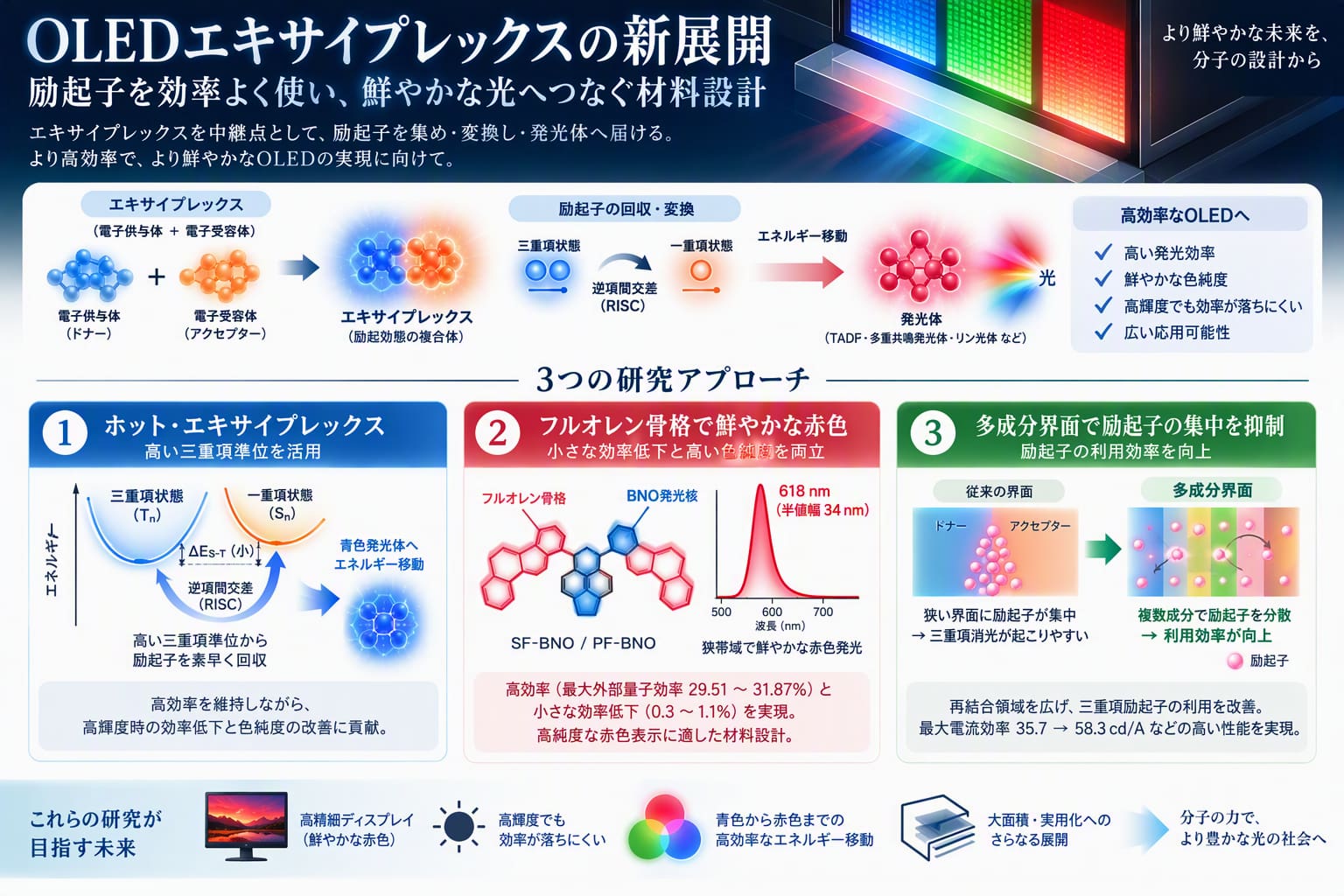
OLEDでは、電気から生じた励起子を効率よく光へ変える必要があります。エキサイプレックスは、異なる二種類の分子が励起状態で形成する複合状態です。三重項励起子を回収したり、色純度に優れた発光体へエネルギーを渡したりできるため、高効率OLEDの重要な設計要素になっています。
一方、狭い分子界面への励起子の集中、高輝度時の消光、青色エキサイプレックスの形成、効率と色純度の両立などが課題です。ここでは、多成分界面による励起子分散、高い励起準位を使うホット・エキサイプレックス、狭帯域赤色発光体へのエネルギー移動を扱った研究を紹介します。
研究内容
1. ホット・エキサイプレックスで高い三重項準位を活用
Hot-Exciplex: A New Regime of Triplet Harvesting Beyond Conventional TADF Advancing Hyperfluorescence
- 青色OLEDで利用できる、広いエネルギーギャップを持つエキサイプレックスの設計に取り組みました。
- ビスピリミジン構造のBisPMDを電子受容体、カルバゾール誘導体CCPを電子供与体として組み合わせました。
- 両分子の高い三重項エネルギーを近づけ、高位の励起状態を利用できるようにしました。
- ピコ秒およびナノ秒の過渡吸収測定により、高い三重項準位が関与する過程を確認しました。
- 高位準位における一重項と三重項のエネルギー差を小さくし、逆項間交差を速めました。
- 青色TADF発光体と狭帯域多重共鳴発光体へ、効率的なフェルスター型エネルギー移動を実現しました。
- 高効率を維持しながら、高輝度時の効率低下と色純度の改善につながる増感方式を示しました。
2. フルオレン骨格で鮮やかな赤色と小さな効率低下を両立
Fluorene-Framework Engineering Enables Narrowband Red Multi-Resonance Emitters for High-Efficiency With Negligible Roll-Off Toward BT.2020
- BNO発光核の周囲にフルオレン骨格を配置し、立体的な分子環境を調節しました。
- アリール部位の環化状態が異なるSF-BNOとPF-BNOを比較しました。
- 両材料は618 nmの狭帯域赤色発光を示し、半値幅は34 nmでした。
- PF-BNOの発光量子収率は98%に達しました。
- エキサイプレックス補助型のリン光増感蛍光OLEDでは、最大外部量子効率がSF-BNOで29.51%、PF-BNOで31.87%でした。
- 高輝度化に伴う効率低下は、それぞれ0.3%と1.1%という小さな値でした。
- 上部発光型PF-BNO OLEDでは、微小共振器効果により620 nm、半値幅23 nm、色度座標(0.68, 0.31)の高純度赤色を得ました。
3. 多成分界面で励起子の集中と消光を抑制
Multicomponent interfacial exciplexes for improved exciton utilization in organic light-emitting diodes
- 従来の界面エキサイプレックスでは、狭いドナー・アクセプター界面に励起子が集中し、三重項消光が起きやすい問題に着目しました。
- 複数成分を組み合わせ、二つの逆項間交差経路と、励起子を空間的に分散する効果を導入しました。
- 励起子の再結合領域を広げ、三重項励起子の利用効率を改善しました。
- 基本デバイスは最大電流効率35.7 cd/A、最大電力効率32.0 lm/Wを示しました。
- 1000 cd/m²での効率低下は14.5%でした。
- 界面へ橙色リン光層を追加し、エキサイプレックスから残る励起子をさらに回収しました。
- 最適化した橙色OLEDは最大電流効率58.3 cd/A、最大電力効率52.3 lm/Wを示し、1000 cd/m²での効率低下は19.6%でした。
研究全体の意義
三つの研究は、エキサイプレックスを単なる発光状態ではなく、励起子を集め、変換し、目的の発光体へ届ける中継点として活用できることを示しています。ホット・エキサイプレックスは高い三重項準位から励起子を素早く回収し、多成分界面は励起子の集中を和らげます。赤色多重共鳴発光体との組合せでは、高効率と狭帯域発光、高輝度時の小さな効率低下を同時に目指せます。
これらの成果は、高精細ディスプレイに求められる鮮やかな赤色、明るさを上げても効率が落ちにくい発光、青色から赤色までの高効率なエネルギー移動設計につながります。今後は、長時間駆動時の寿命、材料組成の再現性、大面積成膜での均一性、製造工程との適合性を確認することが重要です。
English Version
New Directions in OLED Exciplexes: Efficient Exciton Use and Energy Transfer to Color-Pure Emitters
Introduction
OLEDs must convert electrically generated excitons into light with minimal loss. An exciplex is an excited-state complex formed between two different molecules, typically an electron donor and an electron acceptor. It can harvest triplet excitons and transfer their energy to highly color-pure terminal emitters.
Key challenges include exciton accumulation at narrow interfaces, triplet quenching at high brightness, formation of wide-energy-gap blue exciplexes, and the simultaneous achievement of efficiency and narrowband emission. The studies below address these issues through hot-exciplex states, fluorene-engineered red emitters, and multicomponent interfacial exciplexes.
Research Highlights
1. A Hot-Exciplex Harvests Higher Triplet States
- The study targeted a wide-energy-gap exciplex suitable for blue OLED sensitization.
- BisPMD was used as the electron acceptor and the carbazole derivative CCP as the donor.
- Their similar high triplet energies enabled access to higher excited states.
- Picosecond and nanosecond transient-absorption measurements supported the involvement of higher triplet levels.
- The upper-state singlet-triplet energy gap was reduced, accelerating higher-level reverse intersystem crossing.
- Efficient Förster energy transfer was achieved to blue TADF and narrowband multi-resonance emitters.
- The strategy improved high-brightness efficiency behavior and color purity while retaining efficient emission.
2. Fluorene Engineering Produces Narrowband Red Emission with Negligible Roll-Off
- A fluorene framework was used to control the three-dimensional environment around a BNO emitting core.
- Two emitters, SF-BNO and PF-BNO, differed in the ring-closure state of their aryl arms.
- Both produced narrowband red emission at 618 nm with a 34 nm full width at half maximum.
- PF-BNO reached a photoluminescence quantum yield of 98%.
- Exciplex-assisted phosphorescence-sensitized fluorescence OLEDs achieved maximum external quantum efficiencies of 29.51% for SF-BNO and 31.87% for PF-BNO.
- Efficiency roll-off was limited to 0.3% and 1.1%, respectively.
- A top-emitting PF-BNO OLED used microcavity narrowing to produce saturated red emission at 620 nm, a 23 nm bandwidth, and CIE coordinates of (0.68, 0.31).
3. Multicomponent Interfaces Reduce Exciton Accumulation
- Conventional interfacial exciplex OLEDs concentrate excitons within a narrow donor-acceptor region, increasing triplet quenching.
- A multicomponent system introduced two reverse-intersystem-crossing pathways and spatial dilution of excitons.
- The broadened recombination zone improved triplet-exciton utilization.
- The base device achieved maximum current and power efficiencies of 35.7 cd/A and 32.0 lm/W.
- Efficiency roll-off was 14.5% at 1000 cd/m².
- An orange phosphorescent layer was inserted at the interface to harvest additional excitons from the exciplex host.
- The optimized orange OLED reached 58.3 cd/A and 52.3 lm/W, with 19.6% roll-off at 1000 cd/m².
Overall Significance
These studies show that an exciplex can function as more than an emitting state. It can act as an energy relay that harvests, converts, distributes, and transfers excitons to a terminal emitter. A hot-exciplex rapidly accesses higher triplet states, while a multicomponent interface reduces exciton crowding. Coupling exciplex sensitization with red multi-resonance emitters supports high efficiency, narrow emission, and low roll-off at high brightness.
The findings provide design routes toward saturated red pixels for high-definition displays and more efficient energy transfer across blue-to-red OLED systems. Further work should establish operational lifetime, compositional reproducibility, large-area film uniformity, and compatibility with scalable manufacturing processes.
References / 文献
- Rajput, A.; Vergineya, S. N.; Muruganantham, S.; et al. Fluorene-Framework Engineering Enables Narrowband Red Multi-Resonance Emitters for High-Efficiency With Negligible Roll-Off Toward BT.2020. Angewandte Chemie International Edition (2026), Early Access. DOI: 10.1002/anie.9888822
- Barman, D.; Oura, M.; Tsuchiya, Y.; Onda, K.; Adachi, C. Hot-Exciplex: A New Regime of Triplet Harvesting Beyond Conventional TADF Advancing Hyperfluorescence. Angewandte Chemie International Edition (2026), Early Access. DOI: 10.1002/anie.8297276
- Luan, B.; Jing, X.; Sun, C.; et al. Multicomponent interfacial exciplexes for improved exciton utilization in organic light-emitting diodes. Dyes and Pigments 256 (2027), 114148. DOI: 10.1016/j.dyepig.2026.114148