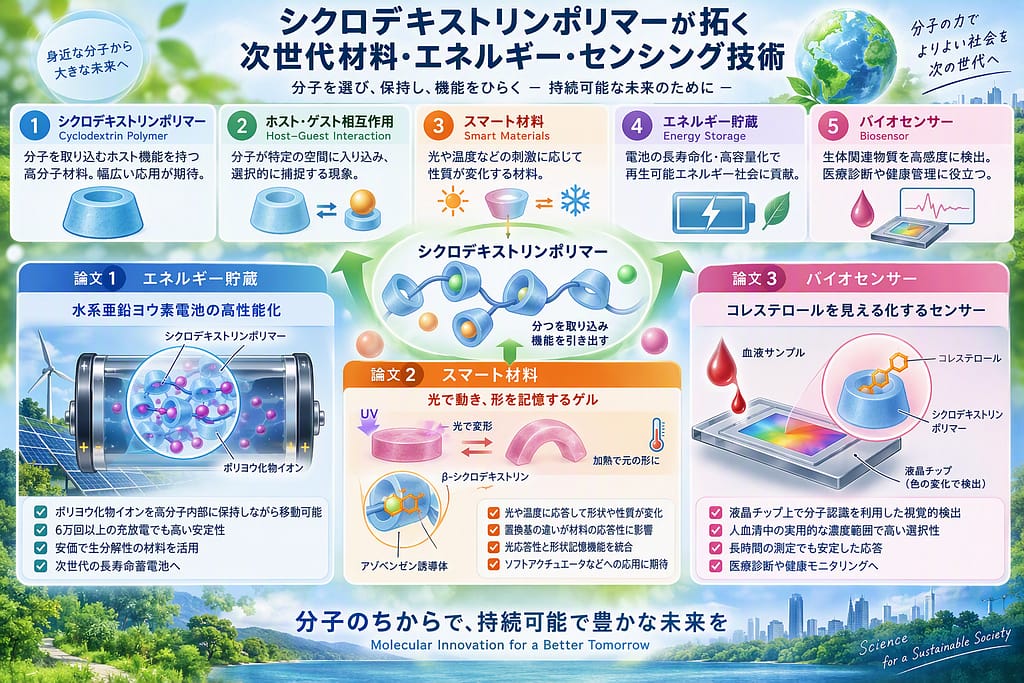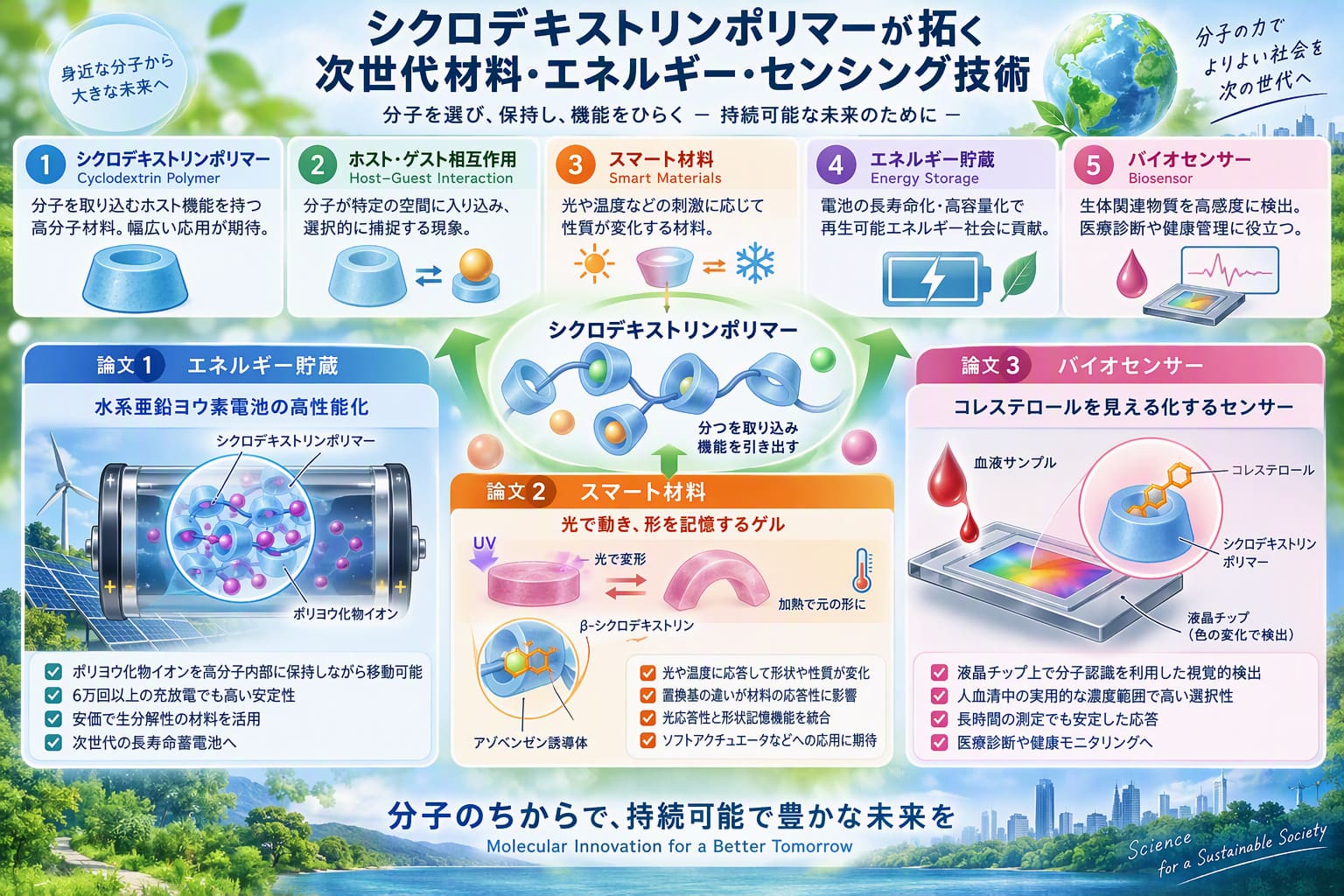
キーワード / Keywords
1. シクロデキストリンポリマー (Cyclodextrin Polymer)
日本語: シクロデキストリンを高分子化した材料で、分子を内部に取り込むホスト機能を持ちます。分子認識や薬物送達、センサー、エネルギーデバイスなど幅広い用途が期待されています。
English: Cyclodextrin polymers retain the host–guest recognition ability of cyclodextrins while providing a stable polymer network, enabling applications in sensing, energy storage, and functional materials.
2. ホスト・ゲスト相互作用 (Host–Guest Interaction)
日本語: 分子が特定の空間に入り込む現象です。分子を選択的に捕捉できるため、材料の性能向上や高感度な検出技術の基盤となります。
English: A molecular recognition phenomenon in which a guest molecule is captured within a host cavity, allowing selective binding and enhanced functionality.
3. スマート材料 (Smart Materials)
日本語: 光や温度などの刺激に応じて性質が変化する材料です。柔らかいロボットや医療デバイスなどへの応用が注目されています。
English: Materials that respond to external stimuli such as light or temperature, making them attractive for adaptive devices and advanced technologies.
4. エネルギー貯蔵 (Energy Storage)
日本語: 電池の性能向上は再生可能エネルギー社会を支える重要課題です。分子レベルの設計によって長寿命化や高容量化が進められています。
English: Advanced energy storage technologies rely on molecular engineering to improve battery lifetime, stability, and energy density.
5. バイオセンサー (Biosensor)
日本語: 生体関連物質を測定するための技術です。医療診断や健康管理に役立ち、簡便かつ高精度な分析手法として発展しています。
English: Biosensors enable rapid and selective measurement of biologically relevant compounds and are increasingly important in healthcare applications.
日本語版
はじめに
シクロデキストリンポリマーは、分子を選択的に取り込む「ホスト・ゲスト相互作用」を利用できる機能性材料です。近年、この特徴を活かして、エネルギー貯蔵材料、刺激応答性材料、化学センサーなどへの応用が広がっています。ここでは、シクロデキストリンポリマーに関連する代表的な研究を紹介します。
論文1
Caging Polyhalide Anions in Polycyclodextrin for Long-Lasting Aqueous Zinc-Iodine Batteries
- シクロデキストリン由来の高分子を水系亜鉛ヨウ素電池の正極材料に利用。
- ポリヨウ化物イオンを高分子内部に保持しながら移動可能にする設計を実現。
- 充放電を6万回以上繰り返しても極めて高い安定性を示した。
- 安価で生分解性を有する材料を活用できる点も特徴。
- 次世代の長寿命蓄電池開発に向けた新しい方向性を示した研究である。
論文2
Substituent Effects on Shape-Memory and Photoisomerization in β-Cyclodextrin-Azobenzene Composite Gels
- β-シクロデキストリンとアゾベンゼン誘導体を組み合わせたゲル材料を開発。
- 光照射や温度変化に応答して形状や性質が変化する機能を評価。
- 分子構造中の置換基の違いが材料の硬さや応答性に大きく影響することを確認。
- 光応答性と形状記憶機能を一つの材料に統合できることを示した。
- ソフトアクチュエータや再構成可能デバイスへの応用が期待される。
論文3
Development of Liquid Crystal Chip-Based Biosensor for Visual and Quantitative Detection of Cholesterol
- シクロデキストリンポリマーを利用したコレステロール検出センサーを開発。
- 液晶チップ上で起こる分子認識現象を利用して視覚的な検出を可能にした。
- 人血清中の実用的な濃度範囲で高い選択性を示した。
- 長時間の測定でも安定した応答が得られた。
- 医療診断や健康モニタリングへの応用可能性を示している。
研究全体の意義
これらの研究は、シクロデキストリンポリマーが単なる高分子材料ではなく、「分子を選び、保持し、制御する」機能を持つ高度な材料であることを示しています。電池の長寿命化、光で動作するスマート材料、医療診断用センサーなど、多様な分野での活用が期待されており、持続可能な社会や次世代技術の発展に貢献する可能性があります。
English Version
Cyclodextrin Polymers for Advanced Materials, Energy Storage, and Biosensing
Introduction
Cyclodextrin polymers are functional materials capable of recognizing and capturing molecules through host–guest interactions. Their unique molecular architecture has led to growing interest in applications ranging from energy storage and smart materials to highly selective sensing technologies.
Paper 1
Caging Polyhalide Anions in Polycyclodextrin for Long-Lasting Aqueous Zinc-Iodine Batteries
- A polycyclodextrin material was introduced into aqueous zinc–iodine batteries.
- The polymer network effectively confined polyhalide species while maintaining ion transport.
- The battery demonstrated exceptionally long cycling stability exceeding 60,000 cycles.
- The approach utilizes inexpensive and biodegradable cyclodextrin-derived materials.
- The study provides a promising direction for sustainable and long-life energy storage systems.
Paper 2
Substituent Effects on Shape-Memory and Photoisomerization in β-Cyclodextrin-Azobenzene Composite Gels
- Researchers developed dual-responsive gels based on β-cyclodextrin and azobenzene derivatives.
- The materials responded to light and temperature stimuli.
- Small molecular modifications strongly influenced mechanical and photoresponsive behavior.
- Shape-memory and optical responsiveness were integrated into a single material platform.
- Potential applications include soft actuators, adaptive devices, and responsive systems.
Paper 3
Development of Liquid Crystal Chip-Based Biosensor for Visual and Quantitative Detection of Cholesterol
- A cyclodextrin-polymer-based biosensor was designed for cholesterol detection.
- Host–guest recognition enabled visual and quantitative sensing on a liquid crystal platform.
- High selectivity was demonstrated in clinically relevant serum concentrations.
- The device maintained stable performance during prolonged monitoring.
- The work highlights the potential of cyclodextrin polymers for healthcare diagnostics.
Overall Significance
Together, these studies demonstrate the versatility of cyclodextrin polymers as molecular recognition materials. By controlling how molecules are captured and released, these polymers enable advances in batteries, smart responsive materials, and biosensors. Their broad applicability suggests a growing role in future sustainable and high-performance technologies.
References / 文献
- Jiang, S. X. et al. Caging Polyhalide Anions in Polycyclodextrin for Long-Lasting Aqueous Zinc-Iodine Batteries. Angewandte Chemie International Edition (2026). DOI: 10.1002/anie.6010682
- Hsieh, H. C. et al. Substituent Effects on Shape-Memory and Photoisomerization in β-Cyclodextrin-Azobenzene Composite Gels. Chemistry of Materials, 37(21), 8677-8687 (2025). DOI: 10.1021/acs.chemmater.5c01578
- Singh, V. et al. Development of Liquid Crystal Chip-Based Biosensor for Visual and Quantitative Detection of Cholesterol at Clinically Relevant Levels in Human Serum. Microchemical Journal, 229 (2026). DOI: 10.1016/j.microc.2026.119347