キーワード / Keywords
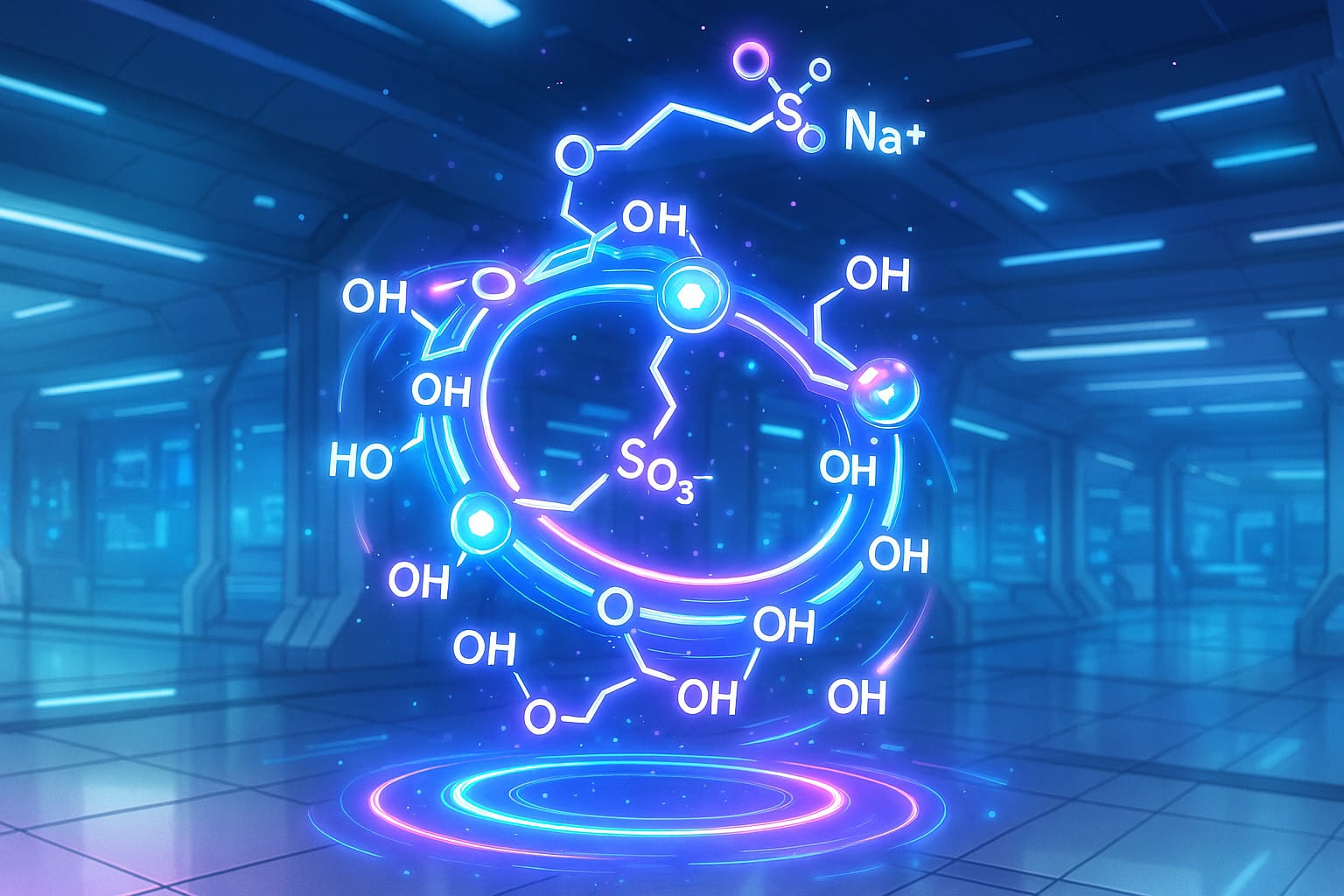
1. SBEβCD(スルホブチルエーテル-β-シクロデキストリン)
日本語: β-シクロデキストリンを水になじみやすく改良した分子です。内側の空洞へ疎水性薬物を取り込み、見かけの溶解性や製剤中での安定性を高めます。
English: A water-compatible β-cyclodextrin derivative whose cavity can host hydrophobic drug regions and improve apparent solubility and formulation performance.
2. 包接複合体(Inclusion Complex)
日本語: シクロデキストリンの空洞へ薬物分子の一部が入り、非共有結合で保持された構造です。薬物の結晶性や水との接触状態を変え、溶解を助けます。
English: A noncovalent host–guest structure in which part of a drug molecule enters the cyclodextrin cavity, supporting dissolution and amorphization.
3. BCSクラスII化合物(BCS Class II Compound)
日本語: 膜は通過しやすい一方、水に溶けにくいため、吸収量が溶解速度に左右される薬物群です。経口製剤では溶解性改善が重要な開発課題になります。
English: Compounds with good membrane permeability but poor aqueous solubility, making dissolution a major limitation for oral absorption.
4. 薬物動態モデリング(Pharmacokinetic Modeling)
日本語: 薬物の溶解、吸収、血中濃度の変化を計算モデルで予測する方法です。候補薬の課題を早く見つけ、適切な製剤戦略を選ぶために利用されます。
English: Computational prediction of drug dissolution, absorption, and plasma exposure, used to identify risks and guide formulation selection.
5. 噴霧乾燥(Spray Drying)
日本語: 薬物を含む液体を微細な霧にし、熱風で素早く乾燥して粉末化する技術です。包接複合体の製造や結晶性の低減に利用できます。
English: A process that atomizes a liquid formulation and rapidly dries it into powder, supporting scalable complex preparation and reduced crystallinity.
日本語版
研究背景
新しい薬物候補の中には、細胞膜を通過する性質は十分でも、水に溶けにくいため、消化管からの吸収が制限されるものがあります。このようなBCSクラスII化合物では、動物試験で得られる血中濃度が薬物本来の能力ではなく、製剤からどれだけ溶けたかに強く左右されます。その結果、有望な候補を過小評価したり、開発判断を誤ったりする可能性があります。
SBEβCDは、外側が水になじみやすく、内側に疎水性の空洞を持つシクロデキストリン誘導体です。薬物の疎水性部分を空洞へ部分的に取り込むことで、水中で扱いやすい状態へ変えられます。本研究では、計算による吸収予測から製剤選択、複合体の構造確認、動物での薬物動態評価までを一つの流れとして検討しました。
研究内容
Mechanistic evaluation of sulfobutylether-β-cyclodextrin complexation as a formulation strategy to enhance solubility and oral exposure of BCS Class II compounds
- 構造の異なる3種類のBCSクラスII新規化合物を対象としました。
- 生理学的吸収モデル、改良型開発分類システム、溶解性制限吸収可能量の解析を用い、経口吸収を妨げる要因が溶解性にあるかを評価しました。
- 評価結果をもとにSBEβCDを製剤戦略として選び、噴霧乾燥によって包接複合体を調製しました。
- 赤外分光法、粉末X線回折、核磁気共鳴、分子ドッキングを組み合わせ、複合体形成を多角的に確認しました。
- 薬物とSBEβCDは共有結合ではなく、ホスト・ゲスト相互作用によって結び付きました。
- 疎水性の芳香族部分がシクロデキストリン空洞へ部分的に入り、薬物の結晶性が低下して非晶質化することが示されました。
- 見かけの水溶解性は、約0.02~0.03 mg/mLから約24~27 mg/mLへ向上しました。
- 改善幅は化合物とSBEβCDの配合比によって異なりましたが、おおむね3桁規模の溶解性向上が得られました。
- マウスでの評価では、比較製剤に対して3化合物すべてで最高血中濃度と全身曝露量が増加しました。
- 計算による開発性評価とSBEβCD製剤化を組み合わせることで、難溶性に起因する吸収不足へ合理的に対応できることが示されました。
期待される応用
この研究の特徴は、難溶性薬物へ一律に添加剤を加えるのではなく、まず吸収モデルと分類法で問題の原因を確認し、その結果に基づいてSBEβCD製剤を選んだ点にあります。候補化合物の開発初期に、溶解性がボトルネックかどうかを見極められれば、不要な試行錯誤を減らし、薬物本来の体内動態を評価しやすくなります。
噴霧乾燥は粉末製剤へ展開しやすい工程であり、包接、非晶質化、溶解性向上を同時に利用できる可能性があります。今後は、化合物ごとの最適な配合比、胃腸環境での複合体の挙動、長期保存時の安定性、ヒトでの吸収との対応を確認することが重要です。SBEβCDは、難溶性候補薬を早期に適切に評価し、経口製剤開発へつなげるための有力な選択肢となり得ます。
English Version
SBEβCD as a Formulation Strategy for Poorly Soluble Oral Drug Candidates
Introduction
Some new drug candidates readily cross biological membranes but dissolve poorly in water. For these BCS Class II compounds, gastrointestinal absorption may be limited by dissolution rather than by the intrinsic permeability of the molecule. Plasma exposure in early animal studies can therefore reflect formulation performance rather than the full potential of the drug candidate, complicating development decisions.
Sulfobutylether-β-cyclodextrin has a water-compatible exterior and a relatively hydrophobic cavity. Partial inclusion of a drug’s hydrophobic region can transform the compound into a more dispersible form. The featured study connected computational absorption assessment, formulation selection, structural characterization, and in vivo pharmacokinetic evaluation within a single mechanistic workflow.
Research Highlights
Mechanistic evaluation of sulfobutylether-β-cyclodextrin complexation as a formulation strategy to enhance solubility and oral exposure of BCS Class II compounds
- Three structurally diverse BCS Class II new chemical entities were evaluated.
- Physiologically based absorption modeling, refined development classification, and solubility-limited absorbable-dose analysis were used to determine whether solubility was the principal oral-development risk.
- SBEβCD was selected as the formulation strategy, and inclusion complexes were prepared by spray drying.
- Fourier-transform infrared spectroscopy, powder X-ray diffraction, nuclear magnetic resonance, and molecular docking provided complementary structural evidence.
- The drugs interacted with SBEβCD through noncovalent host–guest complexation.
- Hydrophobic aromatic regions were partially included within the cyclodextrin cavity, while drug crystallinity was reduced through amorphization.
- Apparent aqueous solubility increased from approximately 0.02–0.03 mg/mL to approximately 24–27 mg/mL.
- The magnitude of improvement varied with the compound and cyclodextrin ratio but was approximately three orders of magnitude.
- In mice, SBEβCD formulations increased both maximum plasma concentration and systemic exposure for all three compounds compared with their respective comparator formulations.
- Combining developability assessment with cyclodextrin formulation provided a rational approach to solubility-limited absorption.
Overall Significance
Rather than applying an excipient through trial and error, this study first identified the mechanistic cause of poor exposure and then selected SBEβCD accordingly. Early recognition of dissolution-limited absorption may reduce unnecessary formulation screening and allow a more accurate assessment of a drug candidate’s pharmacokinetic potential.
Spray drying is compatible with powder production and can combine inclusion complexation, amorphization, and solubility enhancement. Further development should establish compound-specific drug-to-cyclodextrin ratios, behavior under gastrointestinal conditions, long-term storage stability, and translation from animal exposure to human absorption. SBEβCD may therefore provide a practical platform for advancing poorly soluble candidates toward oral dosage-form development.
References / 文献
- Jain, A. K.; Zala, Y. R.; Jain, R. Mechanistic evaluation of sulfobutylether-β-cyclodextrin complexation as a formulation strategy to enhance solubility and oral exposure of BCS Class II compounds. International Journal of Pharmaceutics 703 (2026), 127352. DOI: 10.1016/j.ijpharm.2026.127352