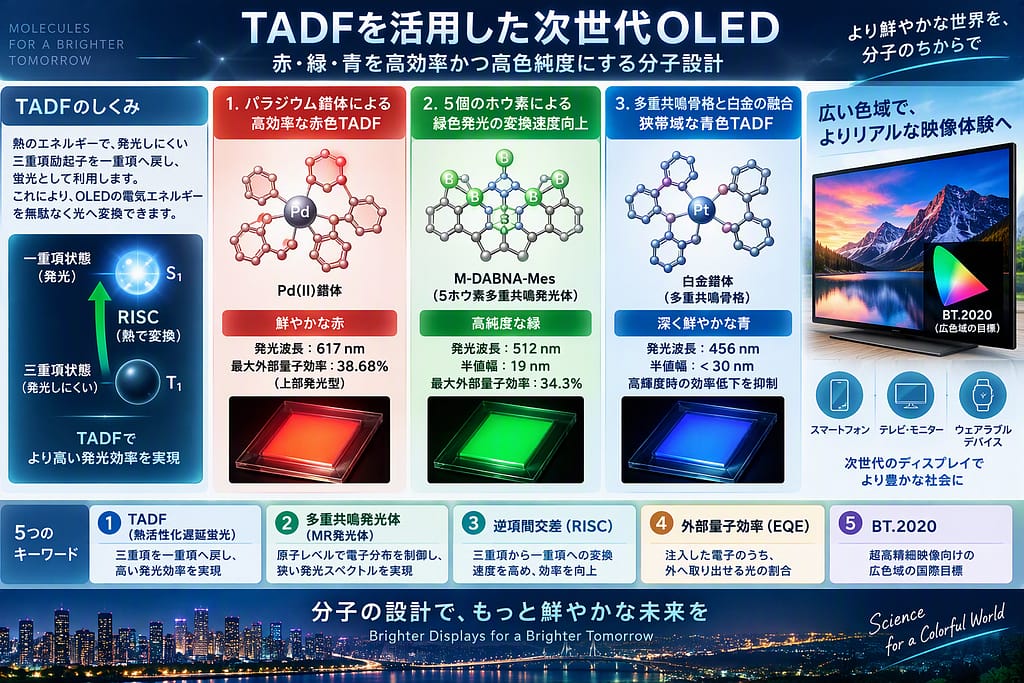
キーワード / Keywords
1. TADF(熱活性化遅延蛍光) / Thermally Activated Delayed Fluorescence
日本語: 熱の力で発光しにくい三重項励起子を一重項へ戻し、蛍光として利用する仕組みです。OLEDの電気エネルギーを無駄なく光へ変える技術として注目されています。
English: A mechanism that uses thermal energy to convert non-emissive triplet excitons into emissive singlet states, improving OLED energy utilization.
2. 多重共鳴発光体(MR発光体) / Multiple-Resonance Emitter
日本語: 分子内の電子分布を原子レベルで整え、発光スペクトルを狭くする材料です。色のにじみを抑え、鮮やかな緑色や青色を表示するために役立ちます。
English: An emitter with atomically controlled electronic distribution that produces narrowband light for high-color-purity OLED displays.
3. 逆項間交差(RISC) / Reverse Intersystem Crossing
日本語: 三重項状態から一重項状態へ励起子を変換する過程です。この速度を高めると、発光までの時間が短くなり、高輝度時の損失も抑えやすくなります。
English: The conversion of triplet excitons into singlet excitons, enabling delayed fluorescence and more efficient use of electrically generated energy.
4. 外部量子効率(EQE) / External Quantum Efficiency
日本語: OLEDへ入れた電子のうち、外部へ取り出せる光になった割合を示す指標です。発光材料だけでなく、電荷輸送や光の取り出し方にも影響されます。
English: The percentage of injected electrical charges converted into photons emitted outside the OLED, reflecting both material and device performance.
5. BT.2020
日本語: 超高精細映像向けに定められた広色域の国際的な目標です。赤・緑・青の各色を純度高く発光させるほど、自然で鮮やかな映像表現に近づきます。
English: A wide-color-gamut target for ultra-high-definition video that requires highly saturated red, green, and blue primary colors.
日本語版
導入
OLEDでは、電気によって一重項と三重項という二種類の励起状態が生じます。通常の蛍光材料が直接利用しやすいのは一重項だけですが、TADF材料は三重項を一重項へ戻すことで、これまで失われやすかったエネルギーも発光へ活用できます。
次の課題は、効率だけでなく色の純度、発光速度、高輝度時の安定性を同時に高めることです。ここでは、赤色のパラジウム錯体、5個のホウ素を含む緑色多重共鳴材料、多重共鳴骨格と白金錯体を融合した青色材料を紹介します。三つの研究は、赤・緑・青それぞれの発光に対して、励起状態の作り方と変換速度を分子構造から制御しています。
研究内容
1. パラジウム錯体で高効率な赤色TADFを実現
Pd(II)-TADF Complexes With Metal-Perturbed Intraligand Charge Transfer State: Emitters and Sensitizers for High-Efficiency Red OLEDs
- パラジウムと、ジベンゾフェナジンを含む配位子から複数の錯体を設計しました。
- 分子のねじれ角を変え、一重項と三重項のエネルギー差を0.05~0.26 eVの範囲で調整しました。
- Pd3は赤色TADFを示し、発光量子収率82%、発光寿命1.13 µsを記録しました。
- 下部発光型OLEDでは617 nmの赤色発光と、最大外部量子効率30.15%を達成しました。
- 1000 cd/m²での効率低下は2.32%に抑えられました。
- 上部発光型のITOフリーOLEDでは、赤色の色度成分が0.68を超え、最大外部量子効率38.68%を示しました。
- 多重共鳴発光体へエネルギーを渡す増感材料としても働き、ハイパーフルオレッセンスOLEDで最大外部量子効率27.06%を達成しました。
2. 5個のホウ素で緑色発光の変換速度を向上
Five-Boron Multiple-Resonance TADF Emitter With Accelerated Reverse Intersystem Crossing for High-Performance Narrowband Green OLEDs
- 5個のホウ素を含む、奇数ホウ素型の多重共鳴TADF発光体M-DABNA-Mesを開発しました。
- 1個、3個、5個のホウ素を持つ骨格を理論的に比較し、5個目のホウ素が励起状態へ与える効果を調べました。
- 5個目のホウ素により、一重項と三重項のエネルギー差と分子構造変化に必要なエネルギーが小さくなりました。
- ポリスチレン膜中で、遅延蛍光寿命0.93 µs、逆項間交差速度2.6 × 10⁶ s⁻¹を示しました。
- 発光は512 nmの緑色で、半値幅は19 nmという狭いスペクトルでした。
- OLEDの最大外部量子効率は34.3%、最大輝度は275,800 cd/m²でした。
- 10,000 cd/m²でも高い性能を維持し、高速なスピン変換と色純度を両立する新しい骨格を示しました。
3. 多重共鳴骨格と白金を融合した狭帯域青色TADF
Fusing Multi-Resonance Framework with Platinum(II) Complex via Cyclometalation for Narrowband Blue TADF
- ホウ素と窒素を含むDBANA由来の多重共鳴骨格を、白金錯体へ組み込みました。
- N-ヘテロ環カルベンと組み合わせ、二座配位型の発光性配位子を形成しました。
- 白金を導入しても、最低一重項・三重項の性質は多重共鳴骨格が主に担いました。
- 約460 nmにピークを持つ青色発光を示し、発光スペクトルの半値幅は30 nm未満でした。
- 白金の効果により、遅延蛍光寿命は5.0~11.4 µsへ短縮しました。
- 選択した錯体を使ったOLEDは456 nmの純青色発光を示し、CIEyは0.15~0.17でした。
- 純有機の多重共鳴材料と比べ、高輝度時の効率低下が抑えられました。
研究全体の意義
三つの研究は、TADFの性能が単に一重項と三重項のエネルギー差だけで決まるのではなく、分子のねじれ、ホウ素原子の数、金属と配位子の結び方によって総合的に調整できることを示しています。赤色ではパラジウム錯体が発光体と増感材料の二つの役割を担い、緑色では5個のホウ素が高速な逆項間交差と狭帯域発光を実現しました。青色では多重共鳴骨格の色純度を保ちながら、白金の効果で遅延発光を速めています。
これらの成果は、赤・緑・青の各画素を高効率かつ鮮やかに発光させる次世代ディスプレイの材料設計につながります。今後は、長時間駆動時の寿命、製造工程での材料安定性、大面積素子での均一性、金属使用量と性能のバランスを検証することが重要です。
English Version
TADF for Next-Generation OLEDs: Molecular Designs for Efficient, Color-Pure Red, Green, and Blue Emission
Introduction
Electrical excitation in an OLED generates singlet and triplet excitons. Conventional fluorescent materials directly use mainly singlets, whereas TADF materials recover triplet energy through reverse intersystem crossing and convert it into delayed fluorescence.
The next challenge is to combine efficiency with spectral purity, rapid exciton conversion, and stable performance at high brightness. The studies highlighted here address red palladium complexes, a five-boron green multiple-resonance emitter, and a blue platinum complex incorporating a multiple-resonance framework.
Research Highlights
1. Palladium Complexes for Efficient Red TADF
- Several palladium complexes were designed using dibenzophenazine-substituted ligands.
- Molecular torsion was varied to tune the singlet-triplet energy gap from 0.05 to 0.26 eV.
- Pd3 exhibited red TADF with an 82% photoluminescence quantum yield and a 1.13 µs lifetime.
- A bottom-emitting OLED produced red light at 617 nm with a maximum external quantum efficiency of 30.15%.
- Efficiency roll-off was limited to 2.32% at 1000 cd/m².
- An ITO-free top-emitting OLED achieved a red CIE coordinate above 0.68 and a maximum external quantum efficiency of 38.68%.
- Pd3 also acted as a sensitizer for a red multiple-resonance emitter, producing a hyperfluorescence OLED with 27.06% maximum external quantum efficiency.
2. Five Boron Atoms Accelerate Green TADF
- M-DABNA-Mes was developed as the first five-boron multiple-resonance TADF emitter.
- Theoretical comparisons of one-, three-, and five-boron frameworks clarified the effect of the fifth boron atom.
- The fifth boron reduced the singlet-triplet gap and total reorganization energy while preserving narrowband emission.
- In a polystyrene film, the emitter showed a 0.93 µs delayed-fluorescence lifetime and a reverse-intersystem-crossing rate of 2.6 × 10⁶ s⁻¹.
- It emitted green light at 512 nm with a narrow 19 nm full width at half maximum.
- The OLED reached a maximum external quantum efficiency of 34.3% and a maximum luminance of 275,800 cd/m².
- The results establish an odd-numbered, boron-rich framework for rapid spin conversion and spectrally pure emission.
3. Combining a Multiple-Resonance Framework with Platinum for Narrowband Blue TADF
- A DBANA-derived boron-nitrogen multiple-resonance framework was incorporated into platinum complexes.
- N-heterocyclic carbene units formed bidentate chromophoric ligands through cyclometalation.
- The multiple-resonance core continued to dominate the lowest singlet and triplet excited states after platinum incorporation.
- The complexes emitted blue light near 460 nm with bandwidths below 30 nm.
- The platinum effect shortened delayed-fluorescence lifetimes to 5.0–11.4 µs.
- Selected OLEDs showed pure-blue electroluminescence at 456 nm with CIEy values of 0.15–0.17.
- Efficiency roll-off was reduced relative to the corresponding purely organic multiple-resonance analogue.
Overall Significance
These studies demonstrate that TADF performance can be controlled through molecular torsion, the number of boron atoms, and coordination between metals and ligands. In red devices, palladium complexes serve as both emitters and sensitizers. In green emission, a five-boron framework combines rapid reverse intersystem crossing with a narrow spectrum. In blue emission, platinum accelerates delayed fluorescence while maintaining the color-pure character of a multiple-resonance core.
Together, the findings provide molecular-design routes toward efficient and saturated red, green, and blue pixels for future displays. Further development should evaluate operational lifetime, material stability during fabrication, uniformity in large-area devices, and the balance between metal content and device performance.
References / 文献
- Jiang, L.; Xia, X.; Zhang, Y.; et al. Pd(II)-TADF Complexes With Metal-Perturbed Intraligand Charge Transfer State: Emitters and Sensitizers for High-Efficiency Red OLEDs. Advanced Materials (2026), Early Access. DOI: 10.1002/adma.74823
- Lee, T.; Ochi, J.; Zhang, Z.; Kondo, Y.; Kondo, M.; Hatakeyama, T. Five-Boron Multiple-Resonance TADF Emitter With Accelerated Reverse Intersystem Crossing for High-Performance Narrowband Green OLEDs. Angewandte Chemie International Edition (2026), Early Access. DOI: 10.1002/anie.3413163
- Liu, H.-C.; Zhang, Y.; Xian, S.; et al. Fusing Multi-Resonance Framework with Platinum(II) Complex via Cyclometalation for Narrowband Blue TADF. Angewandte Chemie International Edition (2026), Early Access. DOI: 10.1002/anie.6004957