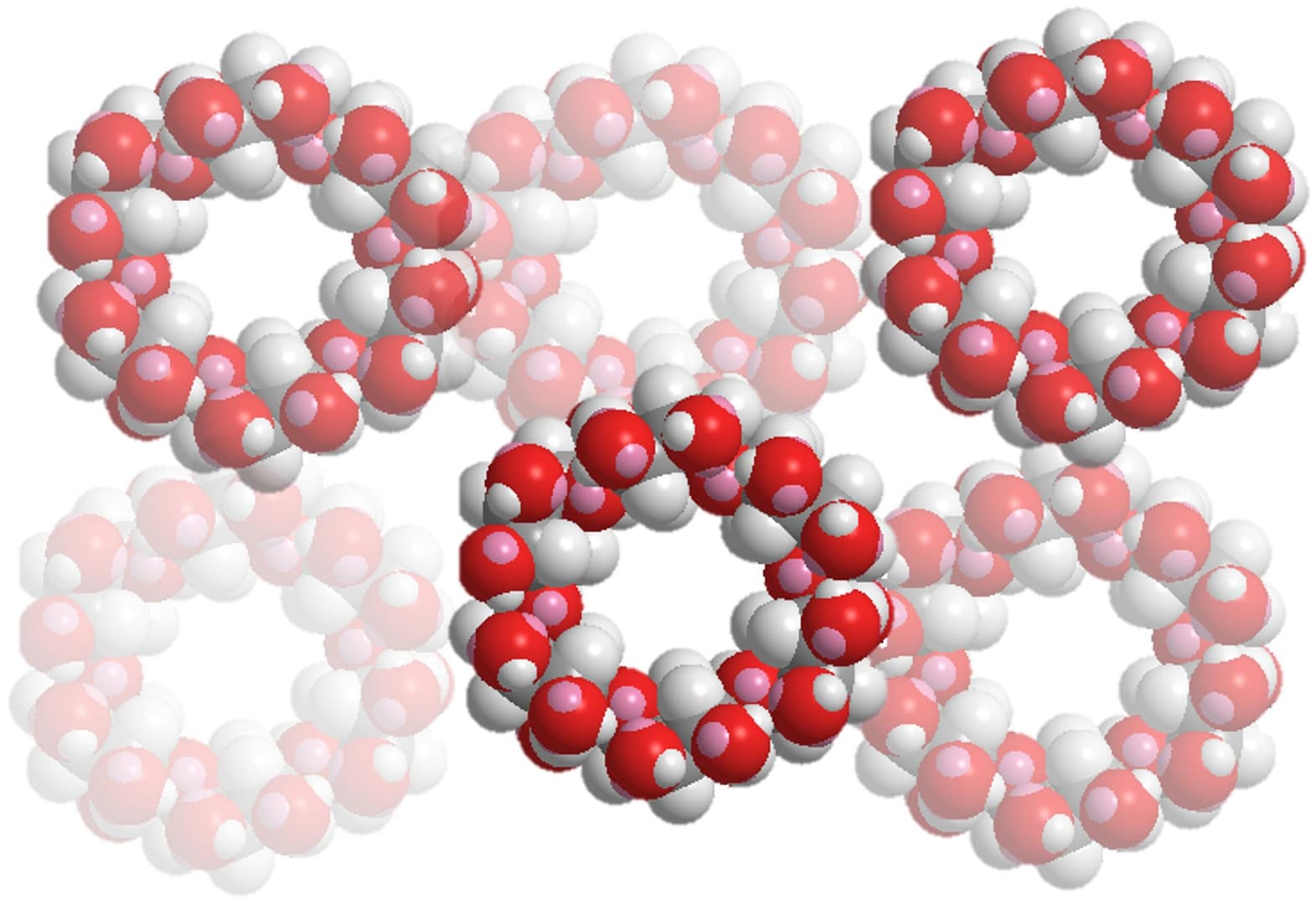
α-Cyclodextrin Polymer: Movable Ring Molecules for Dynamic Polymeric Materials
キーワード / Keywords
-
α-シクロデキストリンポリマー / α-Cyclodextrin Polymer
α-シクロデキストリンを含む高分子材料です。分子を包む空洞や輪の動きを利用し、ゲル、ポリロタキサン、分子認識材料へ展開できます。
EN: A polymer material containing α-cyclodextrin. Its molecular cavity and ring mobility can be used in gels, polyrotaxanes, and molecular-recognition materials. -
ポリロタキサン / Polyrotaxane
ひも状高分子に多数の環状分子が通った構造です。環が動けるため、力を受けたときに応力を分散し、柔らかく丈夫な材料をつくれます。
EN: A structure in which many ring molecules are threaded onto a linear polymer chain. Movable rings can distribute stress and create soft yet tough materials. -
粗視化シミュレーション / Coarse-Grained Simulation
分子を細かくすべて描かず、必要な単位にまとめて計算する方法です。ゲルが流れる、固まる、弱くなる過程を分子レベルで理解できます。
EN: A simulation method that groups atoms into simplified units, allowing researchers to understand gel flow, solidification, and weakening at the molecular level. -
超カオトロピックアニオン / Superchaotropic Anion
水中で特殊な疎水性相互作用を示し、シクロデキストリンの空洞に強く入り込むイオンです。分子輸送や膜透過の新しい設計につながります。
EN: An anion that strongly enters cyclodextrin cavities through unusual water-mediated interactions, offering new ideas for molecular transport and membrane delivery. -
ホスト–ゲスト相互作用 / Host–Guest Interaction
シクロデキストリンの空洞に別の分子やイオンが入る現象です。薬物送達、ゲル形成、分子分離、膜輸送など多くの機能の出発点になります。
EN: A process in which another molecule or ion enters the cyclodextrin cavity. It underlies functions such as drug delivery, gel formation, separation, and membrane transport.
採用した論文 / Selected Papers
-
Macromolecules(JIF 5.7)
Coarse-Grained Simulations of Polyrotaxane Hydrogels under Quiescent and Shear Conditions
DOI: 10.1021/acs.macromol.6c00624 -
Chemistry – A European Journal(JIF 3.6)
Carba-closo-dodecaborates as Superchaotropic Anions
DOI: 10.1002/chem.71450
日本語版
1. ポリロタキサンゲルを3Dプリントするとき、分子の中で何が起きるのか
論文: Coarse-Grained Simulations of Polyrotaxane Hydrogels under Quiescent and Shear Conditions
掲載誌: Macromolecules
DOI: 10.1021/acs.macromol.6c00624
- この研究は、シクロデキストリンを含むポリロタキサンゲルが、静かな状態と流れを受けた状態でどのように構造変化するかを計算で調べたものです。
- ポリロタキサンは、ひも状の高分子に環状分子が通った“分子ネックレス”のような構造を持ちます。
- 水中では、シクロデキストリン同士が集まり、結晶のような領域を作ることでゲルになります。
- 3Dプリントでは、材料がノズルを通るときに強いせん断流を受けます。この力で結晶領域のつながりが壊れ、材料が流れやすくなります。
- しかし、流れが止まったあとも結晶の向きがそろいすぎたり、再び橋渡しできる分子が少なかったりするため、印刷後のゲルは元のゲルより弱くなることが示されました。
- 研究では、濃度や高分子鎖の長さを変えたときの結晶形も再現され、材料設計に使える分子レベルの理解が得られています。
- 一般向けに言えば、「よく流れて印刷できるゲル」と「印刷後に強いゲル」を両立するため、分子の並び方をシミュレーションで見える化した研究です。
2. シクロデキストリン空洞に強く入る“超カオトロピック”ホウ素クラスター
論文: Carba-closo-dodecaborates as Superchaotropic Anions
掲載誌: Chemistry – A European Journal
DOI: 10.1002/chem.71450
- この研究は、1-carba-closo-dodecaborateアニオンとその誘導体が、α-、β-、γ-シクロデキストリンとどのように結合するかを調べたものです。
- これらのホウ素クラスターアニオンは、電荷が広く分散した立体的なイオンで、シクロデキストリンの疎水性空洞に強く入り込みます。
- 特に、小さなα-シクロデキストリンやβ-シクロデキストリンとの結合が強く、結合定数はおよそ10⁵ M⁻¹の大きさでした。
- この強い包接は、単純な油になじみやすい性質だけでなく、水の構造やイオンの電荷密度が関わる“カオトロピック効果”で説明されています。
- 親化合物CB11H12⁻は、対応する二価アニオンよりもはるかに強く結合し、これまで知られている中で最小級の超カオトロピックイオンとして位置づけられました。
- さらに、脂質膜を越えて親水性ペプチドを運ぶ膜キャリアとしての働きも確認されました。
- 一般向けに言えば、「シクロデキストリンの小さな穴に非常に入りやすい特殊なイオンを使い、分子を膜の向こうへ運ぶ可能性を示した」研究です。
まとめ
今回の2本は、α-シクロデキストリンポリマーというテーマを、2つの方向から見せています。1本目は、ポリロタキサンゲルという“動く環”を持つ高分子材料が、3Dプリント中にどう変形し、なぜ印刷後に弱くなることがあるのかを分子レベルで説明しています。2本目は、α-シクロデキストリンの小さな空洞が、特殊なイオンを強く捕まえ、膜輸送の設計にもつながることを示しています。どちらも、シクロデキストリンの空洞と環状構造を使って、材料や分子のふるまいを制御する研究です。
English Version
1. What happens inside polyrotaxane hydrogels during 3D printing?
Paper: Coarse-Grained Simulations of Polyrotaxane Hydrogels under Quiescent and Shear Conditions
Journal: Macromolecules
DOI: 10.1021/acs.macromol.6c00624
- This study uses coarse-grained simulations to examine how cyclodextrin-based polyrotaxane hydrogels assemble and deform under quiet and shear conditions.
- Polyrotaxanes resemble molecular necklaces, with many ring-shaped molecules threaded onto polymer chains.
- In water, cyclodextrin aggregation and crystallization create network structures that form hydrogels.
- During extrusion-based 3D printing, shear flow breaks connections between crystalline domains, allowing the material to flow through a nozzle.
- After flow stops, aligned crystalline domains and limited available bridging chains reduce intercrystal connectivity, making printed gels mechanically weaker than pristine gels.
- The simulations reproduce experimentally observed crystal morphologies across different concentrations and chain lengths.
- In simple terms, this work helps explain how to balance printability and mechanical strength in polyrotaxane hydrogel materials.
2. Superchaotropic boron-cluster anions that strongly enter cyclodextrin cavities
Paper: Carba-closo-dodecaborates as Superchaotropic Anions
Journal: Chemistry – A European Journal
DOI: 10.1002/chem.71450
- This study investigates how 1-carba-closo-dodecaborate anions and their derivatives bind to α-, β-, and γ-cyclodextrins.
- These boron-cluster anions have widely distributed charge and can bind strongly inside hydrophobic cyclodextrin cavities.
- Binding is especially strong with the smaller α-CD and β-CD hosts, with association constants around 10⁵ M⁻¹.
- The binding behavior is explained mainly by the chaotropic effect, which involves water structure and charge distribution rather than only ordinary hydrophobicity.
- The parent CB11H12⁻ anion binds much more strongly than the corresponding divalent isosteric anion, supporting its classification as a very small superchaotropic ion.
- The study also tested these ions as membrane carriers and found activity in transporting hydrophilic peptides through lipid bilayers and live cells.
- For general readers, this work shows how a special ion can fit strongly into cyclodextrin cavities and may help move difficult molecules across membranes.
Overall Takeaway
The two available papers show α-cyclodextrin polymer-related science from complementary angles. The first focuses on movable-ring polymer gels and explains how printing conditions reshape their internal structure. The second focuses on strong host–guest binding between cyclodextrin cavities and superchaotropic ions, pointing toward molecular transport across membranes. Together, they show how cyclodextrin rings can control both material mechanics and molecular recognition.
文献 / References
- Smith, C. D.; Zhang, W. Coarse-Grained Simulations of Polyrotaxane Hydrogels under Quiescent and Shear Conditions. Macromolecules (2026). DOI: 10.1021/acs.macromol.6c00624.
- Barba-Bon, A.; Quintero, G. E.; Ashjari, M.; Niksic-Franjic, I.; Tsung, K.; Wang, X.; Aliaga, M. E.; Grüner, B.; Nau, W. M. Carba-closo-dodecaborates as Superchaotropic Anions. Chemistry – A European Journal (2026). DOI: 10.1002/chem.71450.
選定メモ / Selection Note
- Macromolecules:JIF 5.7(2025データ、2026更新値)
- Chemistry – A European Journal:JIF 3.6(2025データ、2026更新値)
添付ファイル内で確認できた関連論文は2本のみでした。そのため、外部文献を追加せず、「添付ファイル内限定」という条件を優先して2本構成としました。