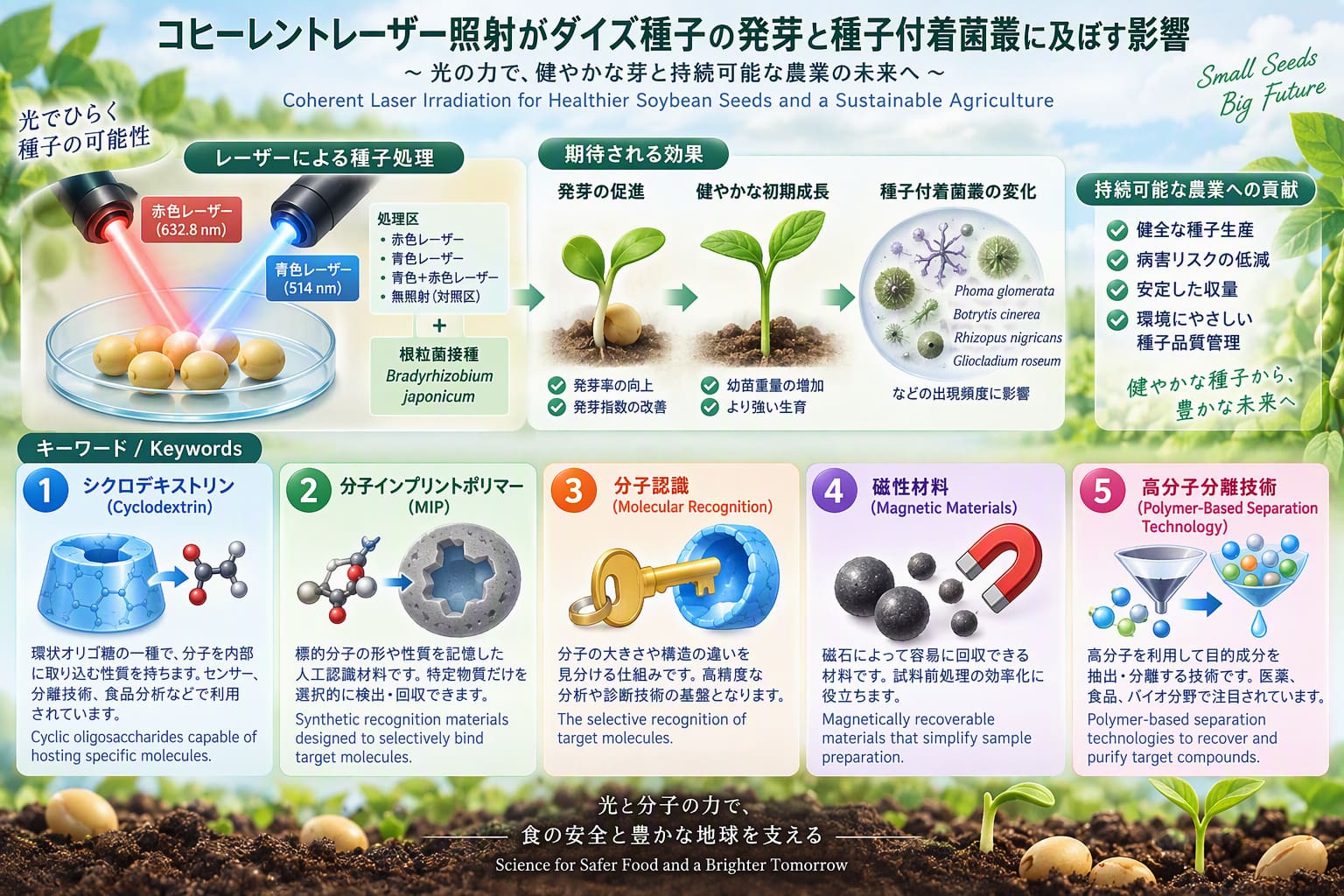
キーワード
1. コヒーレントレーザー照射(Coherent Laser Irradiation)
日本語: 位相が揃ったレーザー光を利用して種子を処理する技術。本研究では赤色レーザー(632.8 nm)と青色レーザー(514 nm)を用いてダイズ種子へ短時間照射を行った。
English: A seed treatment approach using coherent laser light. Red and blue lasers were applied to soybean seeds before germination.
2. 種子活力(Seed Vigor)
日本語: 発芽率や初期成長の指標。本研究では発芽指数と幼苗重量を測定し、レーザー照射の効果を評価した。
English: An indicator of seed performance measured through germination and early seedling growth.
3. ダイズ種子(Soybean Seeds)
日本語: 世界的に重要な作物であり、発芽と病害管理は安定生産に直結する。
English: An economically important crop whose seed quality strongly influences agricultural productivity.
4. 種子付着菌叢(Seed Mycoflora)
日本語: 種子表面や内部に存在する菌類群集で、発芽率や病害発生に影響を与える。
English: Fungal communities associated with seeds that can influence germination and disease development.
5. Bradyrhizobium japonicum
日本語: ダイズと共生して窒素固定を行う根粒菌。本研究ではレーザー処理との併用効果も検討された。
English: A beneficial rhizobial bacterium used as an inoculant to support soybean growth.
研究紹介
研究の背景
レーザーは工業や医療だけでなく、農業においても種子の活力向上技術として注目されています。過去の研究では、適切なレーザー照射によって発芽促進や初期生育の改善が報告されてきました。一方で、種子表面に存在する菌類への影響や、共生微生物との相互作用については十分に理解されていませんでした。
ダイズは重要な油糧・タンパク源作物ですが、種子に付着する病原菌によって発芽率が低下することがあります。本研究では、レーザー照射が発芽と種子付着菌叢の両方に与える影響を評価しました。
研究方法
研究チームはダイズ品種 Augusta を用い、以下の処理を比較しました。
- 赤色レーザー(632.8 nm, He-Ne laser)
- 青色レーザー(514 nm, Argon laser)
- 青色+赤色レーザー
- 無照射対照区
さらに、Bradyrhizobium japonicum ワクチンの有無を組み合わせて評価しました。
評価項目は
- 発芽指数
- 幼苗重量
- 種子上の菌類群集
でした。
主な結果
発芽促進効果
レーザー処理した種子では発芽率と幼苗重量の向上が認められました。特に赤色レーザーとワクチンを組み合わせた処理で高い発芽率が得られました。
幼苗の成長促進
青色レーザーをワクチン処理区に適用した条件では、最も大きな幼苗バイオマスが得られました。
種子付着菌叢への影響
解析の結果、病原性・非病原性を含む複数の菌類が検出されました。
レーザー照射は菌類群集構成を変化させ、
- Phoma glomerata
- Botrytis cinerea
- Rhizopus nigricans
- Gliocladium roseum
などの出現頻度に影響を与えました。
特に青色レーザーは非病原性菌である Rhizopus nigricans と Gliocladium roseum の発生頻度を低下させました。
研究の意義
本研究は、コヒーレントレーザー照射がダイズ種子の発芽促進だけでなく、種子付着菌叢にも影響を与えることを示しました。レーザーと Bradyrhizobium japonicum の併用は、持続的農業に向けた新しい種子品質管理技術として利用できる可能性があります。
Impact of Coherent Laser Irradiation on Germination and Mycoflora of Soybean Seeds
Introduction
Laser technology has recently gained renewed attention as a pre-sowing seed treatment method. This study investigated whether coherent red and blue laser irradiation can improve soybean seed performance and influence fungal communities associated with seeds.
Experimental Approach
Soybean seeds were treated with red laser light, blue laser light, a combination of both, or left untreated. In parallel, treatments involving Bradyrhizobium japonicum inoculation were compared.
Germination performance, seedling biomass, and fungal communities were evaluated.
Main Findings
- Laser treatment improved germination and seedling growth.
- Red laser treatment combined with bacterial inoculation produced the highest germination rates.
- Blue laser treatment produced the greatest seedling biomass in inoculated material.
- Laser irradiation altered fungal community composition on soybean seeds.
- Several fungal species were affected, including Phoma glomerata, Botrytis cinerea, Rhizopus nigricans, and Gliocladium roseum.
Significance
The study demonstrates that coherent laser irradiation can modify both seed physiology and associated microbial communities. These findings suggest that laser-based seed treatment may become a useful tool in sustainable seed quality management.
文献情報
Title: Impact of Coherent Laser Irradiation on Germination and Mycoflora of Soybean Seeds—Innovative and Prospective Seed Quality Management
Authors: Agnieszka Klimek-Kopyra, Joanna Dłużniewska, Anna Ślizowska, Jan Wincenty Dobrowolski
Journal: Agriculture
Year: 2020
Volume: 10
Article: 314
DOI: https://doi.org/10.3390/agriculture10080314