キーワード / Keywords
1. β-シクロデキストリン(β-Cyclodextrin)
日本語: ブドウ糖が環状につながった分子で、中央に小さな空洞を持ちます。ゲスト分子を取り込み、凝集を抑えたり、光反応の起こり方を整えたりできます。
English: A cyclic glucose molecule with a nanoscale cavity that can host guest molecules, suppress aggregation, and regulate photochemical behavior.
2. ビオロゲン(Viologen)
日本語: 光や電子の移動によって色が変化しやすい有機分子群です。酸化還元やラジカル生成を利用し、表示材料、センサー、情報記録へ応用されています。
English: A class of organic molecules that readily changes color through electron transfer and radical formation, enabling sensing and information-storage applications.
3. フォトクロミズム(Photochromism)
日本語: 光を受けることで物質の色が可逆的に変わる現象です。照射量や波長に応じた色変化を利用し、光履歴の可視化や書き換え可能な表示に役立ちます。
English: A reversible light-induced color change that can visualize irradiation history and support rewritable optical displays.
4. 蛍光消光(Fluorescence Quenching)
日本語: 発光していた蛍光が、光反応や分子間相互作用によって弱くなる現象です。色変化と組み合わせると、二つの信号を持つ光センサーを設計できます。
English: A decrease in fluorescence caused by photochemical or molecular interactions, useful as a second signal in optical sensing.
5. 情報暗号化(Information Encryption)
日本語: 特定の光を当てた場合だけ文字や模様を表示し、情報を読み取れるようにする技術です。色と蛍光の変化を組み合わせることで多段階化できます。
English: A technique that reveals patterns or messages only under selected light conditions, with color and fluorescence enabling multilevel security.
日本語版
研究背景
光によって色や発光を切り替えられる材料は、紫外線量の確認、偽造防止、情報記録などへの応用が期待されています。しかし、光応答分子は固体中で集まりすぎると発光が弱くなったり、反応が不均一になったりすることがあります。鮮明な色変化と強い蛍光を一つの材料で両立し、しかも繰り返し利用できるようにするには、分子同士の距離と電子移動を適切に制御する必要があります。
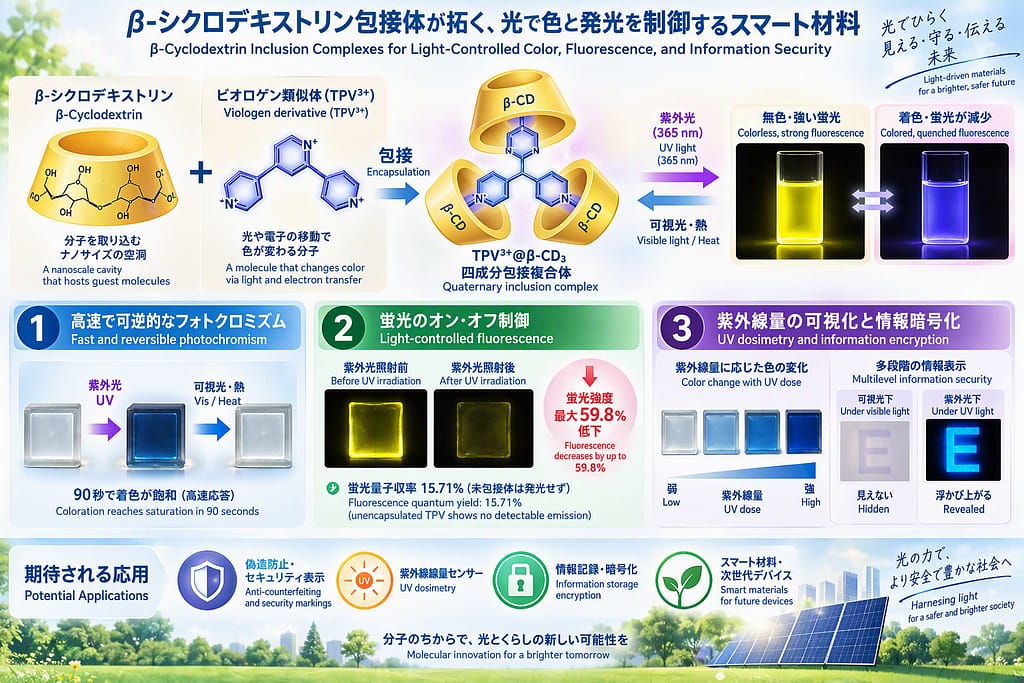
本研究では、三つのピリジニウム部位を持つビオロゲン類似体を、三分子のβ-シクロデキストリンで包み込んだ四成分包接複合体を構築しました。β-シクロデキストリンの空洞を使ってゲスト分子の凝集を抑え、光照射による色変化と蛍光変化を同時に引き出しています。
研究内容
A Quaternary β-Cyclodextrin-Viologen Inclusion Complex with Fast Photochromism and Strong Fluorescence for UV Dosimetry and Information Encryption
- 三つのピリジニウム基を持つビオロゲン類似体TPVを、三分子のβ-シクロデキストリンへ包接しました。
- 核磁気共鳴、蛍光滴定、質量分析によって、TPV³⁺@β-CD₃複合体の形成を確認しました。
- 比較対象として、別のビオロゲンと二分子のβ-シクロデキストリンからなる三成分複合体も調製しました。
- 固体状態のTPV³⁺@β-CD₃は、光照射により高コントラストで可逆的に着色しました。
- 着色が飽和するまでの時間は90秒で、速い光応答を示しました。
- 365 nmの紫外線下で強い黄色蛍光を示し、蛍光量子収率は15.71%でした。
- 包接されていないTPVでは検出可能な発光が見られず、β-シクロデキストリンによる空間的な閉じ込めが凝集消光を抑えたと考えられました。
- 電子スピン共鳴測定と理論計算から、β-シクロデキストリンからピリジニウム部位への光誘起電子移動によりラジカルが生じ、色変化が起こることが示されました。
- 着色状態へ達すると蛍光強度は最大59.8%低下し、色と蛍光の二つの信号を動的に切り替えられました。
- 紫外線照射量を色で読み取るセンサー、複数の偽造防止表示、多段階の情報暗号化へ応用されました。
研究の意義と期待される応用
この研究は、β-シクロデキストリンの空洞が、光応答分子を単に保持するだけでなく、分子の凝集と電子移動を調整する機能空間として働くことを示しています。ゲスト分子が自由に集まる状態では失われる蛍光を回復させながら、ラジカル生成によるフォトクロミズムも維持できるため、一つの材料から「色」と「蛍光」という異なる情報を取り出せます。
こうした二重応答は、紫外線をどの程度受けたかを目視で確認する線量表示、特定条件でのみ現れる認証模様、段階的に読み解く情報記録などにつながります。今後は、屋外光や温度・湿度の変化に対する長期安定性、繰り返し着色した際の耐久性、フィルムやインクへの加工性、照射量と信号変化の定量関係をさらに検証することが重要です。
English Version
β-Cyclodextrin Inclusion Complexes for Light-Controlled Color, Fluorescence, and Information Security
Introduction
Materials that switch color or fluorescence under light are attractive for ultraviolet-dose indication, anti-counterfeiting, and optical information storage. A persistent challenge is that photoresponsive molecules may aggregate in the solid state, weakening fluorescence and creating nonuniform behavior. Combining strong emission, rapid reversible coloration, and repeatable operation therefore requires careful control of molecular spacing and electron transfer.
The featured study constructed a quaternary inclusion complex in which a viologen analogue bearing three pyridinium groups was encapsulated by three β-cyclodextrin hosts. The cyclodextrin cavities suppressed guest aggregation and enabled color and fluorescence responses within a single solid material.
Research Highlights
A Quaternary β-Cyclodextrin-Viologen Inclusion Complex with Fast Photochromism and Strong Fluorescence for UV Dosimetry and Information Encryption
- A viologen analogue containing three pyridinium groups, TPV, was encapsulated by three β-cyclodextrin molecules.
- Nuclear magnetic resonance, fluorescence titration, and mass spectrometry confirmed formation of the TPV³⁺@β-CD₃ complex.
- A second ternary complex containing another viologen guest and two β-cyclodextrin hosts was prepared for comparison.
- Solid TPV³⁺@β-CD₃ displayed reversible, high-contrast photochromism under irradiation.
- Coloration reached saturation in only 90 seconds, indicating a fast optical response.
- Under 365 nm ultraviolet light, the complex emitted strong yellow fluorescence with a quantum yield of 15.71%.
- The unencapsulated TPV guest showed no detectable emission, supporting the role of cyclodextrin confinement in suppressing aggregation-caused quenching.
- Electron-spin-resonance measurements and density-functional calculations indicated that photoinduced electron transfer from β-cyclodextrin to pyridinium units generated radicals responsible for coloration.
- On reaching the colored state, fluorescence intensity decreased by as much as 59.8%, providing dynamically coupled color and emission signals.
- The material was demonstrated for colorimetric ultraviolet dosimetry, multiple anti-counterfeiting patterns, and multilevel information encryption.
Overall Significance
The study shows that the β-cyclodextrin cavity can function as more than a molecular container. It regulates aggregation and electron transfer, restoring fluorescence that is absent in the free guest while preserving radical-based photochromism. A single material can therefore provide two readable outputs: visible color and fluorescence intensity.
This dual response may support visual ultraviolet-dose indicators, authentication patterns revealed only under selected conditions, and information systems decoded in multiple steps. Further development should evaluate long-term stability under outdoor light, temperature, and humidity, fatigue during repeated switching, processability into films or inks, and quantitative relationships between irradiation dose and optical signal.
References / 文献
- Deng, A.-Q.; Fang, Y.; Chen, T.; Lin, R.-L.; Liu, J.-X. A Quaternary β-Cyclodextrin-Viologen Inclusion Complex with Fast Photochromism and Strong Fluorescence for UV Dosimetry and Information Encryption. ACS Applied Materials & Interfaces (2026), Early Access. DOI: 10.1021/acsami.6c13816