キーワード / Keywords
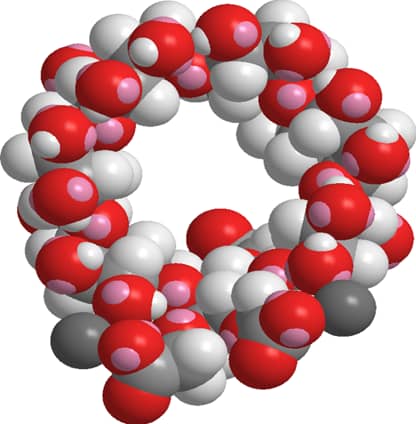
1. CMβCD(カルボキシメチル-β-シクロデキストリン)
日本語: β-シクロデキストリンへカルボキシメチル基を導入した水になじみやすい分子です。薬剤やペプチドを包み、安定性や体内での利用性を高める用途が研究されています。
English: A water-compatible β-cyclodextrin derivative that can encapsulate drugs or peptides and improve their stability and biological availability.
2. 包接複合体(Inclusion Complex)
日本語: シクロデキストリンの空洞へ別の分子が入り込んだ状態です。水に溶けにくい成分を保護し、放出性や分子間の結び付き方を調整できます。
English: A host–guest structure in which a molecule enters the cyclodextrin cavity, enabling protection and control of solubility or release.
3. 超分子集合体(Supramolecular Assembly)
日本語: 共有結合ではない比較的弱い相互作用によって、複数の分子が秩序立って集まった構造です。組成や比率により、単純な1対1を超える集合体も形成されます。
English: An ordered structure formed through noncovalent interactions, sometimes producing higher-order organizations beyond simple one-to-one complexes.
4. 標的送達(Targeted Delivery)
日本語: 有効成分を特定の細胞や組織へ優先的に届ける考え方です。標的分子に結合するペプチドなどを表面へ付け、取り込みの選択性向上を目指します。
English: A strategy that directs active compounds preferentially to selected cells or tissues by adding targeting ligands to a delivery system.
5. 経口バイオアベイラビリティ(Oral Bioavailability)
日本語: 口から摂取した成分が分解を免れ、体内で利用可能になる割合や程度を示します。胃内で保護し、腸で放出する設計が利用性向上につながります。
English: The extent to which an orally administered compound survives digestion and becomes available for biological action in the body.
日本語版
研究背景
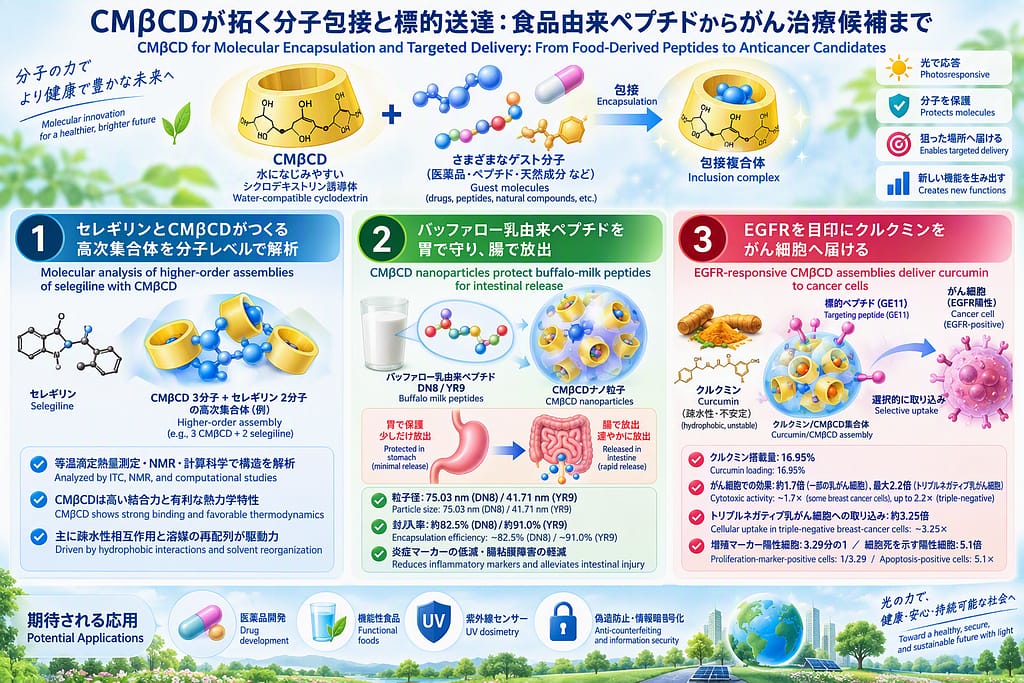
CMβCDは、分子を取り込むβ-シクロデキストリンの空洞と、カルボキシメチル基による水へのなじみやすさを併せ持つ機能性分子です。薬剤や食品由来ペプチドの中には、優れた働きを持ちながら、水に溶けにくい、消化中に壊れやすい、目的の細胞へ届きにくいといった課題を持つものがあります。CMβCDとの包接や自己集合は、こうした成分を保護し、放出や細胞取り込みを調整する方法として研究されています。
今回紹介する研究は、CMβCDが薬物とどのような比率・構造で集合するかを明らかにする基礎研究、食品由来ペプチドを胃から守って腸へ届ける研究、標的化した天然成分をがん細胞へ届ける研究です。分子レベルの理解から生体応用まで、CMβCDの役割が段階的に示されています。
研究内容
1. セレギリンとCMβCDがつくる高次集合体を分子レベルで解析
Thermodynamic and Structural Evidence for Higher-Order Selegiline with Carboxymethyl-β-Cyclodextrin Supramolecular Assemblies in Aqueous Solution
- セレギリン塩酸塩とβ-シクロデキストリン誘導体の相互作用を、水溶液中で調べました。
- 等温滴定型熱量測定、核磁気共鳴、分子動力学シミュレーションを組み合わせました。
- CMβCDは未修飾β-シクロデキストリンより高い平衡定数と有利な熱力学特性を示しました。
- 結合は主に、疎水性相互作用と溶媒の再配列に由来するエントロピーによって進みました。
- 測定された非整数の組成比は単純な1対1複合体ではなく、CMβCD 3分子とセレギリン2分子からなる高次集合体の形成可能性を示しました。
- セレギリンの芳香族部分がCMβCDの空洞深くへ入る構造が、実験と計算の両方から支持されました。
2. バッファロー乳由来ペプチドを胃で守り、腸で放出
Carboxymethyl β-cyclodextrin-loaded buffalo milk peptide nanoparticles ameliorate dextran sodium sulfate-induced intestinal mucosal injury in mice
- バッファロー乳から選ばれた活性ペプチドDN8とYR9をCMβCDへ結合させ、ナノ粒子化しました。
- 粒子径はDN8系で75.03 nm、YR9系で41.71 nm、封入率はそれぞれ約82.5%と約91.0%でした。
- 粒子は試験濃度で安定し、溶血を起こしにくい性質を示しました。
- 細胞試験では、炎症に関係するNO、IL-6、TNF-αの分泌を低減しました。
- ペプチドは胃では少量のみ放出され、腸で速やかに放出される挙動を示しました。
- マウスでは、腸管バリアに関係するオクルディンとZO-1の発現を高め、誘発された腸粘膜障害を軽減しました。
3. EGFRを目印にクルクミンを乳がん細胞へ届ける
Epidermal growth factor receptor-responsive supramolecular curcumin/carboxymethyl β-cyclodextrin self-assemblies enable improved treatment of triple-negative breast cancer
- 水に溶けにくく安定性にも課題があるクルクミンを、CMβCDとの超分子集合体へ封入しました。
- クルクミン搭載量が最も高い16.95%の処方を選び、CMβCDのカルボキシル基へGE11ペプチドを結合しました。
- GE11は細胞表面の上皮成長因子受容体を認識する標的化部位として用いられました。
- 標的化集合体は遊離クルクミンと比べ、細胞毒性の指標を乳がん細胞で約1.7倍、トリプルネガティブ乳がん細胞で最大2.2倍改善しました。
- トリプルネガティブ乳がん細胞への取り込みは、別の乳がん細胞と比べ約3.25倍高い値でした。
- 増殖指標陽性細胞を3.29分の1に減らし、細胞死を示す陽性細胞を5.1倍に増加させました。
期待される応用
三つの研究は、CMβCDの機能が単なる溶解補助にとどまらないことを示しています。高次集合体の構造理解は、薬剤とCMβCDの配合比や安定性を合理的に設計する基盤になります。食品由来ペプチドのナノ粒子化は、胃での分解を抑え、腸で働かせる経口機能性素材の開発につながります。標的ペプチドを付けた集合体は、有効成分を特定細胞へ届けるドラッグデリバリーの可能性を示します。
今後は、製剤の長期保存性、投与後の体内分布、適切な用量、安全性、製造時の再現性を確認する必要があります。とくに細胞や動物で得られた結果を人での利用へつなげるには、段階的な検証が重要です。CMβCDは、食品、医薬、超分子化学をつなぐ分子プラットフォームとして、幅広い応用が期待されます。
English Version
CMβCD for Molecular Encapsulation and Targeted Delivery: From Food-Derived Peptides to Anticancer Candidates
Introduction
Carboxymethyl-β-cyclodextrin combines the molecular cavity of β-cyclodextrin with improved compatibility in aqueous environments. Many drugs and food-derived peptides show useful biological effects but suffer from poor solubility, digestive instability, or insufficient delivery to target cells. Inclusion and self-assembly with CMβCD can protect such compounds and regulate their release and cellular uptake.
The studies highlighted here progress from molecular-level characterization to biological application. One clarifies how CMβCD forms higher-order assemblies with a drug molecule, another protects milk-derived peptides for intestinal delivery, and the third introduces a targeting peptide to improve delivery of curcumin to cancer cells.
Research Highlights
1. Molecular Evidence for Higher-Order CMβCD-Selegiline Assemblies
- Interactions between selegiline hydrochloride and β-cyclodextrin derivatives were investigated in aqueous solution.
- Isothermal titration calorimetry, nuclear magnetic resonance, and molecular-dynamics simulations were combined.
- CMβCD showed higher equilibrium constants and more favorable thermodynamic parameters than unmodified β-cyclodextrin.
- Complexation was mainly entropy-driven, reflecting hydrophobic interactions and solvent reorganization.
- Noninteger stoichiometry indicated assemblies beyond a simple one-to-one complex and supported a possible 3:2 CMβCD-to-selegiline organization.
- Experimental and computational results supported deep inclusion of the aromatic part of selegiline within the CMβCD cavity.
2. CMβCD Nanoparticles Protect Buffalo-Milk Peptides for Intestinal Release
- Bioactive buffalo-milk peptides DN8 and YR9 were associated with CMβCD to form nanoparticles.
- Particle sizes were 75.03 nm for the DN8 system and 41.71 nm for the YR9 system, with encapsulation efficiencies of approximately 82.5% and 91.0%.
- The particles were stable and nonhemolytic at the tested concentrations.
- In cell experiments, they reduced secretion of the inflammatory mediators NO, IL-6, and TNF-α.
- Only small amounts of peptide were released in the stomach, followed by rapid release in the intestine.
- In mice, the formulations increased occludin and ZO-1 expression and reduced induced intestinal mucosal injury.
3. EGFR-Responsive CMβCD Assemblies Target Curcumin Delivery
- Poorly soluble and unstable curcumin was incorporated into CMβCD supramolecular assemblies.
- The formulation with the highest curcumin loading, 16.95%, was selected and functionalized with the GE11 peptide through CMβCD carboxyl groups.
- GE11 served as a ligand for epidermal growth factor receptor-related targeting.
- Compared with free curcumin, the targeted assemblies improved cytotoxic activity by approximately 1.7-fold in one breast-cancer cell line and up to 2.2-fold in a triple-negative breast-cancer cell line.
- Cellular uptake in the triple-negative breast-cancer cells was approximately 3.25-fold higher than in the comparison breast-cancer cells.
- Proliferation-marker-positive cells decreased 3.29-fold, while apoptosis-associated positive cells increased 5.1-fold.
Overall Significance
These studies show that CMβCD functions as more than a solubilizing excipient. Understanding higher-order assembly provides a foundation for rational formulation ratios and stability. Encapsulation of food-derived peptides may support oral products that protect active compounds in the stomach and release them in the intestine. Target-ligand functionalization demonstrates a route toward cell-selective delivery of poorly soluble natural compounds.
Further development will require evaluation of long-term formulation stability, whole-body distribution, appropriate dosing, safety, and manufacturing reproducibility. Translation from cell and animal studies to human use will require stepwise validation. CMβCD therefore represents a molecular platform connecting food science, pharmaceutical delivery, and supramolecular chemistry.
References / 文献
- Coksu, I.; Arayici, P. P.; Poyraz, F. S.; Mansuroglu, B.; Acar, S. Epidermal growth factor receptor-responsive supramolecular curcumin/carboxymethyl β-cyclodextrin self-assemblies enable improved treatment of triple-negative breast cancer. Colloids and Surfaces B: Biointerfaces 269 (2027), 116119. DOI: 10.1016/j.colsurfb.2026.116119
- de Morais, D. C.; Macedo, R. R.; Vieira, B. B. M.; Lula, I.; Lopes, J. F.; De Sousa, F. B. Thermodynamic and Structural Evidence for Higher-Order Selegiline with Carboxymethyl-β-Cyclodextrin Supramolecular Assemblies in Aqueous Solution. The Journal of Physical Chemistry B (2026), Early Access. DOI: 10.1021/acs.jpcb.6c03442
- Zhao, Q.; Zhang, C.; Feng, Y.; et al. Carboxymethyl β-cyclodextrin-loaded buffalo milk peptide nanoparticles ameliorate dextran sodium sulfate-induced intestinal mucosal injury in mice. Journal of Dairy Science 109(9) (2026), 9027–9041. DOI: 10.3168/jds.2025-28156