キーワード
1. フィトクロム(Phytochrome)
日本語: 植物が赤色光と遠赤色光を感知する光受容体です。赤色光で活性型へ、遠赤色光で不活性型へ変化し、発芽や光形態形成を調節します。
English: A plant photoreceptor that senses red and far-red light and regulates germination and photomorphogenesis through reversible photoconversion.
2. フェムト秒レーザー(Femtosecond laser)
日本語: フェムト秒は10のマイナス15乗秒です。本研究では約100フェムト秒の赤色・遠赤色パルスを用い、生きた植物で光受容体が働くかを検証しました。
English: An ultrafast light source. This study used pulses of approximately 100 femtoseconds to test phytochrome function in living plants.
3. 種子発芽(Seed germination)
日本語: 種子が生育を始める重要な過程です。小さな種子は光を周囲の環境情報として利用し、フィトクロムを介して発芽の可否を調節します。
English: A key developmental transition in which light acts as environmental information and phytochromes help regulate the decision to germinate.
4. 光形態形成(Photomorphogenesis)
日本語: 光に応じて植物の形や成長が変化する現象です。本研究では、発芽後の胚軸伸長が赤色フェムト秒パルスによって抑制されるかを調べました。
English: Light-regulated development. The study evaluated hypocotyl growth inhibition after femtosecond red-light treatment.
5. 可逆的光スイッチ(Reversible photoswitch)
日本語: フィトクロムは赤色光と遠赤色光により活性状態を切り替えます。本研究は、この天然の光スイッチがフェムト秒パルスでも作動することを示しました。
English: Phytochrome switches reversibly between inactive and active forms under red and far-red light, even with femtosecond pulses.

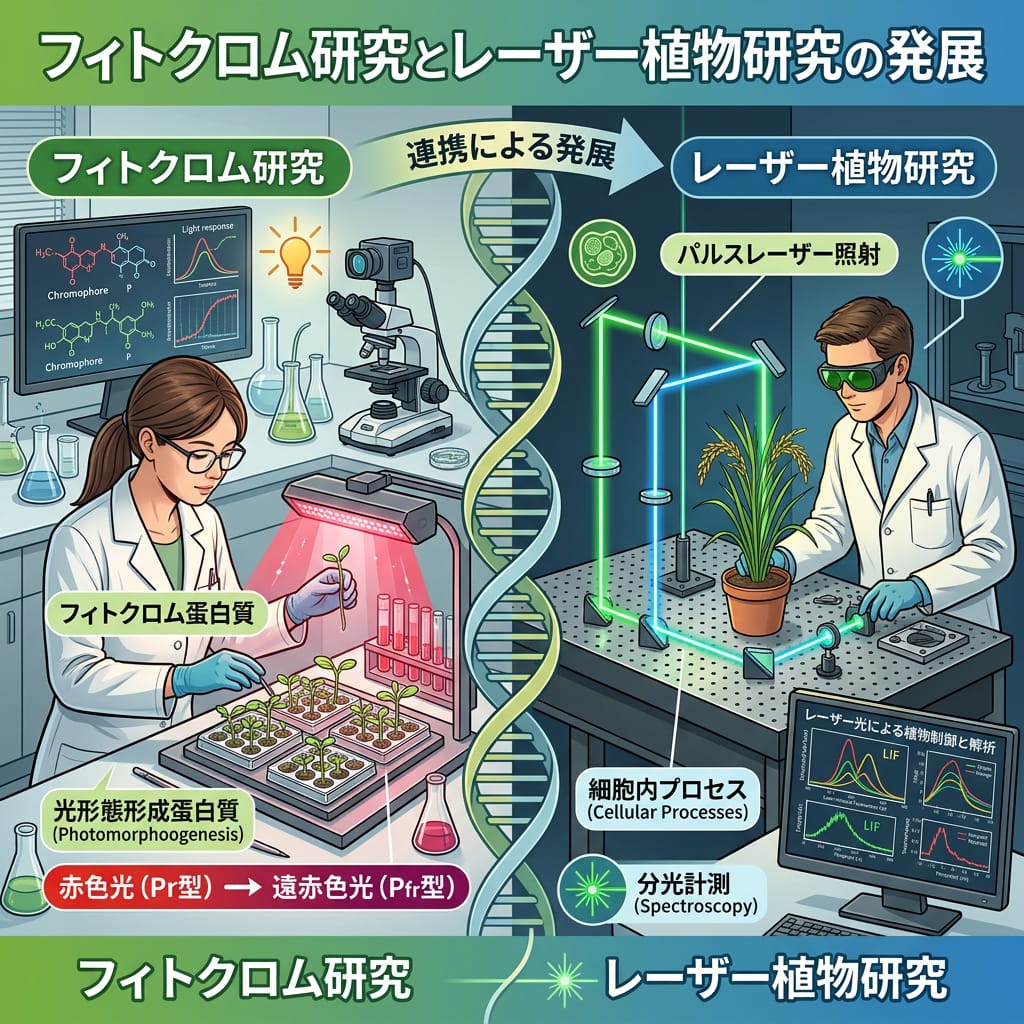
図1. レーザー光照射による植物応答研究の流れ。植物の光環境認識、フィトクロムの可逆変換、超高速反応、既往研究から本研究への展開を示す概念図。
はじめに
植物にとって光は、光合成のためのエネルギーであるだけでなく、周囲の環境を知るための情報でもあります。とくに栄養貯蔵量の少ない種子では、光の有無が地表近くにいるかどうかを判断する手掛かりとなり、発芽後に地上へ到達できる可能性と関係します。この光情報の受容に中心的な役割を果たすのが、赤色光と遠赤色光を感知するフィトクロムです。
本論文のイントロダクションは、植物生理学で確立された光発芽研究から、フィトクロム分子の超高速分光研究、レーザーを用いた種子処理研究へと議論を進め、最後に「フェムト秒パルスは生きた種子のフィトクロムを作動させられるのか」という未解決問題を提示しています。
研究の流れ
1. 植物の発芽は光によって制御される
シロイヌナズナの発芽は暗所では限定的ですが、赤色光を受けると促進されます。シロイヌナズナがもつ5種類のフィトクロムのうち、phytochrome B(phyB)は赤色光による発芽や実生の光形態形成を担う主要な受容体です。
フィトクロムは、不活性な赤色光吸収型Prとして合成されます。Prは赤色光を吸収すると生物学的に活性なPfrへ変換され、Pfrは遠赤色光によってPrへ戻ります。したがって、フィトクロムは赤色光でオン、遠赤色光でオフになる可逆的な天然フォトスイッチとして理解できます。
2. 光受容の開始はフェムト秒領域で起こる
フィトクロムの光変換は、単一の過程ではありません。光を吸収すると約100フェムト秒で励起状態が形成され、その後、ピコ秒領域で発色団の異性化とLumi-R中間体の形成が進みます。さらにマイクロ秒からミリ秒領域で複数の中間体とタンパク質構造変化を経て、ミリ秒から秒の領域で活性型Pfrが形成されます。
このような超高速過程は、主に精製タンパク質や細菌由来フィトクロムを用いたin vitro研究によって詳しく調べられてきました。しかし、試験管内で観測された初期反応が、生きた植物の発芽や成長という長時間スケールの応答へ結び付くかは十分に検証されていませんでした。
3. 短い光でも植物応答を誘導できることが分かってきた
植物生理学では、短時間の赤色光が発芽を促進し、その効果を遠赤色光が打ち消すことが古くから知られています。その後、ミリ秒の赤色光フラッシュやナノ秒レーザーフラッシュでも発芽を誘導できることが報告され、植物が短い光刺激を利用できることが示されてきました。
一方、植物に対するレーザー照射研究では、連続発振レーザーを用いた種子処理や成長への影響が長年検討されてきました。ただし、植物種、発達段階、波長、照射条件が研究ごとに異なるため、結果を直接比較することは容易ではありませんでした。ピコ秒からフェムト秒領域のパルスに対するin planta応答は、とくに知見が限られていました。
4. 未解決問題は「分子の超高速反応」と「植物の生理応答」の間にあった
フェムト秒分光研究から、フィトクロムが光吸収直後に超高速で反応を開始することは知られていました。また、より長いパルスでは植物の発芽を誘導できることも分かっていました。ところが、フェムト秒という極端に短い光パルスそのものが、吸水した種子内部のフィトクロムに吸収され、発芽や光形態形成を引き起こすかは明らかではありませんでした。
さらに、応答が本当にフィトクロムを介するのか、赤色光と遠赤色光によるオン・オフ切替が超短パルスでも成立するのか、後の成長に悪影響がないかも検証すべき課題でした。
5. 本研究のアプローチ
研究グループは、異なる光源を同じ考え方で比較できる照射系を構築しました。吸水したシロイヌナズナ種子を水中で撹拌しながら、赤色LED、連続発振赤色レーザー、フェムト秒赤色レーザー、遠赤色光を照射し、光量と照射条件を管理しました。
評価指標には、72時間後の発芽率と胚軸長を用いました。また、すべてのフィトクロムを欠く変異体と、phyBのみを機能的にもつ変異体を比較することで、受容体の関与を検証しました。さらに、照射した種子を成植物まで育て、形態や光合成関連指標への長期的な影響も調べました。
得られた答え
- 高強度の連続赤色レーザーでは、0.1秒の照射でも発芽が有意に促進され、10秒で応答がほぼ飽和しました。
- 約100フェムト秒の赤色パルスでも、光量に応じて発芽が促進されました。
- 同じ平均光量で比較すると、フェムト秒パルスは連続光より低感度で、50%応答に必要な光量は赤色LEDより高くなりました。
- 赤色フェムト秒パルスによる発芽促進は、続く遠赤色照射で抑制され、フィトクロム型の可逆的スイッチングが確認されました。
- 変異体解析により、phyBがフェムト秒パルスによる発芽誘導の主要な受容体であることが示されました。
- フェムト秒赤色パルスは胚軸伸長も抑制し、発芽後の光形態形成に影響しました。
- 本研究の非集光条件では、照射後に成長した植物への有意な悪影響は検出されませんでした。
研究の意義
本研究は、分光学で知られていたフィトクロムのフェムト秒領域の初期反応が、生きた植物における発芽や光形態形成へつながることを示しました。言い換えると、分子レベルの超高速フォトスイッチングと、数日後に観察される植物の表現型を一つの実験系で結び付けた研究です。
また、同じ総光量でも連続光とフェムト秒パルスで効率が異なるという結果は、光量だけでなく、光子が到来する時間構造もフィトクロムの変換効率に関わることを示唆します。今後、赤色・遠赤色フェムト秒パルスの順序や時間差を精密に制御することで、フィトクロムの光スイッチ機構を生体内で高い時間分解能により調べる展開が期待されます。
How Ultrafast Laser Pulses Control Plant Germination and Growth
Five Keywords
- Phytochrome: A red/far-red photoreceptor that reversibly regulates seed germination and photomorphogenesis.
- Femtosecond laser: An ultrafast source used here to deliver approximately 100-fs red and far-red pulses.
- Seed germination: A physiological readout for evaluating photoreceptor activation in imbibed seeds.
- Photomorphogenesis: Light-regulated development assessed through inhibition of hypocotyl elongation.
- Reversible photoswitch: The interconversion of inactive Pr and active Pfr forms under red and far-red light.
Introduction and Research Context
Light provides plants with both energy and environmental information. In small seeds, light can indicate proximity to the soil surface and help determine whether germination is likely to support successful seedling emergence. Phytochromes are central to this process because they detect red and far-red wavelengths.
The introduction of the paper connects three research traditions. Classical plant physiology established reversible red/far-red control of germination. Ultrafast spectroscopy revealed that the earliest photochemical events in phytochromes begin on femtosecond and picosecond time scales. Laser-based plant studies then showed that millisecond and nanosecond flashes can influence germination. The unresolved question was whether femtosecond pulses could activate phytochromes inside living seeds and produce measurable physiological responses.
From Molecular Photochemistry to Plant Physiology
Phytochromes are synthesized in the inactive Pr form. Red light converts Pr into the biologically active Pfr form, whereas far-red light converts Pfr back into Pr. Photon absorption produces an excited state on an approximately 100-fs scale. Chromophore isomerization and Lumi-R formation follow on the picosecond scale, intermediate states develop from microseconds to milliseconds, and active Pfr is ultimately formed on millisecond-to-second scales.
Most knowledge of these early events came from in vitro experiments with isolated proteins or bacterial phytochromes. The biological consequence of femtosecond excitation in an intact plant system therefore remained unclear.
Experimental Strategy and Main Findings
The authors constructed a standardized irradiation system for comparing LEDs, continuous-wave lasers, and femtosecond lasers. Imbibed Arabidopsis seeds were stirred in water during irradiation, and germination, hypocotyl length, phytochrome mutant responses, and later plant development were evaluated.
Femtosecond red pulses promoted germination and inhibited hypocotyl elongation. Subsequent far-red irradiation reversed the red-light effect. Mutant analysis identified phyB as the principal photoreceptor mediating the response. Femtosecond excitation required a higher fluence than continuous illumination to produce an equivalent response, indicating that temporal photon delivery influences photoconversion efficiency. Under the non-focused conditions used, no significant adverse effect on later plant development was detected.
Overall Significance
The study links femtosecond molecular events to physiological outcomes visible days later. It demonstrates that a natural photoswitch can be driven by ultrashort pulses inside a living plant and provides an experimental platform for investigating phytochrome switching with precisely timed red and far-red pulse sequences.
文献情報 / Reference
Title: A comparative study of femtosecond pulsed and continuous wave lasers on physiological responses through activation of phytochromes in seeds
Authors: Csenger Márk Szabó, Botond Bán, Borbála Sinka, Bálint Tóth, Barnabás Gilicze, Imre Seres, János Bohus, Attila Ébert, Péter Borbély, Zsolt Gulyás, Gábor Galiba, Eva Darko, Miklós Hovári, Béla Hopp, Csaba Péter, Károly Mogyorósi, András Viczián
Journal: Scientific Reports
Year: 2025
Article number: 15:26719
DOI: https://doi.org/10.1038/s41598-025-11183-8
Impact factor: 添付PDF内に記載なし