キーワード
1. フィトクロム(Phytochrome)
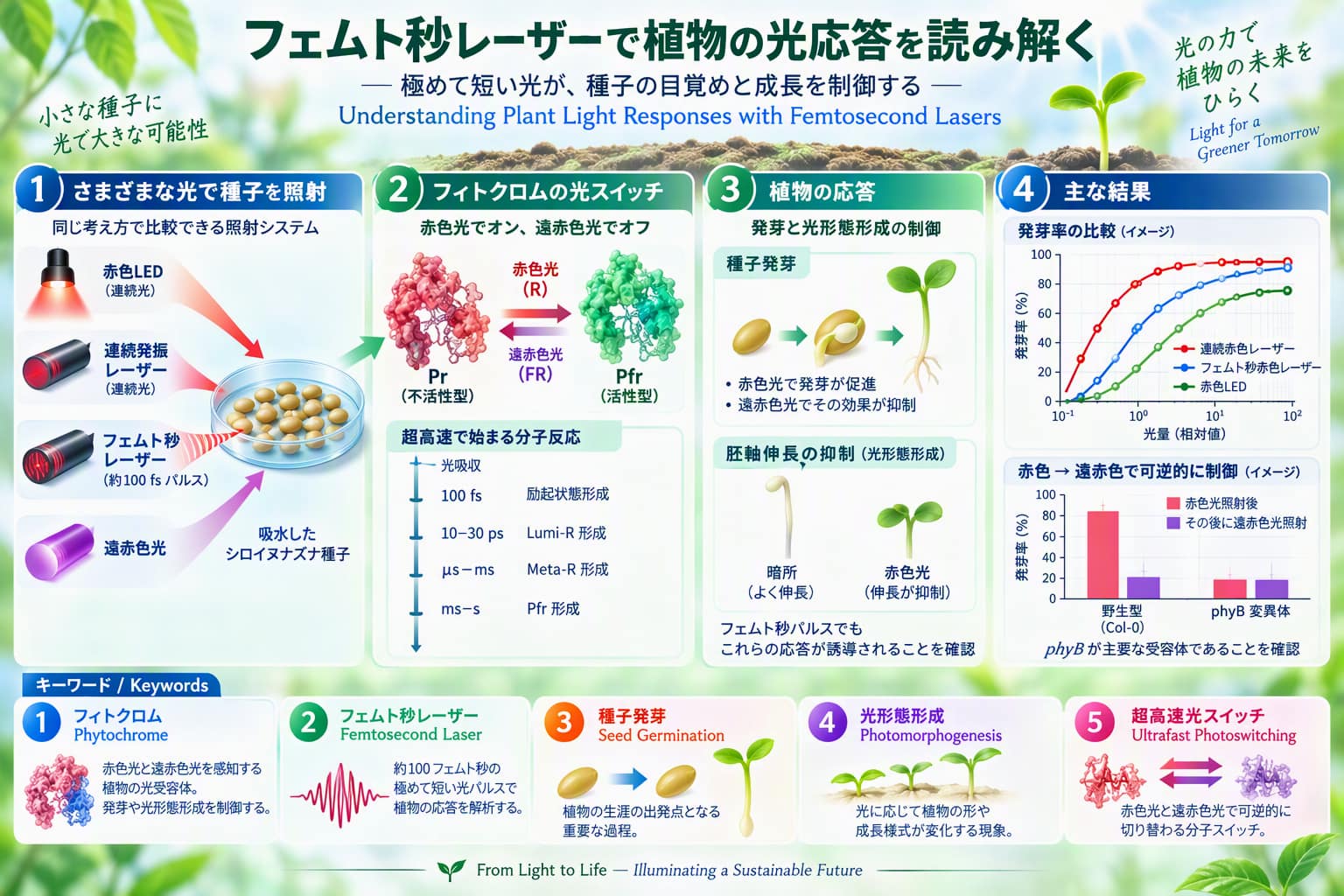
日本語: フィトクロムは植物が赤色光と遠赤色光を感知する光受容体です。本研究では、発芽や光形態形成を制御する主要な受容体として機能し、超短光パルスへの応答にも関与することが示されました。
English: Phytochromes are plant photoreceptors that detect red and far-red light. This study demonstrates that they can respond even to ultrashort femtosecond laser pulses and mediate developmental responses.
2. フェムト秒レーザー(Femtosecond Laser)
日本語: 1フェムト秒は1000兆分の1秒です。本研究では約100フェムト秒の赤色光パルスを利用し、植物が極めて短い光刺激を認識できることを示しました。
English: A femtosecond is one quadrillionth of a second. The study used approximately 100-fs laser pulses to investigate how plants perceive extremely brief light signals.
3. 種子発芽(Seed Germination)
日本語: 発芽は植物の生涯の出発点となる重要な現象です。本研究では発芽率を指標として、異なる光源によるフィトクロム活性化の効率を比較しました。
English: Seed germination is a key developmental transition. The researchers used germination rates as a quantitative indicator to compare different light treatments.
4. 光形態形成(Photomorphogenesis)
日本語: 光形態形成とは、植物が光環境に応じて形態や成長様式を変化させる現象です。本研究では胚軸伸長の抑制を評価し、フェムト秒パルスの効果を確認しました。
English: Photomorphogenesis refers to light-regulated plant development. Hypocotyl growth inhibition was used as an indicator of light-induced developmental responses.
5. 超高速光スイッチ(Ultrafast Photoswitching)
日本語: フィトクロムは赤色光と遠赤色光で活性状態が切り替わる分子スイッチです。本研究は、そのスイッチ機構がフェムト秒領域でも機能することを示しました。
English: Phytochromes act as reversible molecular switches. The study shows that this switching mechanism remains functional under femtosecond light excitation.
日本語記事
導入
植物は周囲の光環境を感知しながら発芽や成長を調節しています。その中心的な役割を担うのがフィトクロムと呼ばれる光受容体です。これまでフィトクロムの研究は主として連続光や比較的長時間の光照射によって行われてきましたが、フェムト秒レーザーのような超短パルス光に対して植物がどのように応答するかはよく分かっていませんでした。
本研究では、シロイヌナズナ種子を用いて、連続光とフェムト秒パルス光による生理応答を比較し、植物が超高速な光刺激をどのように利用できるかを調べました。
研究内容
研究グループは、LED、連続発振レーザー、フェムト秒レーザーを同条件で比較できる照射システムを構築しました。
実験の結果、赤色光による発芽誘導は非常に短い照射時間でも起こることが確認されました。高強度の赤色レーザーでは、わずか0.1秒の照射でも発芽率が上昇し、10秒程度で発芽応答はほぼ飽和しました。
さらに、約100フェムト秒の赤色レーザーパルスでも発芽が促進されることが明らかになりました。一方で、同じ総光量を与えた場合には、連続光のほうがより効率よく発芽を誘導できることも示されました。これは、フィトクロムがフェムト秒パルスを吸収できる一方で、その光変換効率には時間構造の影響があることを示唆しています。
研究チームは赤色パルスと遠赤色パルスを組み合わせた実験も実施しました。その結果、赤色パルスで促進された発芽は遠赤色パルスによって再び抑制されました。これはフィトクロムがもつ可逆的な光スイッチ機構がフェムト秒パルス環境でも維持されていることを示しています。
また、フィトクロム変異体を用いた解析から、主に phytochrome B(phyB)がこの応答を担うことが確認されました。さらに、発芽だけでなく、胚軸伸長の抑制という光形態形成応答もフェムト秒パルスによって誘導されました。
研究の意義
本研究は、フィトクロムがフェムト秒という極めて短い時間スケールで到来する光子を認識し、それを発芽や成長制御へと変換できることを植物個体レベルで示した研究です。
これまで分光学や生化学の分野で蓄積されてきた超高速光反応の知見と、実際の植物生理応答との間を結び付けた点に大きな意義があります。今後は、フィトクロムの光スイッチ機構を生体内で高時間分解能に解析するための新たな実験手法として発展することが期待されます。
Understanding Plant Light Responses with Femtosecond Lasers
Five Keywords
- Phytochrome: A red/far-red light receptor that regulates germination and photomorphogenesis.
- Femtosecond Laser: An ultrafast light source delivering pulses on the order of 10^-15 seconds.
- Seed Germination: A measurable physiological response used to evaluate photoreceptor activity.
- Photomorphogenesis: Developmental changes in plant growth regulated by light signals.
- Ultrafast Photoswitch: Rapid light-induced conformational changes in phytochrome molecules.
Introduction
Plants continuously monitor their light environment to regulate growth and development. Among the most important photoreceptors are phytochromes, which sense red and far-red light and control processes such as seed germination and seedling development.
Although the photochemistry of phytochromes has been studied extensively, little was known about how living plants respond to ultrashort femtosecond laser pulses. This study aimed to bridge that gap by comparing continuous-wave light sources with femtosecond pulsed lasers.
Research Highlights
The authors developed a dedicated irradiation system that enabled direct comparison between LEDs, continuous-wave lasers, and femtosecond laser sources under standardized conditions.
The experiments showed that very brief red-light treatments were sufficient to induce germination. High-intensity continuous laser irradiation produced significant germination responses even after only 0.1 seconds of exposure, while approximately 10 seconds was enough to reach near-saturation.
Importantly, femtosecond red laser pulses also triggered germination. However, a higher photon fluence was required to achieve equivalent biological responses compared with continuous light sources. This observation suggests that phytochromes can absorb femtosecond pulses, but the efficiency of photoconversion depends on the temporal delivery of photons.
The study further demonstrated that germination induced by red femtosecond pulses could be reversed by far-red femtosecond pulses. This confirms that the classical reversible phytochrome switching mechanism remains functional under ultrafast excitation conditions.
Using phytochrome mutants, the researchers identified phytochrome B (phyB) as the primary mediator of these responses. In addition to germination, ultrashort pulses also affected hypocotyl elongation, indicating that photomorphogenic development can be regulated by femtosecond-scale light treatments.
Overall Significance
This work provides direct in vivo evidence that plants can perceive and respond to ultrafast light signals delivered within femtosecond time scales. The findings connect molecular-scale photochemical events with whole-plant physiological responses.
Beyond its biological significance, the study establishes a platform for future investigations of phytochrome photoswitching under precisely controlled ultrafast light regimes. Such approaches may contribute to a deeper understanding of plant light sensing and the dynamics of photoreceptor activation.
文献情報 / Reference
Title: A comparative study of femtosecond pulsed and continuous wave lasers on physiological responses through activation of phytochromes in seeds
Authors: Csenger Márk Szabó, Botond Bán, Borbála Sinka, Bálint Tóth, Barnabás Gilicze, Imre Seres, János Bohus, Attila Ébert, Péter Borbély, Zsolt Gulyás, Gábor Galiba, Eva Darko, Miklós Hovári, Béla Hopp, Csaba Péter, Károly Mogyorósi, András Viczián
Journal: Scientific Reports
Year: 2025
DOI: https://doi.org/10.1038/s41598-025-11183-8