キーワード / Keywords
1. ホスト・ゲスト相互作用 (Host–Guest Interaction)
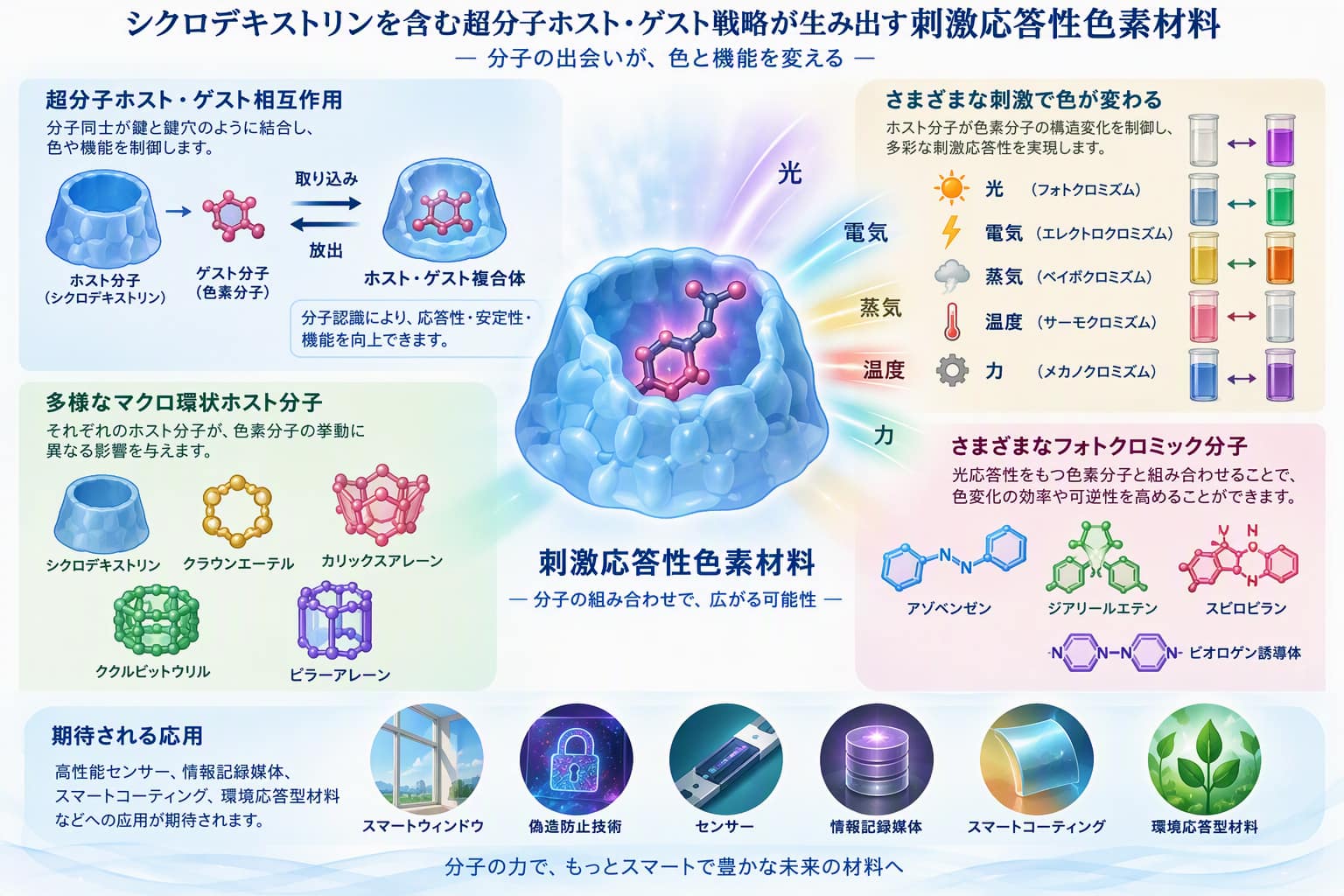
日本語: 分子同士が鍵と鍵穴のように結合する超分子化学の基本概念です。材料の色や機能を外部刺激で制御するための重要な仕組みとして利用されています。
English: A fundamental supramolecular concept where molecules selectively recognize and bind each other, enabling tunable material functions.
2. シクロデキストリン (Cyclodextrin)
日本語: 分子を内部空間に取り込める環状オリゴ糖です。安定化や分子認識に優れ、機能性材料やセンサー開発に広く利用されています。
English: Cyclic oligosaccharides capable of encapsulating guest molecules, widely used in molecular recognition and functional materials.
3. フォトクロミズム (Photochromism)
日本語: 光によって色が変化する現象です。情報記録、スマートウィンドウ、光応答デバイスなどへの応用が進んでいます。
English: A phenomenon in which color changes upon light exposure, useful for optical devices and information storage.
4. 刺激応答性材料 (Stimuli-Responsive Materials)
日本語: 光、熱、電気、蒸気、圧力などの刺激に応じて性質が変化する材料です。次世代スマート材料として注目されています。
English: Materials that respond to light, heat, electricity, vapor, or mechanical force with controllable property changes.
5. 超分子材料 (Supramolecular Materials)
日本語: 分子間の弱い相互作用を利用して構築される材料です。柔軟な機能設計が可能で、多機能化が期待されています。
English: Materials constructed through non-covalent interactions, enabling versatile and multifunctional designs.
日本語版
研究背景
私たちの身の回りには、光や温度によって色が変わる材料が数多く存在します。こうした刺激応答性色素材料は、スマートウィンドウ、偽造防止技術、センサー、情報記録デバイスなどへの応用が期待されています。しかし、応答性と安定性を両立させながら、複数の機能を一つの材料に持たせることは容易ではありません。
本論文は、超分子ホスト・ゲスト化学を利用した刺激応答性色素材料に関する総説であり、特にシクロデキストリンを含むマクロ環状ホスト分子がどのように材料機能を向上させるかを体系的に整理しています。
研究内容
1. 多様なマクロ環状ホスト分子の活用
- クラウンエーテル、シクロデキストリン、カリックスアレーン、ククルビットウリル、ピラーアレーンなどを比較。
- それぞれのホスト分子が、色素分子の挙動に異なる影響を与えることを整理。
- 分子認識を利用して応答性や安定性を向上できることを示した。
2. フォトクロミック分子との組み合わせ
- アゾベンゼン、ジアリールエテン、スピロピラン、ビオロゲン誘導体などを対象に解説。
- 光照射による構造変化をホスト分子が制御することで機能を最適化。
- 色変化の効率や可逆性の改善が期待できることを示した。
3. 多彩な刺激応答機能
- 光応答(フォトクロミズム)
- 電気応答(エレクトロクロミズム)
- 蒸気応答(ベイポクロミズム)
- 温度応答(サーモクロミズム)
- 力学応答(メカノクロミズム)
これらの機能が超分子相互作用によって高度に制御できることを紹介しています。
期待される応用
本論文で紹介された研究群は、シクロデキストリンをはじめとするホスト分子が単なる補助材料ではなく、色や機能を自在に設計するための重要な構成要素であることを示しています。将来的には、高性能センサー、情報記録媒体、スマートコーティング、環境応答型材料などへの応用が期待されます。
English Version
Supramolecular Host–Guest Strategies for Stimuli-Responsive Chromic Materials
Research Background
Stimuli-responsive chromic materials can change color in response to external triggers such as light, temperature, electricity, vapor, or mechanical force. These materials are attracting attention for applications including smart windows, anti-counterfeiting technologies, sensors, and information-storage systems.
This review summarizes recent progress in designing chromic materials through supramolecular host–guest strategies, with particular emphasis on cyclodextrins and other macrocyclic host molecules.
Research Highlights
1. Utilization of Macrocyclic Hosts
- Compared crown ethers, cyclodextrins, calixarenes, cucurbiturils, and pillararenes.
- Demonstrated how different host molecules influence chromic behavior.
- Highlighted the importance of molecular recognition in performance enhancement.
2. Integration with Photoresponsive Chromophores
- Discussed azobenzene, diarylethene, spiropyran, and viologen derivatives.
- Showed how host molecules regulate structural changes induced by external stimuli.
- Improved reversibility and controllability of color switching.
3. Multiple Stimuli-Responsive Functions
- Photochromism
- Electrochromism
- Vapochromism
- Thermochromism
- Mechanochromism
The review illustrates how supramolecular confinement and non-covalent interactions provide precise control over these properties.
Overall Significance
The article highlights the growing importance of cyclodextrins and other macrocyclic hosts in designing intelligent materials. By combining molecular recognition with chromic chromophores, researchers can create multifunctional systems with applications in sensing, information storage, smart coatings, and adaptive materials.
References / 文献
Liu, J.-X.; Chen, K.; Redshaw, C.
Supramolecular host-guest strategies for stimuli-responsive chromic materials: from macrocyclic hosts to multifunctional applications.
Materials Chemistry Frontiers, 2026.
DOI: 10.1039/D6QM00538A