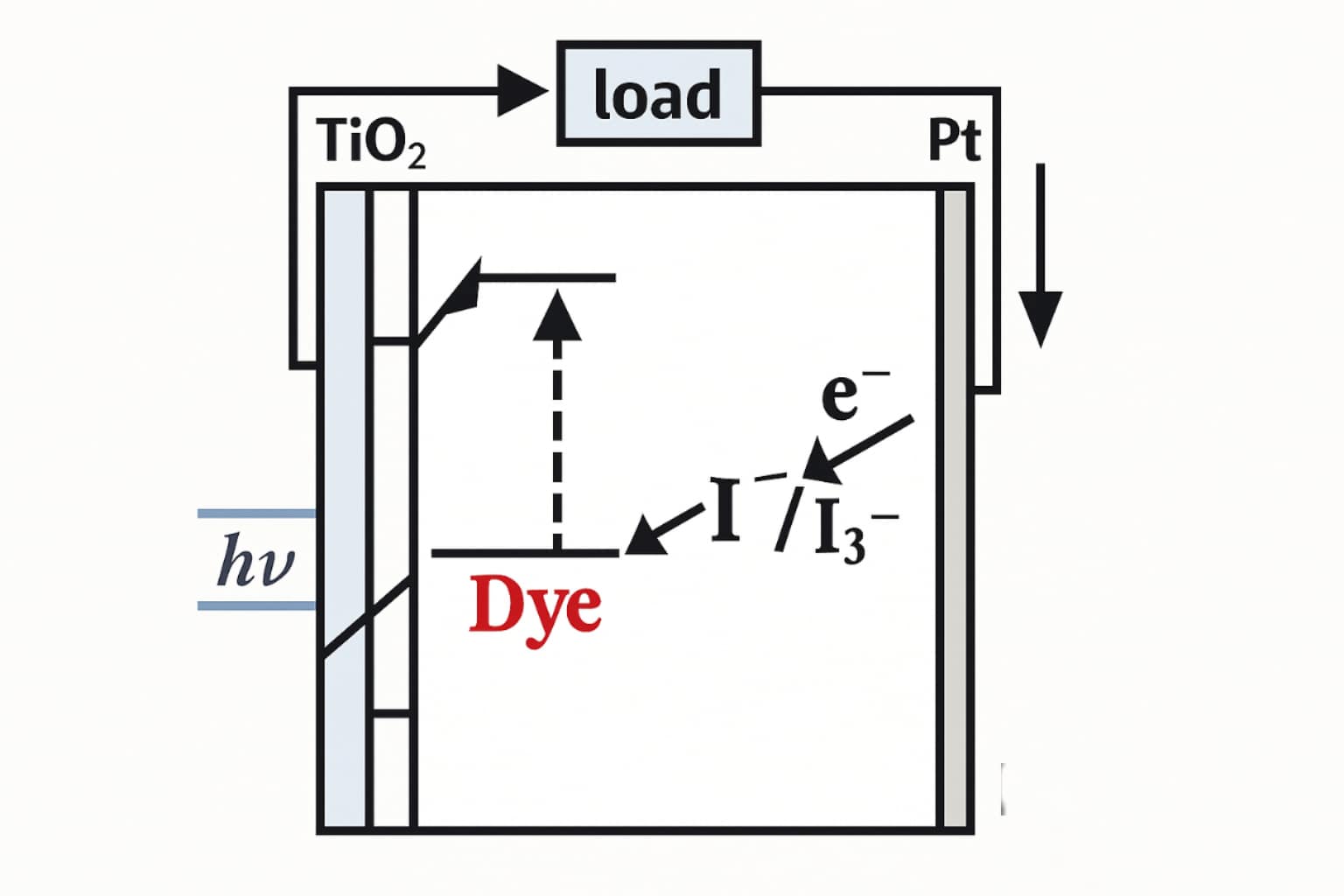
DSSC20260503
DSSC20260503 — Three practical strategies to boost dye‑sensitized solar cells (DSSCs)
キーワード(Keywords)
- 界面パッシベーション(Interfacial passivation):電極表面の欠陥や反応点を整えて、電子が戻って失われる“再結合”を減らし、電流と電圧を底上げする工夫。
EN: Treating interfaces to suppress recombination and improve current/voltage. - プラズモン増強(Plasmonic enhancement):金属ナノ粒子が光を強く集め、吸収を増やす現象。光が“よく捕まる”ほど発電に有利。
EN: Metal nanoparticles concentrate light via plasmon resonance, boosting absorption. - 対極(Counter electrode, CE):電池内の酸化還元反応を進める触媒側電極。Pt代替の低コスト材料開発が実用化の鍵。
EN: Catalytic electrode driving redox; Pt‑free alternatives matter for cost. - 電荷移動抵抗(Charge‑transfer resistance, Rct):電極・電解質界面で反応が進みにくい“抵抗”。小さいほど反応が速く、損失が減る。
EN: Lower Rct means faster interfacial charge transfer and lower losses. - 変換効率(Power conversion efficiency, PCE):入射光に対して取り出せる電力の割合。材料・界面・構造の工夫で数%〜10%超まで変わる。
EN: Fraction of light converted to electricity; engineering can raise it from a few % to >10%.
1) 超短時間合成で“p型半導体”粒子を作り、p型DSSC(光カソード)に展開
Fast Synthesis of Nanosized CuGaO2 Particles as a p-Type Semiconductor for Photocathodes: Preliminary Investigation in DSSCs
- Journal: ACS Applied Materials & Interfaces(Article; Early Access, 2026)
- DOI: https://doi.org/10.1021/acsami.6c01885
日本語
- DSSCの“p型側(光カソード)”を高性能化するには、p型半導体材料の品質と作り方が重要、という問題意識から出発します。
- delafossite型酸化物 CuGaO2 のナノ粒子を、マイクロ波支援の溶媒熱合成で迅速に作る方法を示します。
- 共沈時のpH、還元剤量、反応時間という条件を系統的に変え、相純度や粒径への影響を検討します。
- 合成した粒子を用いた p-DSSCの予備評価(P1色素の導入) を行い、次の設計に繋がる基盤を提供します。
English (Plain-language points)
- Improving the p-type side (photocathode) of DSSCs requires high-quality p-type semiconductors.
- Presents a rapid microwave-assisted hydro-solvothermal route to nanosized CuGaO2 (delafossite-type) particles.
- Systematically studies how coprecipitation pH, reducing agent amount, and reaction time affect phase purity/size.
- Demonstrates feasibility via preliminary p-DSSC tests (with P1 dye loading) as a platform for next designs.
2) “天然由来カーボンドット+銀ナノ粒子”で界面を整え、効率を約28%向上
Synergistic interfacial passivation of dye-sensitized solar cell photoanodes using Myristica fragrans pulp-derived carbon dots and Ag nanoparticles
- Journal: Applied Surface Science(2026, Vol. 735)
- DOI: https://doi.org/10.1016/j.apsusc.2026.166663
日本語
- TiO₂電極界面で起こる“電子の再結合”が、DSSCの効率を下げる大きな原因である点に着目します。
- ナツメグ(Myristica fragrans)果肉由来のカーボンドット(CDs) と 銀ナノ粒子(Ag) を、TiO2中へ光還元でその場形成して界面を改質します。
- その結果、未処理セルに対して 約28%の効率向上、PCE 6.39 ± 0.20% を報告します。
- 抵抗や電子寿命などの電気化学指標を用いて、界面改質が電荷移動や再結合抑制に効いていることを示します。
English (Plain-language points)
- Focuses on interfacial recombination at TiO₂ photoanodes as a key loss pathway in DSSCs.
- Uses carbon dots (from nutmeg pulp) plus Ag nanoparticles formed in situ via photoreduction to passivate TiO2.
- Reports ~28% efficiency improvement, reaching PCE 6.39 ± 0.20%.
- Electrochemical metrics (e.g., resistances, lifetimes) support improved transport and reduced recombination.
3) 強誘電“ドーナツ形”ナノ構造で光利用と電荷分離を同時に高める(DSSC+光触媒)
Toroidal ferroelectric cobalt-doped barium titanates as efficient energy conversion materials for solar cells and photocatalysis
- Journal: Materials Chemistry Frontiers(Early Access, 2026)
- DOI: https://doi.org/10.1039/d5qm00765h
日本語
- ドーナツ状(トロイダル)の強誘電体 BaTiO₃ と、そのCoドープ体を作り、光の散乱・吸収を増やす“形の設計”を行います。
- 酸素欠陥やTi³⁺の形成などが、電荷分離の促進や再結合抑制に寄与する可能性を示します。
- DSSC用の二層構造電極(下層TiO2/上層CoドープBaTiO₃)で、高い変換効率(約10%級) を報告します。
- 同じ材料が光触媒(色素分解)でも機能する点を示し、多機能材料としての方向性を提示します。
English (Plain-language points)
- Designs toroidal ferroelectric BaTiO₃ and Co‑doped BaTiO₃ nanostructures to enhance light scattering/absorption.
- Discusses how defect-related features (oxygen vacancies/Ti³⁺) can promote charge separation and slow recombination.
- Reports ~10%‑level DSSC performance using a bilayer photoanode concept.
- Also shows photocatalytic dye degradation, highlighting multifunctionality.
文献(References)
- Stembauer, Q. et al. Fast Synthesis of Nanosized CuGaO2 Particles as a p-Type Semiconductor for Photocathodes: Preliminary Investigation in DSSCs. ACS Applied Materials & Interfaces (2026). https://doi.org/10.1021/acsami.6c01885
- Jacob, S. et al. Synergistic interfacial passivation of dye-sensitized solar cell photoanodes using Myristica fragrans pulp-derived carbon dots and Ag nanoparticles. Applied Surface Science 735 (2026). https://doi.org/10.1016/j.apsusc.2026.166663
- Balu, M. et al. Toroidal ferroelectric cobalt-doped barium titanates as efficient energy conversion materials for solar cells and photocatalysis. Materials Chemistry Frontiers (2026). https://doi.org/10.1039/d5qm00765h