キーワード / Keywords
1. シクロデキストリン(Cyclodextrin)
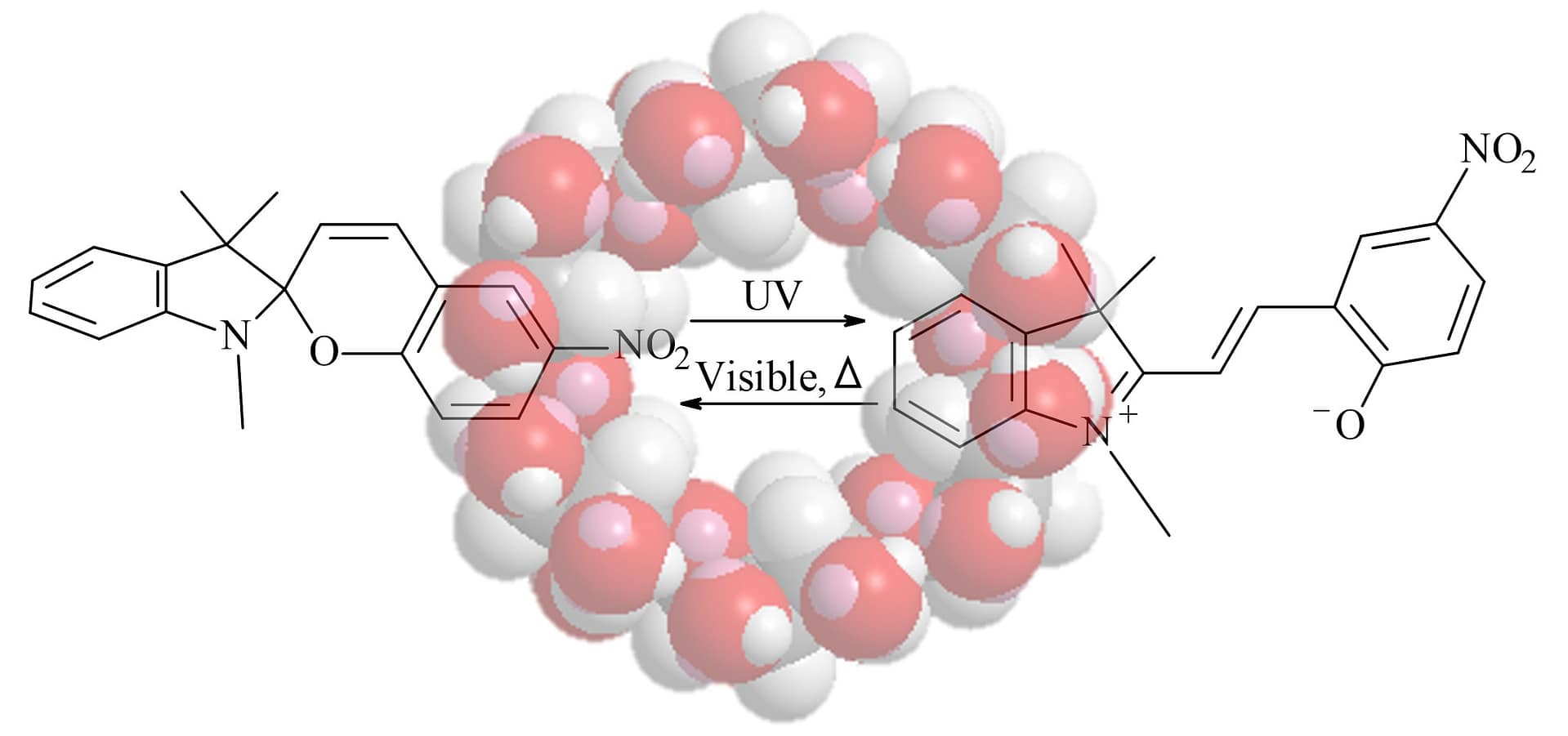
日本語: 分子を内部に取り込む性質を持つ環状オリゴ糖です。分子認識や機能制御に優れ、スマート材料やセンサー開発に幅広く利用されています。
English: Cyclodextrins are cyclic oligosaccharides with molecular recognition abilities that enable advanced functional materials and sensing technologies.
2. スピロピラン(Spiropyran)
日本語: 光や環境変化に応じて構造と色が変化する分子です。可逆的な応答性を利用したスマート材料研究の代表例です。
English: Spiropyrans are photoresponsive molecules that reversibly change structure and color under external stimuli.
3. ホスト・ゲスト化学(Host–Guest Chemistry)
日本語: 分子同士が選択的に結合する超分子化学の概念です。材料機能を高精度に制御するための重要な手法です。
English: Host–guest chemistry enables selective molecular recognition and tunable material functionality.
4. フォトクロミズム(Photochromism)
日本語: 光照射によって色が変化する現象です。情報記録やセンサー、スマートウィンドウへの応用が期待されています。
English: Photochromism refers to reversible color changes induced by light irradiation.
5. 刺激応答性材料(Stimuli-Responsive Materials)
日本語: 光、熱、電気、蒸気、力などの刺激に応じて性質が変化する材料で、次世代機能材料として注目されています。
English: Materials that change properties in response to environmental stimuli and enable adaptive technologies.
日本語版
研究背景
私たちの身の回りでは、光や温度、湿度などに応答して色や性質を変える「刺激応答性材料」が注目されています。これらの材料は、スマートウィンドウ、偽造防止技術、化学センサー、情報記録デバイスなど、多様な分野への応用が期待されています。
その中でも、シクロデキストリンのようなホスト分子と、スピロピランやアゾベンゼンなどの色素分子を組み合わせる超分子ホスト・ゲスト戦略は、材料機能を精密に制御できる方法として大きな関心を集めています。
研究内容
超分子ホスト・ゲスト戦略による刺激応答性色素材料
本論文は、刺激によって色が変化する材料に関する近年の研究を体系的に整理した総説です。
- クラウンエーテル、シクロデキストリン、カリックスアレーン、ククルビットウリル、ピラーアレーンという代表的なホスト分子を比較。
- スピロピラン、アゾベンゼン、ジアリールエテン、ビオロゲン誘導体などの機能性色素との組み合わせを紹介。
- ホスト分子の内部空間に色素分子を取り込むことで、応答性や安定性が向上することを解説。
- 光応答だけでなく、電気応答、蒸気応答、温度応答、力学応答など多様な刺激応答機能を整理。
- 水素結合や静電相互作用などの非共有結合が材料機能の制御に重要な役割を果たすことを示した。
期待される応用
シクロデキストリンとスピロピランを組み合わせた超分子材料は、多機能なスマート材料設計の基盤となる可能性があります。将来的には、環境変化を検知する高感度センサー、書き換え可能な情報記録媒体、光応答性コーティング、偽造防止技術などへの応用が期待されます。
また、複数の刺激に応答できる材料設計は、次世代の知能材料やソフトデバイスの開発にもつながると考えられています。
English Version
Cyclodextrin and Spiropyran-Based Smart Materials for Stimuli-Responsive Technologies
Research Background
Stimuli-responsive materials can alter their properties when exposed to light, temperature, vapor, electricity, or mechanical force. Such materials are attracting attention for applications in smart windows, anti-counterfeiting technologies, sensors, and information storage systems.
Supramolecular host–guest strategies, especially those involving cyclodextrins and chromic molecules such as spiropyrans, provide powerful ways to control these responses at the molecular level.
Research Highlights
Supramolecular Host–Guest Strategies for Chromic Materials
- Reviewed five major classes of macrocyclic host molecules, including cyclodextrins.
- Summarized interactions with spiropyran, azobenzene, diarylethene, and viologen derivatives.
- Demonstrated how molecular encapsulation improves stability and responsiveness.
- Discussed photochromic, electrochromic, vapochromic, thermochromic, and mechanochromic behaviors.
- Highlighted the importance of non-covalent interactions in regulating multifunctional material performance.
Future Perspectives
The review demonstrates that cyclodextrin-based host–guest systems provide versatile platforms for designing intelligent materials. Future applications may include adaptive sensors, rewritable information storage systems, smart coatings, and advanced anti-counterfeiting technologies.
The ability to integrate multiple stimuli-responsive functions into a single material could further expand the development of next-generation smart materials and adaptive devices.
References / 文献
Liu, J.-X.; Chen, K.; Redshaw, C.
Supramolecular host-guest strategies for stimuli-responsive chromic materials: from macrocyclic hosts to multifunctional applications.
Materials Chemistry Frontiers (2026).
DOI: 10.1039/D6QM00538A