シクロデキストリン系材料が支える持続可能な水浄化とペロブスカイト太陽電池
キーワード / Keywords
-
シクロデキストリン(Cyclodextrin)
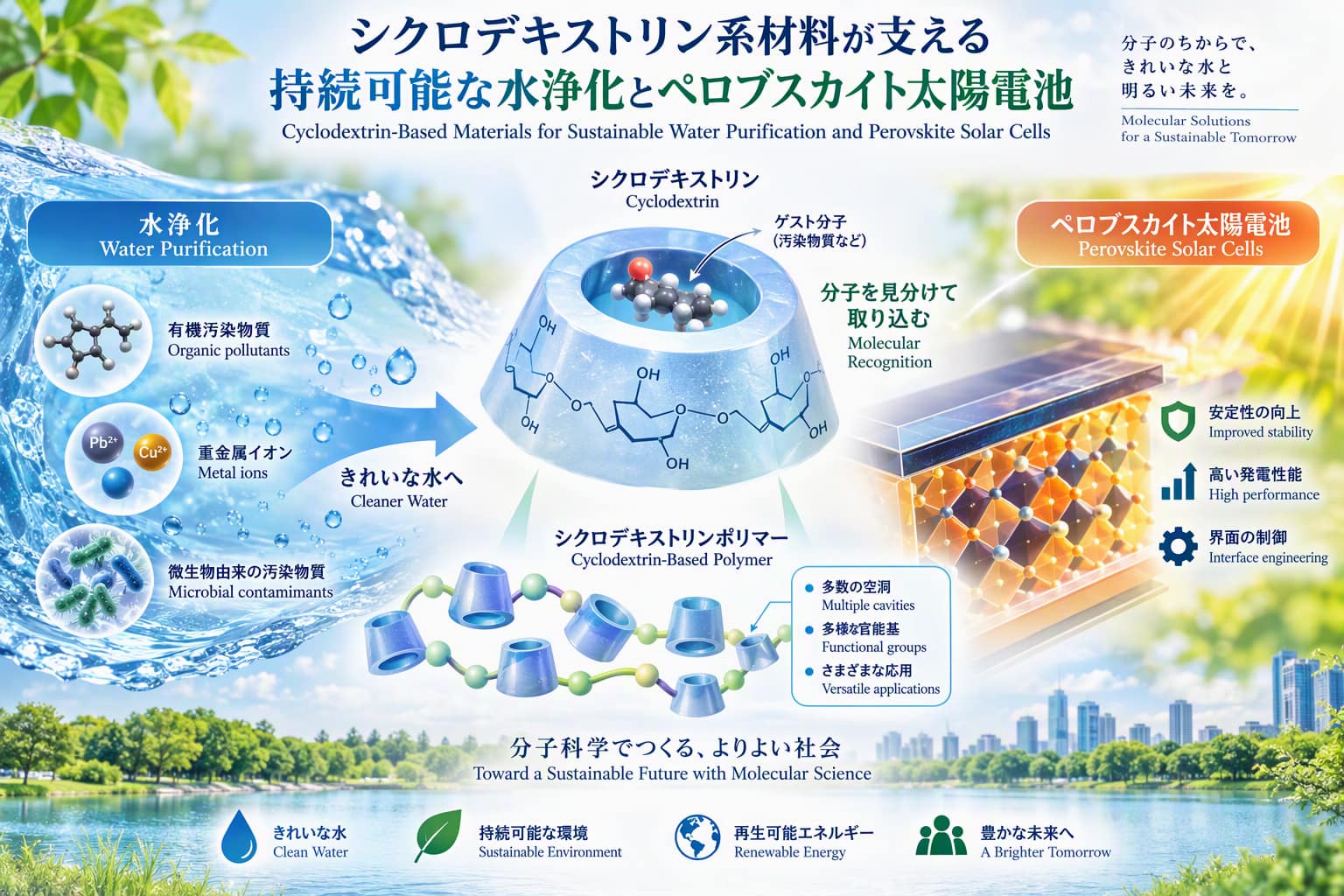
日本語: ブドウ糖が輪状につながった分子で、外側は水になじみやすく、内側には水になじみにくい空洞があります。この構造を利用して、特定の分子を見分けて取り込むことができます。
English: A ring-shaped molecule made of glucose units. Its water-friendly exterior and hydrophobic cavity allow it to recognize and accommodate selected guest molecules. -
ホスト–ゲスト相互作用(Host–guest interaction)
日本語: 空洞をもつ分子を「ホスト」、そこに取り込まれる分子を「ゲスト」と呼びます。形や性質の相性を利用して、汚染物質の選択的な捕集などに役立てる仕組みです。
English: A cavity-bearing host accommodates a compatible guest molecule. Matching molecular shape and properties can support selective capture of pollutants and other target compounds. -
シクロデキストリンポリマー(Cyclodextrin-based polymer)
日本語: シクロデキストリンを網目状・鎖状の材料に組み込んだものです。多数の空洞と外側の官能基を利用し、さまざまな物質を吸着できる機能性材料として研究されています。
English: A polymeric material containing many cyclodextrin units. Its cavities and external functional groups provide multiple sites for adsorption and molecular recognition. -
水浄化(Water purification)
日本語: 水中の有機物、無機物、微生物由来の汚染物質を取り除く技術です。シクロデキストリン系材料では、空洞への取り込みと表面での吸着を組み合わせられます。
English: The removal of organic, inorganic, and microbial contaminants from water. Cyclodextrin materials can combine cavity-based inclusion with adsorption at external functional groups. -
ペロブスカイト太陽電池(Perovskite solar cell)
日本語: 金属ハライド系ペロブスカイト材料を光吸収層に用いる太陽電池です。高い性能が期待される一方、安定性の向上が重要で、界面や材料を整える研究が進んでいます。
English: A solar cell that uses a metal-halide perovskite as its light-absorbing layer. Improving device stability and performance through material and interface design remains important.
はじめに
シクロデキストリンは、中央に小さな空洞をもつ環状の糖分子です。外側は水になじみやすく、空洞の内側は水になじみにくいため、形や性質の合う分子を選んで取り込むことができます。この「分子を見分ける」性質をポリマー材料へ広げると、水中の汚染物質を集める材料や、太陽電池の安定性と性能を支える材料として利用できる可能性があります。
紹介するレビュー論文は、シクロデキストリンとシクロデキストリン系ポリマーの構造的な特徴を整理し、水浄化と金属ハライドペロブスカイト太陽電池という二つの応用分野を結び付けています。
分子を見分けるシクロデキストリン系ポリマー
シクロデキストリン系ポリマーには、分子を受け入れる空洞だけでなく、材料表面で働く多様な官能基があります。そのため、一種類の相互作用だけに頼らず、複数の方法で対象物質と結び付くことができます。
- 研究の焦点: シクロデキストリン系材料のホスト–ゲスト相互作用と、その水浄化およびペロブスカイト太陽電池への応用を幅広く整理しています。
- 構造上の特徴: 水になじみにくい空洞、水になじみやすい外側、多様な官能基を一つの材料内に併せ持ちます。
- 分子認識: 空洞の形や性質に合うゲスト分子を取り込み、対象物質を選択的に認識できます。
- 表面の働き: 外側の官能基もゲスト分子と相互作用し、空洞とは異なる経路で吸着に関与します。
- 材料としての利点: シクロデキストリンをポリマー化することで、分子レベルの認識機能を、回収や加工が可能な材料へ広げられます。
水中の多様な汚染物質を捕らえる
水には、有機化合物、無機イオン、微生物に由来する物質など、性質の異なる汚染物質が含まれることがあります。シクロデキストリン系ポリマーは、空洞への包接と外側の官能基による吸着を組み合わせて、こうした多様な対象に対応します。
- 有機汚染物質: 疎水性の空洞が、形や性質の合う有機分子を受け入れることで捕集に寄与します。
- 無機汚染物質: 材料中の官能基が金属イオンなどと結び付くキレート作用を利用できます。
- 微生物由来の汚染: 表面の化学的性質や吸着機能を利用した除去が研究されています。
- 複数機能の連携: ホスト–ゲスト相互作用とキレート能を同時に利用できる点が、対象範囲の広さにつながります。
- 研究の意義: 汚染物質の種類に応じて空洞や官能基を設計することで、より選択的で持続可能な水処理材料へ発展する可能性があります。
ペロブスカイト太陽電池の安定性と性能を支える
このレビューは、水浄化だけでなく、シクロデキストリン系材料をペロブスカイト太陽電池へ応用する研究も扱っています。ペロブスカイト太陽電池では、材料や界面の状態が、発電性能と長期安定性に影響します。
- 応用の方向: シクロデキストリン系材料を、金属ハライドペロブスカイト太陽電池の安定性と性能を高めるために利用します。
- 材料の役割: 多数の官能基と分子認識能を生かし、太陽電池内部の材料や界面に働きかけます。
- 期待される効果: デバイスを不安定にする要因を抑え、性能を維持しやすい構造へ整えることが検討されています。
- 水浄化との共通点: どちらの用途でも、特定の分子やイオンと選択的に相互作用する性質が機能の基礎になります。
- 研究の意義: 同じ超分子材料の設計原理を、環境浄化とエネルギーデバイスという異なる課題へ展開できることを示しています。
研究全体から見えること
シクロデキストリン系ポリマーの特徴は、内側の空洞と外側の官能基が異なる役割を担いながら、協力して働ける点にあります。水浄化では汚染物質を選択的に吸着し、ペロブスカイト太陽電池では材料や界面の状態を整えるために利用されます。
このレビューからは、シクロデキストリンが単なる「分子の入れ物」ではなく、分子認識、吸着、キレート作用、界面制御を組み合わせられる材料設計の基盤であることがわかります。対象に応じて空洞の種類、官能基、ポリマー構造を調整することが、環境とエネルギーの両分野における応用拡大につながります。
Cyclodextrin-Based Materials for Sustainable Water Purification and Perovskite Solar Cells
Introduction
Cyclodextrins are ring-shaped sugar molecules with central cavities. Their outer surfaces interact favorably with water, while their inner cavities are relatively hydrophobic and can accommodate compatible molecular guests. Extending this molecular-recognition ability into polymeric materials creates opportunities for capturing water contaminants and supporting the stability and performance of solar-cell devices.
The review introduced here examines the structural characteristics of cyclodextrins and cyclodextrin-based polymers and connects two application areas: sustainable water purification and metal-halide perovskite solar cells.
Cyclodextrin Polymers as Molecular-Recognition Materials
Cyclodextrin-based polymers contain not only molecular cavities but also diverse functional groups on their external surfaces. They can therefore interact with target substances through more than one pathway.
- Focus: The review surveys host–guest interactions in cyclodextrin materials and their applications in water purification and perovskite solar-cell devices.
- Structural features: These materials combine hydrophobic cavities, hydrophilic exteriors, and diverse functional groups.
- Molecular recognition: Compatible guest molecules can be accommodated in the cavities, supporting selective recognition.
- External interactions: Functional groups on the outer surface provide additional adsorption sites distinct from the cavities.
- Material advantage: Polymerization translates molecular-scale recognition into recoverable and processable functional materials.
Capturing Different Classes of Water Contaminants
Water may contain pollutants with very different chemical properties, including organic compounds, inorganic ions, and microbial contaminants. Cyclodextrin-based polymers can combine inclusion within their cavities with adsorption at external groups.
- Organic contaminants: Hydrophobic cavities can accommodate suitably shaped organic guest molecules.
- Inorganic contaminants: Functional groups can contribute chelating interactions with metal ions and related species.
- Microbial contaminants: Removal approaches can use the surface chemistry and adsorption functions of the polymeric material.
- Cooperative functions: Host–guest recognition and chelating ability can operate together, broadening the range of target contaminants.
- Importance: Adjusting cavities, functional groups, and polymer structures may support more selective and sustainable water-treatment materials.
Supporting Perovskite Solar-Cell Stability and Performance
The review also examines cyclodextrin-based materials in metal-halide perovskite solar cells. In these devices, the condition of materials and interfaces affects both photovoltaic performance and long-term stability.
- Application direction: Cyclodextrin-based materials are investigated as components that can improve device stability and performance.
- Material role: Their multiple functional groups and molecular-recognition properties allow them to interact with materials and interfaces inside the device.
- Expected benefit: These interactions may suppress destabilizing factors and help maintain favorable device structures.
- Connection with water purification: Both applications rely on selective interactions with particular molecules or ions.
- Importance: A shared supramolecular design principle can be applied to two different challenges: environmental remediation and energy-device engineering.
Overall Significance
Cyclodextrin-based polymers are distinctive because their internal cavities and external functional groups can perform different but cooperative roles. In water purification, they support selective adsorption of contaminants. In perovskite solar cells, they can be used to regulate materials and interfaces.
The review presents cyclodextrins not merely as molecular containers, but as a platform that combines molecular recognition, adsorption, chelation, and interface control. Tailoring the cavity type, functional groups, and polymer architecture may expand their use across both environmental and energy technologies.
文献 / Reference
- Taka, A. L.; Samaei, S. H.-A.; Xue, J.; Maheshwari, V. “Cyclodextrins and Cyclodextrin-Based Polymers and Their Supramolecular Host-Guest Interactions for Sustainable Water Purification and Perovskite Solar Cell Devices: A Review.” ChemPlusChem, 2026, 91(9), e70247. DOI: 10.1002/cplu.70247.