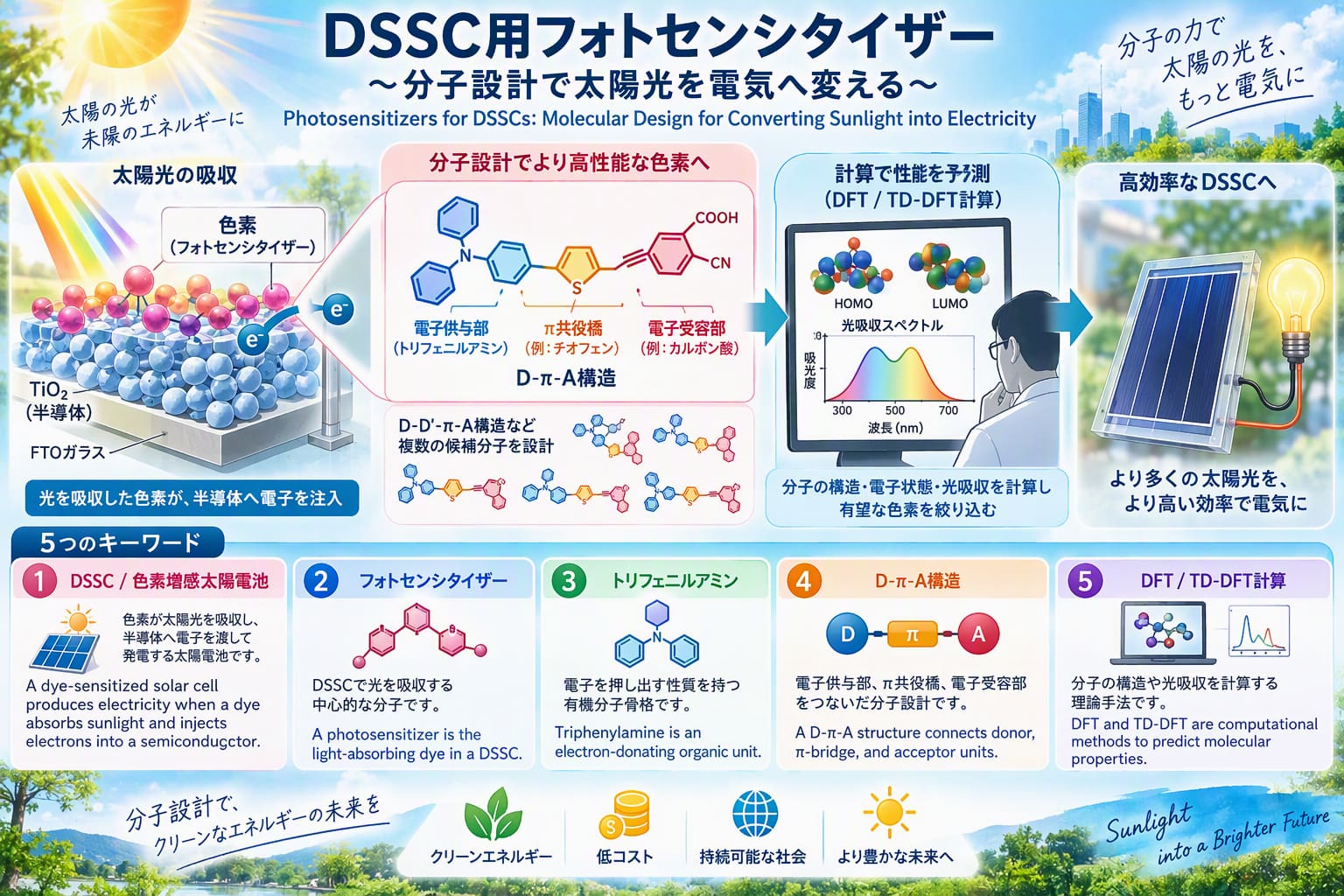
Photosensitizers for DSSCs: Molecular Design for Converting Sunlight into Electricity
キーワード / Keywords
-
DSSC / 色素増感太陽電池
色素が太陽光を吸収し、酸化チタンなどの半導体へ電子を渡して発電する太陽電池です。低コスト化や柔軟な設計が期待されています。
EN: A dye-sensitized solar cell produces electricity when a dye absorbs sunlight and injects electrons into a semiconductor such as TiO₂. -
フォトセンシタイザー / Photosensitizer
DSSCで光を吸収する中心的な分子です。どの波長を吸収し、どれだけ効率よく電子を渡せるかが発電性能を左右します。
EN: A photosensitizer is the light-absorbing dye in a DSSC. Its absorption and electron-injection ability strongly affect cell efficiency. -
トリフェニルアミン / Triphenylamine
電子を押し出す性質を持つ有機分子骨格です。DSSC用の金属フリー色素で、ドナー部位としてよく利用されます。
EN: Triphenylamine is an electron-donating organic unit often used as the donor part of metal-free DSSC dyes. -
D-π-A構造 / D-π-A Architecture
電子供与部、π共役橋、電子受容部をつないだ分子設計です。光を受けた電子が一方向へ動きやすくなるように設計します。
EN: A D-π-A structure connects donor, π-bridge, and acceptor units to guide photoexcited electrons in a useful direction. -
DFT/TD-DFT計算 / DFT and TD-DFT
分子の構造、電子状態、光吸収を計算する理論手法です。実験前に有望な色素候補を絞り込む設計ツールとして使われます。
EN: DFT and TD-DFT are computational methods used to predict molecular structure, electronic properties, and light absorption.
日本語版
チオフェン置換トリフェニルアミン色素を、計算でDSSC向けに設計する
論文: Structure-Property Analysis of Thiophene-Substituted Triphenylamine-Based Photosensitizers for DSSC Applications
掲載誌: Journal of the Chinese Chemical Society
DOI: 10.1002/jccs.70263
- 色素増感太陽電池では、太陽光を最初に受け取る「色素」の性能が、発電効率を大きく左右します。
- この研究では、チオフェン置換トリフェニルアミンを電子供与部に持つ、金属を含まない有機色素を理論的に設計しています。
- 基本となるD-π-A構造に加えて、もう一つの電子供与部を加えたD-D′-π-A構造も検討しています。
- 分子内で、電子を押し出す部分、電子を運ぶπ共役橋、電子を受け取る部分をどう並べるかが重要です。
- 研究では、2種類のπスペーサーを用いて、合計10種類の色素候補を設計しました。
- それぞれの分子をナノ結晶TiO₂表面に吸着させた状態として考え、DSSCで働く可能性を評価しています。
- DFTとTD-DFTにより、HOMO/LUMOエネルギー、エネルギーギャップ、最大吸収波長、電子親和力、イオン化ポテンシャルなどを調べています。
- 分子のわずかな構造差によって、光吸収や電荷移動、予測される太陽電池性能が変わることが示されています。
- 検討した色素の中では、CBと呼ばれる分子が、短絡電流密度15 mA cm⁻²の条件で最大5.3%の効率を示すと予測されました。
- 一般向けに言えば、「太陽光を受け取る分子の形をコンピューターで少しずつ変え、よりよく発電できる色素を探す」研究です。
ここがポイント
- DSSCでは、色素が光を吸収して電子をTiO₂へ渡すため、色素分子の設計が非常に重要です。
- トリフェニルアミンは電子を供与しやすく、金属を使わない有機色素の設計に向いています。
- チオフェンやπスペーサーを組み合わせることで、光吸収の範囲や電子移動のしやすさを調整できます。
- D-D′-π-A型のように電子供与部を追加すると、分子内の電荷移動が変化し、性能向上につながる可能性があります。
- 計算化学を使うことで、多数の候補分子を合成する前に、効率が期待できる分子を絞り込めます。
まとめ
この研究は、DSSC用の金属フリー有機色素を、分子構造と太陽電池性能の関係から考えたものです。チオフェン置換トリフェニルアミンを中心に、D-π-A型とD-D′-π-A型の色素を比較し、電子状態や光吸収、TiO₂上でのふるまいを理論計算で評価しています。高効率なDSSCをつくるには、単に強く光を吸収するだけでなく、吸収したエネルギーを電子移動へうまくつなげる分子設計が必要です。
English Version
Designing thiophene-substituted triphenylamine dyes for DSSCs using computation
Paper: Structure-Property Analysis of Thiophene-Substituted Triphenylamine-Based Photosensitizers for DSSC Applications
Journal: Journal of the Chinese Chemical Society
DOI: 10.1002/jccs.70263
- In a dye-sensitized solar cell, the dye is the first component that captures sunlight, so dye design strongly influences power conversion efficiency.
- This study theoretically designs metal-free organic dyes based on thiophene-substituted triphenylamine donor units.
- The researchers compare basic D-π-A structures with D-D′-π-A structures that include an additional donor unit.
- The arrangement of the electron donor, π-bridge, and electron acceptor determines how photoexcited electrons move through the molecule.
- Ten candidate dyes are designed using two different π-spacers.
- Each dye is evaluated as if adsorbed on a nanocrystalline TiO₂ surface, which is the typical semiconductor surface in DSSCs.
- DFT and TD-DFT calculations are used to estimate HOMO/LUMO energies, energy gaps, maximum absorption wavelengths, electron affinity, ionization potential, and photovoltaic parameters.
- Small changes in molecular geometry lead to meaningful differences in light absorption, charge transfer, and predicted DSSC performance.
- Among the studied molecules, the dye labeled CB is predicted to reach a maximum efficiency of 5.3% at a short-circuit current density of 15 mA cm⁻².
- In simple terms, this work uses computer calculations to adjust dye structures and identify molecules that may convert sunlight into electricity more effectively.
Key Points
- In DSSCs, the dye must absorb light and inject electrons efficiently into TiO₂.
- Triphenylamine is useful as an electron-donating unit in metal-free organic dyes.
- Thiophene and π-spacer design can tune light absorption and charge-transfer behavior.
- Adding an extra donor unit in a D-D′-π-A architecture may improve intramolecular charge movement.
- Computational screening helps narrow promising dye candidates before synthesis and device fabrication.
Overall Takeaway
This study connects molecular structure with predicted DSSC performance. By comparing D-π-A and D-D′-π-A dyes based on thiophene-substituted triphenylamine, the work shows how donor choice, π-bridge design, and TiO₂ adsorption can influence light absorption and electron transfer. Better DSSC dyes require not only strong sunlight absorption, but also molecular structures that guide the absorbed energy into useful electron flow.
文献 / References
- Jahina; Chetti, P. Structure-Property Analysis of Thiophene-Substituted Triphenylamine-Based Photosensitizers for DSSC Applications. Journal of the Chinese Chemical Society (2026). DOI: 10.1002/jccs.70263.