β-シクロデキストリンがひらく「包む・見つける・届ける」技術
キーワード / Keywords
-
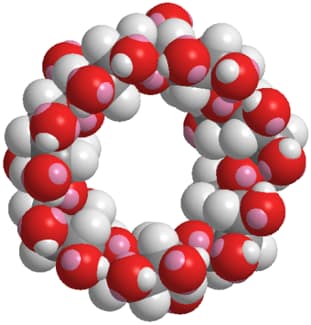
β-シクロデキストリン(β-Cyclodextrin)
日本語: ブドウ糖が輪状につながった分子です。外側は水になじみ、内側の空洞は油になじみやすいため、香り成分や薬などを一時的に包み込めます。
English: A ring-shaped molecule made of glucose units. Its water-friendly exterior and relatively hydrophobic cavity allow it to temporarily host fragrances, drugs, and other compounds. -
包接複合体(Inclusion complex)
日本語: β-シクロデキストリンの空洞に別の分子の一部または全体が入り込んだ状態です。溶けやすさ、安定性、放出速度などを変える手段として利用されます。
English: An inclusion complex forms when part or all of a guest molecule enters the cyclodextrin cavity. This can change solubility, stability, protection, and release behavior. -
湿度応答放出(Humidity-triggered release)
日本語: 周囲の湿度が高くなると、水分が材料内部へ入り、包まれていた成分の移動や放出が進む仕組みです。必要な環境で働く保存材料につながります。
English: Moisture entering a material can promote the movement and release of an encapsulated compound. This enables delivery systems that respond to humid storage or food environments. -
電気化学センサー(Electrochemical sensor)
日本語: 物質が電極上で起こす電気的変化を測り、濃度を調べる装置です。β-シクロデキストリンを加えると、標的分子を電極付近へ集めやすくなる場合があります。
English: An electrochemical sensor determines concentration from electrical changes at an electrode. Beta-cyclodextrin can help enrich selected molecules close to the sensing surface. -
口腔内崩壊錠(Orodispersible tablet)
日本語: 水を使わず、口の中で速やかに崩れる錠剤です。飲み込みにくさのある高齢者などにも使いやすい剤形として、成分の溶けやすさとの両立が研究されています。
English: An orodispersible tablet rapidly breaks apart in the mouth without water. It is designed for easier administration, including for older people or those with swallowing difficulties.
はじめに
β-シクロデキストリンは、ブドウ糖からできた小さな「分子のカップ」のような物質です。中央の空洞に別の分子を迎え入れる性質があり、揮発しやすい香りを守る、検出したい物質をセンサー表面へ集める、水に溶けにくい成分を扱いやすくするといった用途が研究されています。
ここでは、食品保存、健康状態の測定、医薬品製剤という三つの場面から、β-シクロデキストリンの働きを紹介します。同じ分子でも、組み合わせる材料と目的によって役割が変わる点が重要です。
1. 香りを包み、湿度に応じて放出する
Fengらは、通常のβ-シクロデキストリン、メチル化β-シクロデキストリン、ヒドロキシプロピルβ-シクロデキストリンを用い、4種類の精油成分の包み込みと放出を比較しました。
- 研究の目的: シクロデキストリンの縁に付いた置換基と、精油分子の大きさ・水となじみにくい性質が、包接効率と放出にどう影響するかを調べました。
- 方法: X線回折、赤外分光、核磁気共鳴などで複合体を確認し、放出挙動の測定と分子動力学計算を組み合わせました。
- わかったこと: すべての組み合わせで安定な1対1の包接複合体が確認されました。包み込みやすさは精油分子だけで決まらず、シクロデキストリン側の置換基にも左右されました。
- 湿度の役割: 放出は湿度に強く応答しました。水分による空洞の水和と、結晶構造内を移動する際の抵抗とのバランスが、放出速度を決める重要な要因でした。
- 意義: 保存環境の湿度に応じて香り成分を放出する、食品保存用の制御放出材料を設計する手がかりになります。
2. 微量のプロゲステロンを電気信号で測る
NageshとCherianは、二次元材料MXeneとβ-シクロデキストリンを組み合わせ、ステロイドホルモンのプロゲステロンを測定する電気化学センサーを開発しました。
- 研究の目的: 生体試料中では濃度が低く、高感度測定が難しいプロゲステロンを定量することを目指しました。
- 方法: Ti3C2Tx MXeneとβ-シクロデキストリンの複合材料を電極に用い、サイクリックボルタンメトリーと差動パルスボルタンメトリーで電気化学応答を調べました。
- わかったこと: プロゲステロンは約0.856 Vで明確な酸化ピークを示しました。10~500 nMの範囲で濃度に応じた応答が得られました。
- 検出性能: 検出限界は0.46 nM、定量限界は1.52 nMでした。
- 意義: β-シクロデキストリンの分子認識とMXeneの電気化学的性質を組み合わせることで、低濃度のホルモンを測る材料設計の可能性が示されました。
3. クルクミノイドを溶けやすくし、口で崩れる錠剤へ
Patrojanasophonらは、クルクミノイドをヒドロキシプロピルβ-シクロデキストリンに包接させ、高齢者向けの口腔内崩壊錠へ応用しました。
- 研究の目的: 水に溶けにくいクルクミノイドの性質を改善し、飲み込みやすい剤形にすることを目指しました。
- 方法: クルクミノイドとシクロデキストリンの比率を検討し、実験計画法を使って結合剤と崩壊剤の配合を最適化しました。
- わかったこと: 1対1の複合体が最適で、未処理のクルクミノイドと比べて溶解性が214倍に向上しました。光、熱、通常保管に対する安定性も高まりました。
- 錠剤の性能: 最適化した錠剤は22.21±1.94秒で崩壊し、60分後の試験管内放出率は97.79±0.66%でした。
- 意義: 分子レベルで溶けやすさを改善し、錠剤レベルで使いやすさを整える二段階の設計が、溶けにくい成分の製剤化に役立つ可能性があります。
研究全体から見えること
三つの研究に共通するのは、β-シクロデキストリンの空洞を単なる「容器」ではなく、分子の性質を調整する機能部位として使っていることです。精油の研究では湿度に応じた放出、センサー研究では標的分子の認識、錠剤研究では溶解性と安定性の改善に結びついています。
一方で、望ましい働きを得るには、空洞の大きさだけでなく、シクロデキストリンの置換基、相手分子の大きさや疎水性、周囲の水分、複合材料の構造まで考える必要があります。β-シクロデキストリンは、食品、分析、医薬品という異なる分野を「分子を選んで包む」という共通原理でつなぐ材料といえます。
Beta-Cyclodextrin: Technologies for Encapsulation, Detection, and Delivery
Introduction
Beta-cyclodextrin is a small, cup-like molecule built from glucose units. Its central cavity can host suitable parts of other molecules. Researchers use this property to protect volatile aromas, enrich target compounds near sensor surfaces, and improve the handling of poorly water-soluble substances.
The three studies introduced here illustrate its roles in food preservation, hormone sensing, and pharmaceutical formulation. Together, they show that the same molecular cavity can perform different functions depending on the guest molecule, surrounding material, and intended application.
1. Encapsulating Essential Oils and Releasing Them in Response to Humidity
Feng and colleagues compared native beta-cyclodextrin, methyl-beta-cyclodextrin, and hydroxypropyl-beta-cyclodextrin with four representative essential-oil molecules.
- Aim: To determine how substituents around the cyclodextrin rim and the size and hydrophobicity of essential-oil molecules affect encapsulation and release.
- Approach: X-ray diffraction, infrared spectroscopy, nuclear magnetic resonance, release measurements, and molecular-dynamics simulations were combined.
- Main finding: Stable 1:1 inclusion complexes were verified across the tested systems. Encapsulation was governed not only by the guest molecule but also by the substituents on the cyclodextrin.
- Role of humidity: Release showed a pronounced humidity response. Water-mediated cavity hydration and resistance to diffusion through the crystalline material jointly influenced release rates.
- Importance: The findings provide guidance for designing controlled-release carriers that respond to humid conditions in food-preservation applications.
2. Measuring Trace Progesterone with an Electrical Signal
Nagesh and Cherian developed an electrochemical sensing platform by combining two-dimensional Ti3C2Tx MXene with beta-cyclodextrin for progesterone determination.
- Aim: To quantify progesterone, a steroid hormone that can be difficult to detect sensitively because of its low concentration in physiological samples.
- Approach: The MXene–beta-cyclodextrin composite was studied using cyclic voltammetry and differential-pulse voltammetry.
- Main finding: Progesterone produced a defined oxidation peak at approximately 0.856 V, with a linear response from 10 to 500 nM.
- Analytical performance: The reported limit of detection was 0.46 nM, and the limit of quantification was 1.52 nM.
- Importance: Combining cyclodextrin-based molecular recognition with the electrochemical properties of MXene offers a route toward sensitive hormone-sensing materials.
3. Improving Curcuminoid Solubility in a Fast-Disintegrating Tablet
Patrojanasophon and colleagues complexed curcuminoids with hydroxypropyl-beta-cyclodextrin and incorporated the complex into an orodispersible tablet designed with older users in mind.
- Aim: To improve the physicochemical properties of poorly soluble curcuminoids while producing a dosage form that rapidly disintegrates in the mouth.
- Approach: The complex ratio was examined, and a design-of-experiments method was used to optimize binder and superdisintegrant levels.
- Main finding: A 1:1 curcuminoid-to-cyclodextrin complex was optimal and increased solubility 214-fold. It also improved photostability, thermal resistance, and storage stability.
- Tablet performance: The optimized tablet disintegrated in 22.21 ± 1.94 seconds and released 97.79 ± 0.66% of the curcuminoids after 60 minutes in vitro.
- Importance: The work combines molecular-level solubility enhancement with dosage-form optimization, offering a potential formulation strategy for poorly soluble compounds.
Overall Significance
Across these studies, the beta-cyclodextrin cavity functions as more than a passive container. It supports humidity-responsive release of essential oils, molecular enrichment in an electrochemical sensor, and improvements in the solubility and stability of a tablet ingredient.
Successful design depends on more than cavity size alone. Cyclodextrin substituents, guest size and hydrophobicity, environmental moisture, and the architecture of the surrounding composite all affect performance. Beta-cyclodextrin therefore provides a shared molecular principle for otherwise different applications in food science, analytical sensing, and pharmaceutical technology.
文献 / References
- Feng, X.; Wang, Y.; Wu, X.; Hu, X.; Ren, T. “Structural-function relationship of β-cyclodextrin derivatives in regulating encapsulation and humidity-triggered release of essential oils.” Food Hydrocolloids, 2027, 185, 113368. DOI: 10.1016/j.foodhyd.2026.113368.
- Nagesh, P.; Cherian, A. R. “β-Cyclodextrin embedded MXene sheets based electrochemical assay for quantification of luteal phase hormone-progesterone.” Analytical Methods, 2026, Early Access. DOI: 10.1039/d6ay01187j.
- Patrojanasophon, P.; Pengnam, S.; Charoenying, T.; Pamornpathomkul, B.; Opanasopit, P.; Taesotikul, T.; Chaksmithanont, P.; Pornpitchanarong, C. “DoE-guided Development of Hydroxypropyl-β-cyclodextrin Complex-loaded Curcuminoid Orodispersible Tablets for Geriatric Use.” AAPS PharmSciTech, 2026, 27(7), 304. DOI: 10.1208/s12249-026-03544-x.