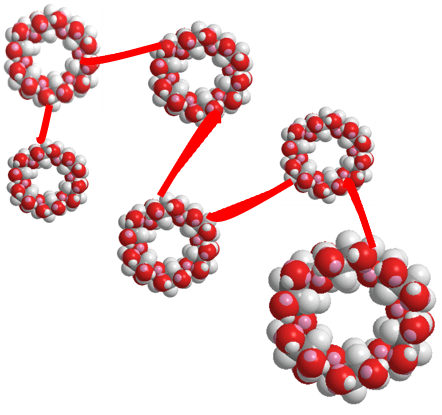
β-Cyclodextrin Polymer: Molecular-Cavity Polymers for Materials Design, Water Purification, and Soft Functional Materials
キーワード / Keywords
-
β-シクロデキストリンポリマー / β-Cyclodextrin Polymer
β-CDを高分子、ゲル、膜、粒子に組み込んだ材料です。分子を包む空洞と外側の修飾性により、吸着、分離、刺激応答へ展開できます。
EN: A polymer, gel, membrane, or particle incorporating β-CD. Its molecular cavity and modifiable exterior enable adsorption, separation, and responsive functions. -
ホスト–ゲスト相互作用 / Host–Guest Interaction
β-CDの空洞に別の分子が入り込む現象です。薬、汚染物質、油分子、イオンなどを選んで捕まえ、材料機能へ変換できます。
EN: A process in which another molecule enters the β-CD cavity. It can capture drugs, pollutants, oil molecules, or ions and convert recognition into material function. -
超分子材料 / Supramolecular Materials
共有結合だけでなく、包接、水素結合、静電相互作用などの弱い力で組み上がる材料です。自己修復や再構成に向きます。
EN: Materials assembled through reversible interactions such as inclusion, hydrogen bonding, and electrostatic forces, useful for self-healing and reconfigurable systems. -
構造化液体 / Structured Liquid
液体の界面に分子集合体を作り、液体に形や力学的安定性を持たせる技術です。柔らかいロボットや再構成材料に応用されます。
EN: A liquid given shape and mechanical stability by molecular assemblies at an interface, with potential in soft robotics and reconfigurable materials. -
放射性有機廃水処理 / Radioactive Organic Wastewater Treatment
ウランなどの金属回収と有機物分解を同時に行う考え方です。β-CDポリマーはウラニル種を集める電極材料として働きます。
EN: A strategy that combines metal recovery, such as uranium extraction, with organic pollutant degradation. β-CD polymers can act as uranium-capturing electrode materials.
採用した3本 / Three Selected Papers
-
Progress in Polymer Science(2025 JIF: 32.8)
Cyclodextrin-based polymer materials and their applications – A review covering a 20-year period
DOI: 10.1016/j.progpolymsci.2026.102149 -
Nature Communications(2025 JIF: 18.1)
Arrested coalescence in structured liquids
DOI: 10.1038/s41467-026-71812-2 -
Nature Communications(2025 JIF: 18.1)
Coupling uranyl upcycling with photoelectrochemical urea degradation for radioactive organic wastewater management
DOI: 10.1038/s41467-026-72145-w
日本語版
1. シクロデキストリン高分子材料の20年を俯瞰する総説
論文: Cyclodextrin-based polymer materials and their applications – A review covering a 20-year period
掲載誌: Progress in Polymer Science
DOI: 10.1016/j.progpolymsci.2026.102149
- この総説は、シクロデキストリンを使った高分子材料の発展を、約20年の研究動向として整理したものです。
- かつてシクロデキストリンは、水に溶けにくい分子を扱いやすくする補助剤として注目されていました。
- 現在では、ポリマー、ハイドロゲル、ナノスポンジ、繊維、金属有機構造体など、多様な材料の中心的な構成要素になっています。
- β-CDポリマーは、分子を包む空洞を保ちながら、高分子ネットワークとして形や強度、吸着性を与えられる点が特徴です。
- 応用分野は、医薬、環境浄化、食品、分析化学、材料工学まで広がっています。
- さらに、持続可能性、ライフサイクル評価、AI支援材料設計、産業化や規制面の課題も議論されています。
- 一般向けに言えば、「分子を包む小さな輪を、社会で使える高分子材料へどう進化させるか」をまとめた地図のような論文です。
2. β-CD誘導体で液体の形を保つ、構造化液体の研究
論文: Arrested coalescence in structured liquids
掲載誌: Nature Communications
DOI: 10.1038/s41467-026-71812-2
- この研究は、水に溶ける星型β-シクロデキストリン誘導体を使って、油と水の界面に分子集合体を作る方法を示しています。
- 通常、液体の滴同士が触れると合体しますが、この系では界面にできる分子の膜が合体を途中で止めます。
- β-CDの空洞は油分子と相互作用し、油滴表面に力学的に安定な構造を作ります。
- 特に芳香族炭化水素を含む系では、界面が混み合った多孔質集合体になり、液体が形を保てるようになります。
- その結果、液体でありながら、形を変えたり、再構成したり、接触しても完全には融合しない挙動を示します。
- 応用として、プログラム可能な液体材料、ソフトロボット、柔らかい機能材料への展開が期待されます。
- 一般向けに言えば、「β-CDの小さな空洞が油分子をつかみ、液体の表面に見えない骨組みを作る」研究です。
3. β-CDポリマー電極でウランを回収し、尿素も分解する廃水処理
論文: Coupling uranyl upcycling with photoelectrochemical urea degradation for radioactive organic wastewater management
掲載誌: Nature Communications
DOI: 10.1038/s41467-026-72145-w
- この研究は、放射性有機廃水からウランを回収しながら、同時に尿素を分解する光電気化学システムを開発したものです。
- 原子力関連の廃水では、金属資源の回収と有機物の分解を同時に達成することが大きな課題です。
- システムでは、光アノードにNi修飾TiO2ナノチューブ、カソードにβ-CDポリマーを担持した炭素布を用いています。
- β-CDポリマーは、ウラニル種を電極側に集め、還元・回収を進めるための捕集場として働きます。
- 低レベル放射性有機廃水を想定した条件で、ウラニル抽出効率99.08%、尿素分解効率ほぼ100%が報告されています。
- 汚染物質を除くだけでなく、ウラン資源を回収する点で、循環型の水処理技術といえます。
- 一般向けに言えば、「β-CDポリマーを使って、難しい廃水から有用な金属を取り出し、同時に水をきれいにする」研究です。
まとめ
今回の3本から、β-シクロデキストリンポリマーは、単なる分子カプセルではなく、実用材料の設計部品として広がっていることがわかります。総説は分野全体の流れを示し、構造化液体の研究はβ-CD誘導体が液体の界面を制御できることを示し、廃水処理の研究はβ-CDポリマーが資源回収と浄化を同時に担えることを示しています。共通する鍵は、β-CDの「分子を包む空洞」と「高分子として組み込める設計自由度」です。
English Version
1. A 20-year overview of cyclodextrin-based polymer materials
Paper: Cyclodextrin-based polymer materials and their applications – A review covering a 20-year period
Journal: Progress in Polymer Science
DOI: 10.1016/j.progpolymsci.2026.102149
- This review summarizes about two decades of research on cyclodextrin-based polymer materials.
- Cyclodextrins were once mainly used as solubilizing agents for poorly soluble molecules.
- They are now used as active building blocks in polymers, hydrogels, nanosponges, fibers, and metal-organic frameworks.
- β-CD polymers combine molecular cavities with polymer-network properties such as shape, strength, adsorption capacity, and processability.
- Applications span pharmaceutics, environmental purification, food technology, analytical chemistry, and materials engineering.
- The review also discusses sustainability, life-cycle assessment, AI-assisted material design, industrial scale-up, and regulatory issues.
- In simple terms, this paper maps how small molecular rings can become functional polymer materials for real-world use.
2. Structuring liquids with β-CD derivatives
Paper: Arrested coalescence in structured liquids
Journal: Nature Communications
DOI: 10.1038/s41467-026-71812-2
- This study uses water-soluble, star-shaped β-cyclodextrin derivatives to form molecular assemblies at oil-water interfaces.
- Normally, liquid droplets merge when they touch, but here the interfacial assembly can stop merging partway.
- β-CD cavities interact with oil molecules and help build a mechanically stable structure around droplets.
- Aromatic hydrocarbon-water systems form jammed, porous interfacial assemblies that make liquids shapeable and reconfigurable.
- These liquids can retain shape and show arrested coalescence on gentle contact.
- Potential applications include programmable liquid constructs, soft robotics, and reconfigurable soft materials.
- In simple terms, β-CD creates an invisible molecular framework on a liquid surface.
3. Recovering uranium while degrading urea in radioactive organic wastewater
Paper: Coupling uranyl upcycling with photoelectrochemical urea degradation for radioactive organic wastewater management
Journal: Nature Communications
DOI: 10.1038/s41467-026-72145-w
- This study develops a photoelectrochemical system that simultaneously extracts uranium and degrades urea from radioactive organic wastewater.
- Treating nuclear-related wastewater is challenging because valuable metal recovery and organic pollutant degradation must occur together.
- The system uses Ni-modified TiO2 nanotube arrays as the photoanode and β-CD polymer-loaded carbon cloth as the cathode.
- The β-CD polymer helps capture uranyl species at the electrode surface for reduction and recovery.
- In simulated low-level radioactive organic wastewater, the system achieved 99.08% uranyl extraction and nearly complete urea degradation.
- The approach supports both wastewater purification and resource recovery.
- For general readers, this work uses β-CD polymer chemistry to clean complex wastewater while recovering useful uranium resources.
Overall Takeaway
The selected papers show β-cyclodextrin polymer science moving from molecular encapsulation toward practical material design. The review provides a broad map of the field, the structured-liquid study shows how β-CD derivatives can control liquid interfaces, and the wastewater study demonstrates β-CD polymer use in simultaneous purification and resource recovery. Across these examples, the key idea is the same: β-CD cavities can be integrated into larger materials to convert molecular recognition into useful function.
文献 / References
- Crini, G.; Lacalamita, D.; Liu, C.; Fourmentin, M.; Kfoury, M.; Mongioví, C.; Fourmentin, S.; Morin-Crini, N. Cyclodextrin-based polymer materials and their applications – A review covering a 20-year period. Progress in Polymer Science 179 (2026), 102149. DOI: 10.1016/j.progpolymsci.2026.102149.
- Li, P.; Feng, W.; Wen, Y.; Luo, Y.; Liu, X.; Shi, S. Arrested coalescence in structured liquids. Nature Communications 17 (2026), 5342. DOI: 10.1038/s41467-026-71812-2.
- Jin, H.; Shen, Z.; Yan, C.; Liu, Y.; Tian, Y.; Bao, H.; Ji, Z.; Hu, Y.; Zhao, G.; Wang, X.; Huang, X. Coupling uranyl upcycling with photoelectrochemical urea degradation for radioactive organic wastewater management. Nature Communications 17 (2026), 5329. DOI: 10.1038/s41467-026-72145-w.
選定メモ / Selection Note
- Progress in Polymer Science:2025 JIF 32.8
- Nature Communications:2025 JIF 18.1
添付ファイル内には、β-CDポリマーによる染料分離膜、RNA送達、ポルフィリン担持ゲル、ゲスト–ホスト型生体材料、クロマトグラフィー固定相、応力可視化ヒドロゲルなど多くの関連研究も含まれていました。本稿では、添付ファイル内限定を守りつつ、β-cyclodextrin polymerとの関連性が明確で、かつジャーナル指標が高い3本を優先しました。