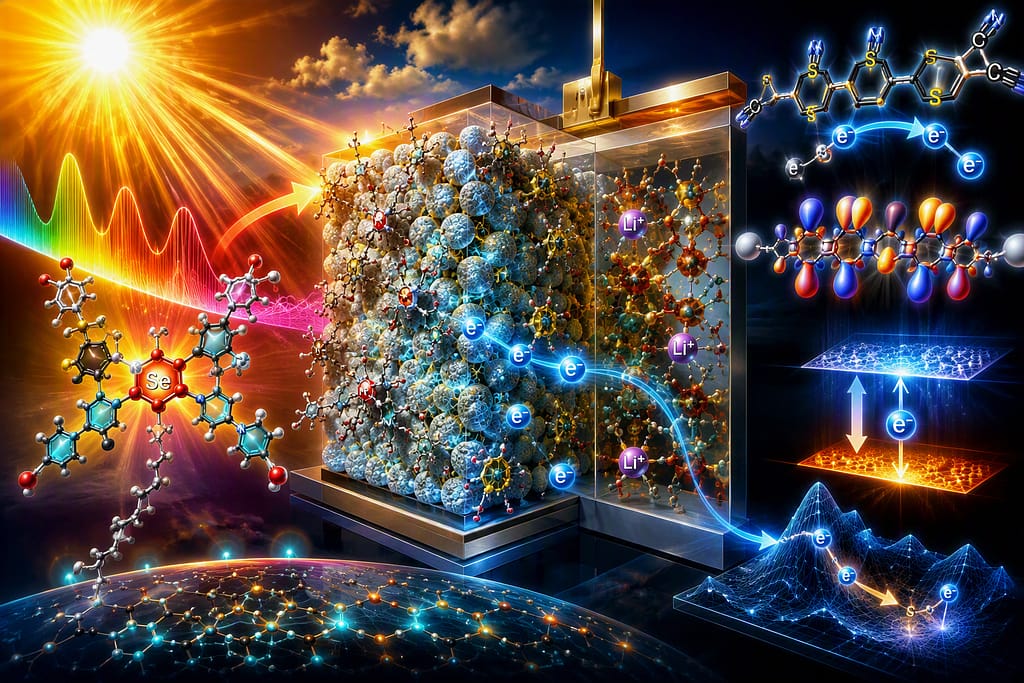
DSSC: New Directions in Low-Cost Solar Cells through Dyes, Electrolytes, and Electrodes
キーワード / Keywords
-
DSSC / Dye-Sensitized Solar Cell
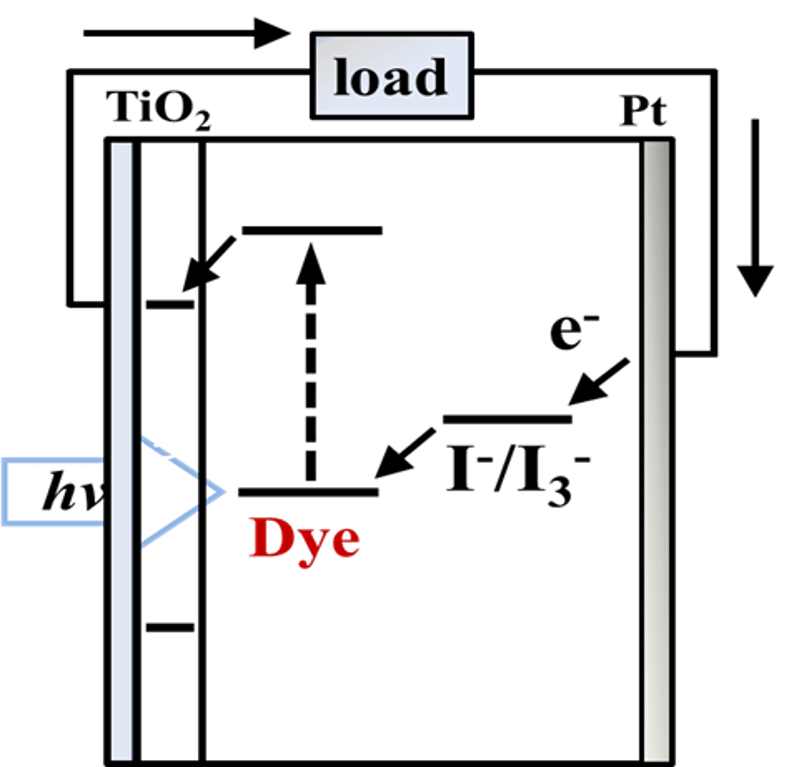
色素が光を吸収し、半導体へ電子を渡して発電する太陽電池です。構造が比較的単純で、低コスト化や室内光利用が期待されます。
EN: A solar cell in which a dye absorbs light and injects electrons into a semiconductor, offering potential for low-cost and indoor-light photovoltaics. -
光増感色素 / Photosensitizer
太陽光を受け取る中心分子です。吸収波長、電子を渡す力、TiO2表面への固定性が、DSSCの電流と効率を左右します。
EN: The key light-absorbing molecule. Its absorption range, electron-injection ability, and binding to TiO2 strongly affect current and efficiency. -
πスペーサー / π-Spacer
色素分子内で電子の流れ道になる共役部分です。長さや構造を変えると、吸収色、電荷移動、発電性能を調整できます。
EN: A conjugated bridge that supports electron movement inside dye molecules. Changing it tunes absorption, charge transfer, and device performance. -
深共晶溶媒 / Deep Eutectic Solvent
複数成分を混ぜることでできる、低揮発で比較的扱いやすい溶媒です。DSSC電解質の安定性向上に役立つ可能性があります。
EN: A low-volatility solvent formed by mixing components. It can help improve electrolyte stability in DSSCs. -
光電変換効率 / Power Conversion Efficiency
入った光エネルギーをどれだけ電気に変えられるかを示す指標です。短絡電流、開放電圧、曲線因子の組み合わせで決まります。
EN: A metric showing how much incoming light becomes electricity. It depends on short-circuit current, open-circuit voltage, and fill factor.
採用した3本 / Three Selected Papers
-
Chemical Science(2025 JIF: 8.1)
Chalcogenide substitution for the synthesis of dye MSe5: a benzoselenadiazole photosensitizer for high-performance DSSCs
DOI: 10.1039/d5sc07460f -
Solar Energy Materials and Solar Cells(2025 JIF例: 6.6 / 2024-2025 Impact Score: 6.88)
Overcoming the efficiency-stability trade-off in DSSCs: Engineered Zn2SnO4 photoanodes with optimized deep eutectic solvent electrolytes
DOI: 10.1016/j.solmat.2026.114530 -
Spectrochimica Acta Part A: Molecular and Biomolecular Spectroscopy(2025 JIF: 4.8 / 2024-2025 Impact Score: 4.91)
DFT investigation of thiophene-based auxiliary acceptors and π-conjugated linkers in the photosensitization mechanism of dye-sensitized solar cells
DOI: 10.1016/j.saa.2026.128380
日本語版
1. セレンを入れた新色素MSe5で、高性能DSSCをめざす
論文: Chalcogenide substitution for the synthesis of dye MSe5: a benzoselenadiazole photosensitizer for high-performance DSSCs
掲載誌: Chemical Science
DOI: 10.1039/d5sc07460f
- この研究は、DSSC用の新しいD-π-A型色素として、ベンゾセレナジアゾールを含むMSe5を設計・合成したものです。
- 従来の硫黄を含む類似色素に対し、セレンへの置換が分子内電荷移動を強め、バンドギャップを狭くします。
- バンドギャップが狭くなることで、より長波長側の光も利用しやすくなり、光の取り込みが改善されます。
- TiO2表面への被覆性やエネルギー準位の整合も改善され、短絡電流密度と曲線因子の向上につながりました。
- MSe5単独のDSSCでは、既存のセレン系増感色素の中で高い部類の電力変換効率が得られました。
- さらにXY1b色素と共増感すると、全体の効率は13.3%まで向上しました。
- 一般向けに言えば、「色素の一部の原子を硫黄からセレンに替えるだけで、光を集める力と電子を渡す力を高めた」研究です。
2. Zn2SnO4光電極と深共晶溶媒で、効率と安定性の両立へ
論文: Overcoming the efficiency-stability trade-off in DSSCs: Engineered Zn2SnO4 photoanodes with optimized deep eutectic solvent electrolytes
掲載誌: Solar Energy Materials and Solar Cells
DOI: 10.1016/j.solmat.2026.114530
- この研究は、DSSCでよく問題になる「高効率だが不安定」「安定だが効率が伸びにくい」という課題に取り組んだものです。
- 光電極にはZn2SnO4ナノ粒子を用い、合成法の違いによる表面状態、欠陥密度、色素吸着性の違いを調べています。
- 共沈法で作ったZn2SnO4は、より好ましいバンドギャップ、低い欠陥密度、正の表面電荷を示し、N719色素の吸着を高めました。
- 純アセトニトリル電解質では高い効率が得られましたが、長期安定性に課題がありました。
- アセトニトリルとエタリン系深共晶溶媒を組み合わせた電解質では、効率は少し下がる一方で、長期安定性が大きく改善されました。
- 分子動力学シミュレーションにより、深共晶溶媒がLi+の過剰な表面集積を防ぎ、再結合を抑える仕組みが示されています。
- 一般向けに言えば、「電極の表面と電解液の中のイオンの動きを整えて、よく発電し、長く使えるDSSCに近づける」研究です。
3. チオフェンで電子の通り道を設計する計算化学研究
論文: DFT investigation of thiophene-based auxiliary acceptors and π-conjugated linkers in the photosensitization mechanism of dye-sensitized solar cells
掲載誌: Spectrochimica Acta Part A: Molecular and Biomolecular Spectroscopy
DOI: 10.1016/j.saa.2026.128380
- この研究は、DSSC用有機色素の分子構造を、DFTとTD-DFTで詳しく調べた計算化学研究です。
- 対象は、ドナー、補助アクセプター、π共役ブリッジ、末端アクセプターを持つD-A’-π-A型色素です。
- 特に、チオフェンを含むπブリッジが、光吸収と分子内電荷移動にどう関わるかに注目しています。
- 複数のチオフェンを含むπブリッジは、HOMO-LUMO準位の差を小さくし、吸収を長波長側へずらすと示されました。
- これは、太陽光をより広く利用し、電子を流しやすくする色素設計につながります。
- 実験の前に分子設計の方向性を絞り込めるため、DSSC色素開発の効率化にも役立ちます。
- 一般向けに言えば、「色素の中にある電子の通り道をコンピューターで調べ、より光を集める分子の形を探す」研究です。
まとめ
今回の3本は、DSSCの性能向上には、色素、光電極、電解質、そして分子設計のすべてが関わることを示しています。MSe5の研究は色素分子の原子置換、Zn2SnO4の研究は電極と電解質の最適化、チオフェン系色素の研究は計算化学による設計指針を示しています。共通する鍵は、光を吸収した後の電子の流れを、分子からデバイス全体まで丁寧に整えることです。
English Version
1. Selenium-containing MSe5 dye for high-performance DSSCs
Paper: Chalcogenide substitution for the synthesis of dye MSe5: a benzoselenadiazole photosensitizer for high-performance DSSCs
Journal: Chemical Science
DOI: 10.1039/d5sc07460f
- This study designs and synthesizes MSe5, a D-π-A photosensitizer containing a benzoselenadiazole core for DSSCs.
- Replacing sulfur with selenium strengthens intramolecular charge transfer and narrows the bandgap.
- A narrower bandgap helps the dye absorb longer-wavelength light, improving light harvesting.
- The selenium-containing dye also improves surface coverage on TiO2 and supports favorable energy-level alignment.
- These effects increase short-circuit current density and fill factor.
- MSe5 achieves a high efficiency among selenium-based DSSC sensitizers, and co-sensitization with XY1b raises the overall efficiency to 13.3%.
- In simple terms, changing one key atom in the dye structure improves how the molecule captures light and sends electrons into the solar cell.
2. Zn2SnO4 photoanodes and deep eutectic solvent electrolytes for efficiency and stability
Paper: Overcoming the efficiency-stability trade-off in DSSCs: Engineered Zn2SnO4 photoanodes with optimized deep eutectic solvent electrolytes
Journal: Solar Energy Materials and Solar Cells
DOI: 10.1016/j.solmat.2026.114530
- This study addresses a common DSSC problem: high efficiency often comes with limited long-term stability.
- Zn2SnO4 nanoparticles are used as photoanodes, and different synthesis routes are compared.
- Co-precipitated Zn2SnO4 shows lower defect density, a more favorable bandgap, and a positive surface charge that enhances N719 dye adsorption.
- A pure acetonitrile electrolyte gives high efficiency but lower long-term retention.
- A hybrid acetonitrile/ethaline deep eutectic solvent electrolyte improves long-term stability while maintaining useful device performance.
- Molecular dynamics simulations suggest that the DES-hybrid electrolyte prevents excessive Li+ accumulation on the Zn2SnO4 surface, reducing recombination and supporting dye regeneration.
- In simple terms, this work tunes both the electrode surface and the electrolyte environment to make DSSCs work better for longer.
3. Computational design rules for thiophene-based DSSC dyes
Paper: DFT investigation of thiophene-based auxiliary acceptors and π-conjugated linkers in the photosensitization mechanism of dye-sensitized solar cells
Journal: Spectrochimica Acta Part A: Molecular and Biomolecular Spectroscopy
DOI: 10.1016/j.saa.2026.128380
- This is a computational study using DFT and TD-DFT to understand organic dye structures for DSSCs.
- The dyes are D-A’-π-A systems, containing a donor, auxiliary acceptor, π-conjugated bridge, and terminal acceptor.
- The study focuses on how thiophene-based π-bridges affect light absorption and charge transfer.
- Multiple-thiophene π-bridges reduce HOMO-LUMO gaps and shift absorption toward longer wavelengths.
- This supports stronger light harvesting and more favorable charge-transfer behavior.
- The results provide molecular design guidance before experimental synthesis.
- In simple terms, this study uses computation to decide how to build better dye molecules for solar cells.
Overall Takeaway
The selected studies show that improving DSSCs requires coordinated design across dyes, photoanodes, electrolytes, and molecular architecture. The MSe5 paper highlights atom-level dye tuning. The Zn2SnO4 paper connects electrode engineering with electrolyte stability. The thiophene-linker study provides computational rules for designing future sensitizers. Together, they show that the path to better DSSCs lies in controlling electron flow from the molecule to the full device.
文献 / References
- Marin Moncusi, L.; Wu, H.; Tahuilan-Anguiano, D. E.; Martinez-Ferrero, E.; Puerto Galvis, C. E.; Palomares, E. Chalcogenide substitution for the synthesis of dye MSe5: a benzoselenadiazole photosensitizer for high-performance DSSCs. Chemical Science (2026). DOI: 10.1039/d5sc07460f.
- Estakhr, O.; Zolghadr, A. R.; Salari, H. Overcoming the efficiency-stability trade-off in DSSCs: Engineered Zn2SnO4 photoanodes with optimized deep eutectic solvent electrolytes. Solar Energy Materials and Solar Cells 306 (2026), 114530. DOI: 10.1016/j.solmat.2026.114530.
- Wei, B.; Wang, R.; Liu, Y.; Zhuang, Y.; Qu, X.; Shi, B. DFT investigation of thiophene-based auxiliary acceptors and π-conjugated linkers in the photosensitization mechanism of dye-sensitized solar cells. Spectrochimica Acta Part A: Molecular and Biomolecular Spectroscopy 363 (2026), 128380. DOI: 10.1016/j.saa.2026.128380.
選定メモ / Selection Note
- Chemical Science:2025 JIF 8.1。
- Solar Energy Materials and Solar Cells:2025 JIF例 6.6、2024-2025 Impact Score 6.88。
- Spectrochimica Acta Part A: Molecular and Biomolecular Spectroscopy:2025 JIF 4.8、2024-2025 Impact Score 4.91。