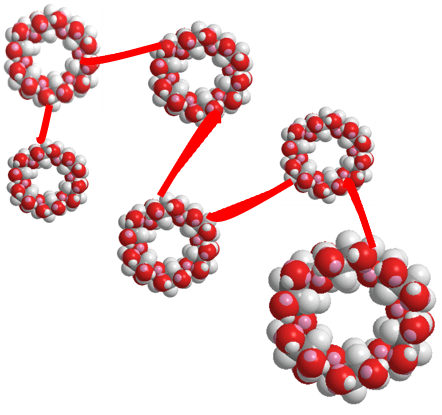
β-Cyclodextrin Polymer: Polymer Materials for Water Cleanup, Molecular Recognition, and Controlled Delivery
キーワード / Keywords
-
β-シクロデキストリンポリマー / β-Cyclodextrin Polymer
β-シクロデキストリンを高分子やゲル、膜に組み込んだ材料です。分子を包む空洞と化学修飾しやすい外側を使い、吸着、検出、薬物放出へ応用できます。
EN: A polymer, gel, or membrane incorporating β-cyclodextrin. Its molecular cavity and chemically tunable exterior enable adsorption, sensing, and controlled release. -
ホスト–ゲスト相互作用 / Host–Guest Interaction
β-CDの空洞に、汚染物質、薬、PFASなどの分子が入り込む現象です。分子を選んで捕まえる力が、吸着材やセンサーの働きの基本になります。
EN: A process in which pollutants, drugs, PFAS, or other molecules enter the β-CD cavity. This selective capture is central to adsorbents and sensors. -
水処理 / Water Decontamination
水中の分解されにくい有機汚染物質や抗生物質を取り除く技術です。β-CDポリマーは、捕集と反応を組み合わせた水浄化材料として有望です。
EN: Technologies for removing persistent pollutants and antibiotics from water. β-CD polymers can combine capture and reaction for water purification. -
PFAS検出 / PFAS Detection
PFASは分解されにくく、微量でも環境や健康への影響が懸念されます。β-CD材料はPFASを認識し、電気信号や分析信号へ変換する部品になります。
EN: PFAS are persistent contaminants of environmental concern. β-CD materials can recognize PFAS and convert that recognition into analytical or electrical signals. -
超分子リザーバー / Supramolecular Reservoir
分子を一時的に蓄え、少しずつ放出する仕組みです。β-CDナノスポンジやPVAゲルは、薬を急に出さず、必要な時間で放出する材料になります。
EN: A system that temporarily stores molecules and releases them gradually. β-CD nanosponges and PVA gels can reduce burst release and support sustained delivery.
採用した3本 / Three Selected Papers
-
Water Research(2025 update IF: 12.8)
Structure-activity relationships and rational screening of cyclodextrin polymer-confined nZVI activators for efficient persulfate oxidation of recalcitrant organic pollutants in water
DOI: 10.1016/j.watres.2026.126324 -
Journal of Water Process Engineering(2025 IF/metric: 7.34 to 7.59 depending on source)
Cyclodextrin-based electrochemical sensors for PFAS detection: From host-guest recognition to signal transduction
DOI: 10.1016/j.jwpe.2026.110523 -
Analytica Chimica Acta(2025 update IF: 6.1)
A porous phosphate-rich β-cyclodextrin polymer for efficient and broad-spectrum enrichment of antibiotics
DOI: 10.1016/j.aca.2026.345686
日本語版
1. β-CDポリマーに閉じ込めたナノ鉄で、水中のしつこい汚染物質を分解する
論文: Structure-activity relationships and rational screening of cyclodextrin polymer-confined nZVI activators for efficient persulfate oxidation of recalcitrant organic pollutants in water
掲載誌: Water Research
DOI: 10.1016/j.watres.2026.126324
- この研究は、β-シクロデキストリンなどを組み込んだポリマーの中にナノゼロ価鉄(nZVI)を閉じ込め、水中の難分解性有機汚染物質を分解する材料を設計したものです。
- シクロデキストリンの種類、鉄イオン量、架橋剤と調整剤の比率を変え、どの構造が高い反応性を生むかをモデル化しています。
- β-CDを含むポリマーは、鉄粒子の成長を制御し、小さく反応しやすいnZVIを作る助けになります。
- 最適化された材料は、過硫酸塩を活性化し、ナフタレンを繰り返し分解できました。
- 河川水や排水中でも、多環芳香族化合物、フェノール類、農薬、抗生物質などを高効率に除去できることが示されています。
- 一般向けに言えば、「β-CDポリマーを反応性の鉄の入れ物にして、水の中のしつこい汚れを壊す」研究です。
2. PFASを見つけるための、シクロデキストリン電気化学センサー
論文: Cyclodextrin-based electrochemical sensors for PFAS detection: From host-guest recognition to signal transduction
掲載誌: Journal of Water Process Engineering
DOI: 10.1016/j.jwpe.2026.110523
- この総説は、PFASを検出するためのシクロデキストリン系電気化学センサーを整理したものです。
- PFASは分解されにくく、水や生体に残りやすいため、ごく微量でも検出できる方法が求められています。
- β-CDを含むシクロデキストリン材料は、疎水性空洞や官能基を使ってPFASを認識する部品になります。
- その分子認識は、電流、電位、インピーダンスなどの測定可能な電気信号へ変換できます。
- 導電性ポリマー、ナノ構造電極、分子インプリント材料と組み合わせることで、選択性や感度を高める設計が可能になります。
- 一般向けに言えば、「β-CDの小さな穴でPFASをつかみ、その出来事を電気信号として読む」技術の全体像です。
3. 抗生物質を幅広く濃縮する、リン酸基を多く持つβ-CD多孔性ポリマー
論文: A porous phosphate-rich β-cyclodextrin polymer for efficient and broad-spectrum enrichment of antibiotics
掲載誌: Analytica Chimica Acta
DOI: 10.1016/j.aca.2026.345686
- この研究では、リン酸基を多く持つβ-CD多孔性架橋ポリマー(PCD-PCP)を作り、環境水中の抗生物質を高感度に濃縮する方法を開発しています。
- 抗生物質は種類によって水へのなじみやすさや分子構造が大きく異なり、まとめて検出するのが難しい物質群です。
- PCD-PCPは、β-CDの空洞、リン酸基、ポリマー骨格の相互作用により、6種類の分類にまたがる抗生物質を捕集できます。
- 薄膜マイクロ抽出とHPLC-MS/MSを組み合わせることで、18種類の抗生物質を高感度に同時定量できました。
- 作用には、静電相互作用、水素結合、ファンデルワールス力などが組み合わさって関わります。
- 一般向けに言えば、「水の中に少しだけ含まれるさまざまな抗生物質を、β-CDポリマーで集めて測りやすくする」研究です。
まとめ
今回の3本から、β-シクロデキストリンポリマーは、環境水中の問題物質に対して、捕まえる、壊す、見つけるという三つの役割を担えることがわかります。ナノ鉄を閉じ込めたポリマーは汚染物質を分解し、電気化学センサーはPFASを検出し、多孔性ポリマーは抗生物質を濃縮します。共通する鍵は、β-CDの空洞と高分子ネットワークを組み合わせ、分子認識を実用機能へ変える点です。
English Version
1. Breaking down stubborn pollutants with nano-iron confined in β-CD polymers
Paper: Structure-activity relationships and rational screening of cyclodextrin polymer-confined nZVI activators for efficient persulfate oxidation of recalcitrant organic pollutants in water
Journal: Water Research
DOI: 10.1016/j.watres.2026.126324
- This study designs cyclodextrin-polymer-confined nanoscale zero-valent iron (nZVI) materials for degrading recalcitrant organic pollutants in water.
- The researchers modeled how CD type, iron dosage, and crosslinking/tailoring ratios affect Fe content and activation potential.
- β-CD-containing polymer networks help control iron nucleation and growth, producing smaller and more reactive nZVI structures.
- The optimized material activates persulfate and repeatedly degrades naphthalene.
- It also removes PAHs, phenols, aromatic compounds, pesticides, and antibiotics from river water and wastewater.
- In simple terms, this work uses β-CD polymer as a molecular container and reaction platform for cleaning contaminated water.
2. Cyclodextrin electrochemical sensors for detecting PFAS
Paper: Cyclodextrin-based electrochemical sensors for PFAS detection: From host-guest recognition to signal transduction
Journal: Journal of Water Process Engineering
DOI: 10.1016/j.jwpe.2026.110523
- This review summarizes cyclodextrin-based electrochemical sensors for detecting PFAS.
- PFAS are persistent contaminants, so highly selective and sensitive detection methods are needed.
- Cyclodextrin cavities and functional groups can recognize PFAS through host-guest inclusion and interfacial interactions.
- These recognition events can be translated into measurable electrical signals such as current, voltage, and impedance changes.
- Combining CDs with nanostructured electrodes, conductive polymers, and molecularly imprinted systems can improve performance.
- For general readers, this is a sensing approach in which β-CD-like cavities “catch” PFAS and convert that event into an electrical readout.
3. A phosphate-rich β-CD porous polymer for broad-spectrum antibiotic enrichment
Paper: A porous phosphate-rich β-cyclodextrin polymer for efficient and broad-spectrum enrichment of antibiotics
Journal: Analytica Chimica Acta
DOI: 10.1016/j.aca.2026.345686
- This study develops a phosphate-rich β-CD porous crosslinked polymer, named PCD-PCP, for enriching antibiotics from environmental water.
- Antibiotics vary widely in polarity and chemical structure, making broad-spectrum monitoring difficult.
- PCD-PCP captures antibiotics through β-CD cavities, phosphate-rich functionality, and polymer-network interactions.
- When used as a thin-film microextraction coating, it enriched antibiotics from six classes more effectively than commercial HLB coatings.
- Coupling the extraction film with HPLC-MS/MS enabled simultaneous detection of 18 antibiotics at very low levels.
- In simple terms, this β-CD polymer concentrates tiny amounts of many different antibiotics so they can be measured more easily.
Overall Takeaway
The three selected papers show that β-cyclodextrin polymers can do more than simply adsorb molecules. They can degrade persistent pollutants, detect PFAS, and enrich broad classes of antibiotics for analysis. Across these examples, the central principle is the same: β-CD cavities and polymer networks transform molecular recognition into practical environmental technologies.
文献 / References
- Wang, K.; Zhao, D.; Lu, Z.; Cai, X. Structure-activity relationships and rational screening of cyclodextrin polymer-confined nZVI activators for efficient persulfate oxidation of recalcitrant organic pollutants in water. Water Research 304 (2026), 126324. DOI: 10.1016/j.watres.2026.126324.
- Vo, T. S.; Kim, K. Cyclodextrin-based electrochemical sensors for PFAS detection: From host-guest recognition to signal transduction. Journal of Water Process Engineering 91 (2026), 110523. DOI: 10.1016/j.jwpe.2026.110523.
- Peng, S.; Lin, S.; Zheng, J.; Lai, Z.; Xu, J.; Ouyang, G. A porous phosphate-rich β-cyclodextrin polymer for efficient and broad-spectrum enrichment of antibiotics. Analytica Chimica Acta 1414 (2026), 345686. DOI: 10.1016/j.aca.2026.345686.
選定メモ / Selection Note
- Water Research:2025 update IF 12.8、Impact Score 13.64として公開値が示されています。
- Journal of Water Process Engineering:2025 IF/metricとして7.34から7.59前後の公開値が示されています。
- Analytica Chimica Acta:2025 update IF 6.1、Impact Score 6.41として公開値が示されています。
添付ファイル内には、TBBPA検出蛍光ゲル、PFAS包接の実験・分子シミュレーション、PVA/β-CDナノスポンジ薬物放出、抗ウイルスPETナノファブリック、油田用一時閉塞ゲル、キラルHPLC分離などの関連研究も含まれていました。本稿では、β-cyclodextrin polymerとの関連性が明確で、かつジャーナル指標が高い3本を優先しました。