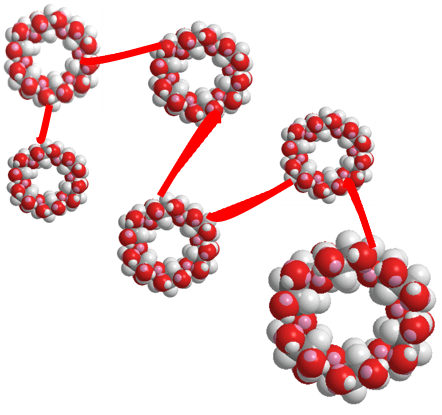
Cyclodextrin Polymer: Ring-Shaped Molecular Platforms for Selective Capture, Assembly, and Functional Materials
キーワード / Keywords
-
シクロデキストリンポリマー / Cyclodextrin Polymer
シクロデキストリンを高分子・膜・ゲル・電極などに組み込んだ材料です。分子を包み込む空洞を使い、吸着、分離、薬物送達、環境浄化などに役立ちます。
EN: A material that incorporates cyclodextrin into polymers, membranes, gels, or electrodes. Its molecular cavities enable adsorption, separation, drug delivery, and environmental cleanup. -
ホスト–ゲスト相互作用 / Host–Guest Interaction
シクロデキストリンの空洞に、汚染物質、薬、疎水性分子などが入り込む現象です。分子を選んでつかむ性質が、材料の機能を生み出す基本になります。
EN: A molecular recognition process in which pollutants, drugs, or hydrophobic molecules enter the cyclodextrin cavity, creating the foundation for selective material functions. -
超分子集合 / Supramolecular Assembly
共有結合ではなく、包接や水素結合などの弱い力で分子が集まる仕組みです。外部刺激に応じて組み替わる柔らかい材料を作るうえで重要です。
EN: A process in which molecules organize through reversible interactions such as inclusion and hydrogen bonding, enabling soft materials that can reorganize under stimuli. -
分離膜 / Separation Membrane
水やイオン、小さな分子を通し、色素や汚染物質を止める薄い材料です。シクロデキストリンポリマーを入れると水の通り道や防汚性を設計できます。
EN: A thin material that lets water or small ions pass while blocking dyes or pollutants. Cyclodextrin polymers help tune water pathways and antifouling behavior. -
資源回収 / Resource Recovery
廃水中の有用元素や物質を捨てずに取り出す考え方です。シクロデキストリンポリマーは、選択的な捕集により環境浄化と資源循環をつなげます。
EN: The idea of recovering valuable substances from wastewater instead of discarding them. Cyclodextrin polymers can connect purification with circular resource use.
採用した3本 / Three Selected Papers
-
Progress in Polymer Science(JIF 32.8)
Cyclodextrin-based polymer materials and their applications – A review covering a 20-year period
DOI: 10.1016/j.progpolymsci.2026.102149 -
Nature Communications(JIF 18.1)
Arrested coalescence in structured liquids
DOI: 10.1038/s41467-026-71812-2 -
Nature Communications(JIF 18.1)
Coupling uranyl upcycling with photoelectrochemical urea degradation for radioactive organic wastewater management
DOI: 10.1038/s41467-026-72145-w
日本語版
1. 20年の研究を俯瞰する、シクロデキストリンポリマー材料の総説
論文: Cyclodextrin-based polymer materials and their applications – A review covering a 20-year period
掲載誌: Progress in Polymer Science
DOI: 10.1016/j.progpolymsci.2026.102149
- この総説は、シクロデキストリン材料の発展を、過去20年の研究動向と応用から整理しています。
- シクロデキストリンは、もともと薬などを溶けやすくする補助剤として使われてきました。
- しかし近年は、ポリマー、ハイドロゲル、ナノスポンジ、繊維、金属有機構造体などに組み込まれ、より能動的な機能材料へ進化しています。
- 重要なのは、シクロデキストリンの空洞が分子を包み込むだけでなく、材料全体の形、強さ、拡散、吸着、放出を設計する部品になる点です。
- 応用先は、医薬、環境浄化、分離、食品、持続可能材料、機械学習を使った材料設計などに広がっています。
- 一般向けに言えば、「分子を入れる小さな輪」が、社会で使える高分子材料の設計部品へ広がってきた流れをまとめた論文です。
2. 液体を“形のある材料”にするシクロデキストリン誘導体
論文: Arrested coalescence in structured liquids
掲載誌: Nature Communications
DOI: 10.1038/s41467-026-71812-2
- この研究は、水に溶ける星型β-シクロデキストリン誘導体を使い、油と水の界面に分子を集めて液体を構造化するものです。
- 通常、液体は形を保ちにくいですが、界面に分子が詰まることで、液滴が合体しにくくなり、形をもつ柔らかい材料のように振る舞います。
- アルカン、芳香族炭化水素、ハロゲン化炭化水素など、油の種類によって界面での結合の強さや液体の挙動が変わります。
- 特に芳香族炭化水素と水の系では、硬さと空隙をあわせ持つ界面集合体が形成されました。
- その結果、液体を形づくったり、再配置したり、そっと触れたときに合体を止めたりできる可能性が示されています。
- 一般向けに言えば、「シクロデキストリンの分子認識を使って、液体そのものを柔らかい構造材料に変える」研究です。
3. 放射性有機廃水からウランを回収し、有機物も分解するシステム
論文: Coupling uranyl upcycling with photoelectrochemical urea degradation for radioactive organic wastewater management
掲載誌: Nature Communications
DOI: 10.1038/s41467-026-72145-w
- この研究は、ウラニルを含む放射性有機廃水を、資源回収と浄化の両方から扱うシステムを提案しています。
- 自立型Ni修飾TiO2ナノチューブを光陽極に、β-シクロデキストリンポリマーを含む材料を陰極に使っています。
- 光電気化学反応により、尿素の分解とウラニルの還元・回収を同時に進めます。
- 低レベル放射性有機廃水を用いた試験では、8時間でウラニル抽出効率99.08%、尿素分解効率ほぼ100%が示されました。
- これは、汚れを取り除くだけでなく、ウラン資源を再利用する考え方にもつながります。
- 一般向けに言えば、「やっかいな放射性廃水から、汚れを分解しながら有用資源を取り出す」ためのシクロデキストリンポリマー応用です。
まとめ
今回の3本から見えるのは、シクロデキストリンポリマーが単なる吸着材ではなく、分子を選んでつかむ力を利用した“材料設計のプラットフォーム”になっていることです。総説論文は分野全体の広がりを示し、構造化液体の研究は柔らかい材料への展開を示し、放射性廃水処理の研究は環境浄化と資源回収を同時に進める可能性を示しています。小さな環状分子の空洞が、医療、環境、エネルギー、持続可能社会を支える新しい材料へつながっています。
English Version
1. A 20-year overview of cyclodextrin-based polymer materials
Paper: Cyclodextrin-based polymer materials and their applications – A review covering a 20-year period
Journal: Progress in Polymer Science
DOI: 10.1016/j.progpolymsci.2026.102149
- This review summarizes two decades of progress in cyclodextrin-based polymer materials and their applications.
- Cyclodextrins were originally known mainly as solubilizing agents, especially in pharmaceutical contexts.
- Today, they are integrated into polymers, hydrogels, nanosponges, fibers, and metal-organic frameworks.
- Their cavities do more than include small molecules; they help control material morphology, mechanics, diffusion, adsorption, and release.
- Applications now extend to medicine, environmental cleanup, separation, food systems, sustainable materials, and machine-learning-assisted design.
- In simple terms, the review shows how small ring-shaped molecules have become building blocks for practical functional polymer materials.
2. Turning liquids into shapeable materials with cyclodextrin derivatives
Paper: Arrested coalescence in structured liquids
Journal: Nature Communications
DOI: 10.1038/s41467-026-71812-2
- This study uses water-soluble, star-shaped β-cyclodextrin derivatives to structure liquids at oil-water interfaces.
- Liquids normally flow and merge easily, but interfacial assemblies can prevent droplets from coalescing.
- Different oil solvents, including alkanes, aromatic hydrocarbons, and halohydrocarbons, lead to different interfacial binding energies and liquid behaviors.
- In aromatic hydrocarbon/water systems, the β-cyclodextrin derivatives form jammed but porous interfacial assemblies.
- These structured liquids can be shaped, reconfigured, and designed to undergo arrested coalescence upon gentle contact.
- For general readers, this is a way to use cyclodextrin molecular recognition to make liquids behave more like soft, programmable materials.
3. Recovering uranium while degrading organic pollutants in radioactive wastewater
Paper: Coupling uranyl upcycling with photoelectrochemical urea degradation for radioactive organic wastewater management
Journal: Nature Communications
DOI: 10.1038/s41467-026-72145-w
- This study proposes a system that treats uranyl-containing radioactive organic wastewater while recovering valuable uranium resources.
- The system uses Ni-modified TiO2 nanotube arrays as the photoanode and a β-cyclodextrin polymer-based material as the cathode.
- Under photoelectrochemical operation, urea degradation and uranyl reduction proceed at the same time.
- In low-level radioactive organic wastewater, the system achieved 99.08% uranyl extraction and nearly complete urea degradation within 8 hours.
- The work connects water purification with circular resource recovery.
- In simple terms, this is a strategy for cleaning complicated radioactive wastewater while recovering useful uranium instead of treating it only as waste.
Overall Takeaway
These three papers show that cyclodextrin polymers are becoming versatile platforms rather than simple adsorbents. The review maps the whole field, the structured-liquid paper expands cyclodextrin chemistry into soft and programmable liquid materials, and the wastewater-management study demonstrates environmental cleanup coupled with resource recovery. The common principle is molecular recognition: a small ring-shaped cavity can be embedded into larger materials to control capture, assembly, transport, and function.
文献 / References
- Crini, G.; Lacalamita, D.; Liu, C.; Fourmentin, M.; Kfoury, M.; Mongioví, C.; Fourmentin, S.; Morin-Crini, N. Cyclodextrin-based polymer materials and their applications – A review covering a 20-year period. Progress in Polymer Science 179 (2026), 102149. DOI: 10.1016/j.progpolymsci.2026.102149.
- Li, P.; Feng, W.; Wen, Y.; Luo, Y.; Liu, X.; Shi, S. Arrested coalescence in structured liquids. Nature Communications 17 (2026), 5342. DOI: 10.1038/s41467-026-71812-2.
- Jin, H.; Shen, Z.; Yan, C.; Liu, Y.; Tian, Y.; Bao, H.; Ji, Z.; Hu, Y.; Zhao, G.; Wang, X.; Huang, X. Coupling uranyl upcycling with photoelectrochemical urea degradation for radioactive organic wastewater management. Nature Communications 17 (2026), 5329. DOI: 10.1038/s41467-026-72145-w.
選定メモ / Selection Note
- Progress in Polymer Science:JIF 32.8(2025データ、2026更新値)
- Nature Communications:JIF 18.1(2025データ、2026更新値)