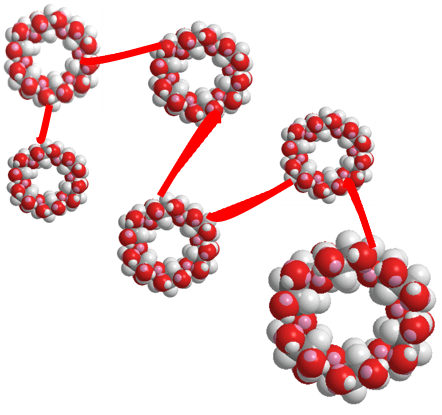
Cyclodextrin Polymers: “Molecule-Grabbing” Polymers Powering Next-Gen Materials
キーワード(5つ) / Keywords (5)
- シクロデキストリン(Cyclodextrin)
- デンプン由来の環状分子。内側の空洞に分子を取り込み、溶けにくい物質の利用や分子認識を可能にする。
- Ring-shaped molecules with a cavity that can host other molecules, enabling molecular recognition and functionalization.
- ホスト–ゲスト相互作用(Host–Guest Interaction)
- 空洞(ホスト)に分子(ゲスト)が出入りする結合。可逆で設計しやすく、自己修復・応答材料の核になる。
- Reversible binding between a host cavity and a guest molecule; key to dynamic and responsive materials.
- ポリロタキサン/スライドリング(Polyrotaxane / Slide-Ring)
- 輪(CD)が鎖に通った構造。輪が“滑る”ことで、伸びても壊れにくい柔らかさと強さを両立できる。
- Ring-on-chain architectures where rings slide, improving toughness and stretchability.
- 機能性ハイドロゲル(Functional Hydrogel)
- 水を含む柔らかい材料。導電性や粘着性などを付与すると、皮膚電極・センサー・医療材料に応用できる。
- Water-rich soft materials; adding conductivity/adhesion enables sensors and biointerfaces.
- 吸着・水浄化(Adsorption / Water Purification)
- 分子を選んで“捕まえる”設計は、水中汚染物質の除去に直結。材料の孔と認識能の両輪が重要。
- Designing selective capture of pollutants links directly to advanced water purification materials.
概要(一般向け) / Overview (for general audiences)
日本語
シクロデキストリン(CD)は、分子を中に取り込める“空洞”をもつ環状分子です。この性質をポリマー(高分子)設計に組み込むと、
– ほしい分子だけを“選んでつかむ”(分子認識・吸着)
– 材料が伸びても壊れにくい(輪が滑る=スライドリング)
– ゲルに導電性や粘着性などの機能を与える(センサー・エネルギー材料)
といった、「構造」×「機能」の発想で応用が一気に広がります。
English
Cyclodextrins (CDs) are ring-shaped molecules with a host cavity. Embedding this “molecule-hosting” capability into polymers enables:
– selective capture (molecular recognition/adsorption),
– high stretchability and toughness (slide-ring architectures),
– functional hydrogels for sensing and energy devices.
In short, CD polymers connect molecular design to real-world functions.
注目論文 / Selected Top 3 Papers (by Journal Impact Factor)
1) 水浄化のための“分子をつかむ材料設計”総説
1) Review: Designing “Molecule-Capturing” Porous Materials for Water Purification
Journal: Coordination Chemistry Reviews(JIF 23.5, 2024)
Paper: Porous materials for adsorption of aqueous pollutants: from discrete macrocyclic hosts to extended porous frameworks
DOI: 10.1016/j.ccr.2024.216256
かみ砕きポイント / Plain-language takeaways
- 汚染物質を“たくさん吸う”だけでなく、“選んで強くつかむ”設計が効く(分子認識が鍵)。
- クラウンエーテルやシクロデキストリンなどのホスト分子から、MOF/COFのような枠組み材料まで俯瞰。
- 今後は「容量」だけでなく、残留濃度をどこまで下げられるかが重要になる、という設計指針が示される。
- Beyond high capacity, selective and strong binding is crucial for trace pollutants.
- Reviews macrocyclic hosts (including cyclodextrins) and porous frameworks (MOFs/COFs).
- Emphasizes design goals such as lowering residual concentration, not just adsorption amount.
2) “輪が滑る”電解質で、安全で長寿命な全固体電池へ
2) Slide-Ring Electrolytes for Fire-Safe, Long-Cycling All-Solid-State Batteries
Journal: Advanced Functional Materials(JIF 19.0, 2024)
Paper: Bifunctional Polyrotaxane-Based Electrolytes Enable Long-Cycling and Fire-Safe All-Solid-State Lithium Metal Batteries
DOI: 10.1002/adfm.202526101
かみ砕きポイント / Plain-language takeaways
- α-シクロデキストリンが鎖に通ったポリロタキサン構造が、材料の硬さとイオン移動を両立しやすい。
- 難燃性や界面安定化など、安全性にも効く設計要素を組み込んでいる。
- “燃えにくい”だけでなく、繰り返し充放電に耐える方向性を示す。
- Polyrotaxane (cyclodextrin-on-chain) architectures help balance mechanics and ion transport.
- The design targets safety (flame retardancy) and interface stability.
- Demonstrates a pathway toward durable all-solid-state lithium metal batteries.
3) 伸びる・導電・自己生成:柔らかい電子材料のためのCDハイドロゲル
3) Stretchable, Conductive CD Hydrogels for Flexible Electronics
Journal: Chemical Science(JIF 7.5, 2024)
Paper: Stretchable cyclodextrin slide-ring copolymer self-generating hydrogels for high-performance flexible electronics
DOI: 10.1039/d6sc00045b
かみ砕きポイント / Plain-language takeaways
- シクロデキストリンを含むスライドリング(輪が動く)架橋で、従来より大きく伸びるハイドロゲルを設計。
- 導電性材料を組み合わせ、曲げ・伸ばしに強い柔軟電子(ウェアラブル等)へ。
- “硬くすると脆い”というジレンマを、構造設計で回避する発想が読みどころ。
- Slide-ring crosslinks enable large stretchability without catastrophic failure.
- Coupling with conductive components targets flexible/wearable electronics.
- Shows how structural design can mitigate the trade-off between stiffness and brittleness.
参考文献 / References
- Hou, B. et al. Porous materials for adsorption of aqueous pollutants: from discrete macrocyclic hosts to extended porous frameworks. Coordination Chemistry Reviews (2026). DOI: https://doi.org/10.1016/j.ccr.2024.216256
- Chen, Q. et al. Bifunctional Polyrotaxane-Based Electrolytes Enable Long-Cycling and Fire-Safe All-Solid-State Lithium Metal Batteries. Advanced Functional Materials (2025/2026). DOI: https://doi.org/10.1002/adfm.202526101
- Pan, X. et al. Stretchable cyclodextrin slide-ring copolymer self-generating hydrogels for high-performance flexible electronics. Chemical Science (2026). DOI: https://doi.org/10.1039/d6sc00045b