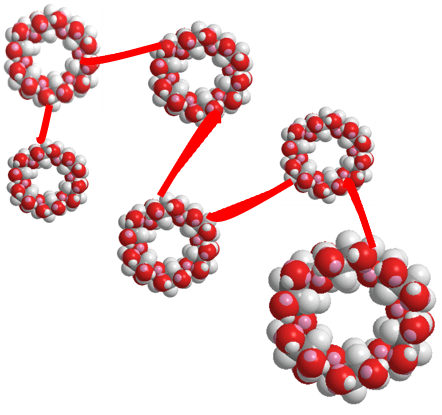
Cyclodextrin Polymer: Smart Polymer Materials Built from Ring-Shaped Molecules
キーワード / Keywords
-
シクロデキストリンポリマー / Cyclodextrin Polymer
シクロデキストリンを高分子やゲルに組み込んだ材料です。分子を包み込む穴と、柔らかい高分子構造をあわせ持つため、水処理・医療・電池などへ応用できます。
EN: A material that incorporates cyclodextrin into polymers or gels. It combines molecular cavities with flexible polymer networks for applications in water treatment, medicine, and batteries. -
ホスト–ゲスト相互作用 / Host–Guest Interaction
シクロデキストリンの内側の空洞に、薬やイオン、有機分子などが入り込む現象です。接着、薬物放出、イオン移動の制御など、材料機能の中心になります。
EN: A phenomenon in which molecules or ions enter the inner cavity of cyclodextrin. It is central to adhesion, drug release, and controlled ion transport. -
ハイドロゲル / Hydrogel
水を多く含む柔らかい高分子材料です。生体に近い性質を示し、傷の治療、薬の放出、柔軟な電池材料などに利用できる可能性があります。
EN: A soft polymer material containing a large amount of water. Its tissue-like properties make it useful for wound care, drug delivery, and flexible battery systems. -
イオン輸送 / Ion Transport
電池や生体膜では、イオンがどれだけ速く安全に動けるかが性能を決めます。シクロデキストリンポリマーは、イオンの通り道や動き方を整える役割を担えます。
EN: In batteries and biological systems, performance depends on how efficiently ions move. Cyclodextrin polymers can organize ion pathways and regulate transport. -
スマート材料 / Smart Materials
温度、光、酵素、電場などの刺激に応答して性質を変える材料です。シクロデキストリンの包接機能と高分子構造を組み合わせることで実現しやすくなります。
EN: Materials that change their behavior in response to stimuli such as temperature, light, enzymes, or electric fields. Cyclodextrin-based polymer design is well suited for this purpose.
採用した3本 / Three Selected Papers
-
Advanced Materials:A Unified Polymer Hydrogel Electrolyte Integrating Robust Adhesion, Self-Healing, and Oxygen Permeability in Flexible Neutral Zn-Air Batteries
選定理由:添付ファイル内のシクロデキストリン含有ポリマーハイドロゲル研究のうち、掲載誌の影響度が最も高い研究として採用しました。 -
Advanced Functional Materials:MMP-2/Temperature Dual-Responsive Smart Eutectogels With Strong Tissue Adhesion, Superior Stability, and Adaptability for Glaucoma Treatment
選定理由:β-シクロデキストリンを使ったスマートゲル型薬物送達材料で、医療応用に近い高機能ポリマー材料として採用しました。 -
ACS Energy Letters:Active Interfacial Solvation Architecture for Highly Reversible Zinc Metal Anodes
選定理由:β-シクロデキストリンとポリマーフレームワークを使い、水系亜鉛電池の界面を分子レベルで制御する研究として採用しました。
日本語版
1. 柔らかく、くっつき、自分で直る電池用ゲル
論文: A Unified Polymer Hydrogel Electrolyte Integrating Robust Adhesion, Self-Healing, and Oxygen Permeability in Flexible Neutral Zn-Air Batteries
掲載誌: Advanced Materials
DOI: 10.1002/adma.73665
- この研究は、β-シクロデキストリンを含む高分子ハイドロゲルを、柔軟な亜鉛空気電池の電解質として使うものです。
- ゲルは、水を含む柔らかい材料でありながら、強く伸び、くっつき、傷がついても自己修復する性質を示します。
- β-シクロデキストリンによる水素結合ネットワークと、鉄イオンによる配位ネットワークが、強さと柔らかさを両立させています。
- 酸素を通しやすいことも特徴で、亜鉛空気電池に必要な反応を助けます。
- 電池としては、折り曲げや伸縮を繰り返しても界面の接触が保たれ、長いサイクル安定性が示されました。
- 一般向けに言えば、「曲げても使える電池」を支える、柔らかくて壊れにくいゼリー状材料の研究です。
2. 緑内障治療をめざす、刺激に応答するスマートゲル
論文: MMP-2/Temperature Dual-Responsive Smart Eutectogels With Strong Tissue Adhesion, Superior Stability, and Adaptability for Glaucoma Treatment
掲載誌: Advanced Functional Materials
DOI: 10.1002/adfm.76484
- この研究では、β-シクロデキストリンとフィチン酸を使って、薬を保持しやすい深共晶溶媒をつくり、それをスマートゲル材料へ展開しています。
- 目的は、緑内障治療で課題となる薬の利用効率、組織への密着性、長期安定性を改善することです。
- ゲルは、温度とMMP-2という酵素に応答して薬を放出するよう設計されています。
- 4Dプリンティングを用いて、緑内障ドレナージデバイスとして使える形状へ加工されています。
- 動物実験では、眼圧の制御や線維化の抑制、組織構造の改善につながる可能性が示されています。
- 一般向けに言えば、「必要な場所で、必要なきっかけに応じて薬を出す、貼りつく医療用ゲル」の研究です。
3. 亜鉛電池の水の動きを整える分子設計
論文: Active Interfacial Solvation Architecture for Highly Reversible Zinc Metal Anodes
掲載誌: ACS Energy Letters
DOI: 10.1021/acsenergylett.6c01189
- この研究は、水系亜鉛イオン電池で問題になる、亜鉛の樹枝状成長、腐食、水素発生を抑えるための界面設計です。
- β-シクロデキストリンとポリドーパミンからなる高分子フレームワークを使い、電極近くの水分子の並び方を調整しています。
- 連続した水素結合ネットワークを乱すことで、余分な水の反応を減らし、亜鉛イオンがより安定に動けるようにしています。
- その結果、亜鉛の析出が安定化し、長時間の充放電に耐えられる界面が得られました。
- 一般向けに言えば、「電池の中の水を暴れにくくして、亜鉛をきれいに出し入れする」ための分子レベルの工夫です。
まとめ
シクロデキストリンポリマーは、単なる「包み込む分子」ではなく、柔らかいゲル、医療用接着材料、電池の界面制御材料へと発展しています。今回の3本からは、シクロデキストリンの空洞、ヒドロキシ基、水素結合、ポリマー骨格を組み合わせることで、エネルギー、医療、環境に役立つスマート材料を設計できることが見えてきます。
English Version
1. A soft, adhesive, and self-healing gel for flexible batteries
Paper: A Unified Polymer Hydrogel Electrolyte Integrating Robust Adhesion, Self-Healing, and Oxygen Permeability in Flexible Neutral Zn-Air Batteries
Journal: Advanced Materials
DOI: 10.1002/adma.73665
- This study uses a β-cyclodextrin-containing polymer hydrogel as an electrolyte for flexible neutral zinc-air batteries.
- The gel is soft and water-rich, yet it shows strong adhesion, high stretchability, and autonomous self-healing.
- A hydrogen-bonding network involving β-cyclodextrin and a coordination network involving iron ions work together to balance toughness and flexibility.
- The material also allows oxygen to pass through, which is important for the reactions in zinc-air batteries.
- The resulting battery system maintained good interfacial contact even under repeated folding and stretching.
- In simple terms, this is a jelly-like material that may help make flexible, wearable, and mechanically durable batteries.
2. A stimulus-responsive smart gel for glaucoma treatment
Paper: MMP-2/Temperature Dual-Responsive Smart Eutectogels With Strong Tissue Adhesion, Superior Stability, and Adaptability for Glaucoma Treatment
Journal: Advanced Functional Materials
DOI: 10.1002/adfm.76484
- This study uses β-cyclodextrin and phytic acid to create a deep eutectic solvent, which is then incorporated into a smart gel drug-delivery system.
- The goal is to improve drug utilization, tissue adhesion, and long-term stability for glaucoma treatment.
- The gel is designed to release drug molecules in response to temperature and the enzyme MMP-2.
- The researchers used 4D printing to fabricate a glaucoma drainage device from this smart gel.
- In vivo results suggest potential benefits for intraocular pressure control, fibrosis suppression, and extracellular matrix remodeling.
- For general readers, this is a medical gel that can adhere to tissue and release medicine when specific biological cues are present.
3. Molecular control of water at zinc battery interfaces
Paper: Active Interfacial Solvation Architecture for Highly Reversible Zinc Metal Anodes
Journal: ACS Energy Letters
DOI: 10.1021/acsenergylett.6c01189
- This work addresses key problems in aqueous zinc-ion batteries, including dendrite growth, corrosion, and hydrogen evolution.
- A β-cyclodextrin and polydopamine-based polymer framework is used to reorganize water molecules near the zinc surface.
- By disrupting continuous hydrogen-bond networks, the interface reduces the activity of free water and supports more stable zinc-ion transport.
- This leads to smoother and more reversible zinc deposition over long-term cycling.
- In simple terms, the material helps “calm down” water inside the battery so that zinc can move in and out more cleanly.
Overall Takeaway
Cyclodextrin polymers are no longer just molecular containers. They are becoming platforms for soft gels, medical adhesives, and battery interface materials. The three selected studies show that by combining cyclodextrin cavities, hydroxyl groups, hydrogen bonding, and polymer frameworks, researchers can design smart materials for energy, healthcare, and environmental technologies.
文献 / References
- Sun, Z.; Liao, K.; Zhou, W.; Shao, Z. A Unified Polymer Hydrogel Electrolyte Integrating Robust Adhesion, Self-Healing, and Oxygen Permeability in Flexible Neutral Zn-Air Batteries. Advanced Materials (2026). DOI: 10.1002/adma.73665.
- Zhang, Y.; Jiang, M.; Zhang, S.; Dong, A.; Zhang, F.; Liu, Y.; Yuan, H.; Leng, J. MMP-2/Temperature Dual-Responsive Smart Eutectogels With Strong Tissue Adhesion, Superior Stability, and Adaptability for Glaucoma Treatment. Advanced Functional Materials (2026). DOI: 10.1002/adfm.76484.
- Li, D.; Shuai, Y.; Yang, Z.; Liu, Y.; Wang, H.; Luo, X. Active Interfacial Solvation Architecture for Highly Reversible Zinc Metal Anodes. ACS Energy Letters (2026). DOI: 10.1021/acsenergylett.6c01189.
インパクトファクター選定メモ / Impact-Factor Selection Note
- Advanced Materials:2024 JIF 26.8、2025更新値として29.1を示すデータもあります。
- Advanced Functional Materials:2024 JIF 19.0、2025更新値として19.9を示すデータもあります。
- ACS Energy Letters:2024–2025系の指標として17.5前後の値が示されています。
本稿では、添付ファイル内に含まれる論文情報を対象とし、ジャーナル指標の高い順に上記3本を採用しました。