OLED TPD: Three Perspectives on Hole Transport and Emission Stability in Organic Light-Emitting Diodes
キーワード / Keywords
-
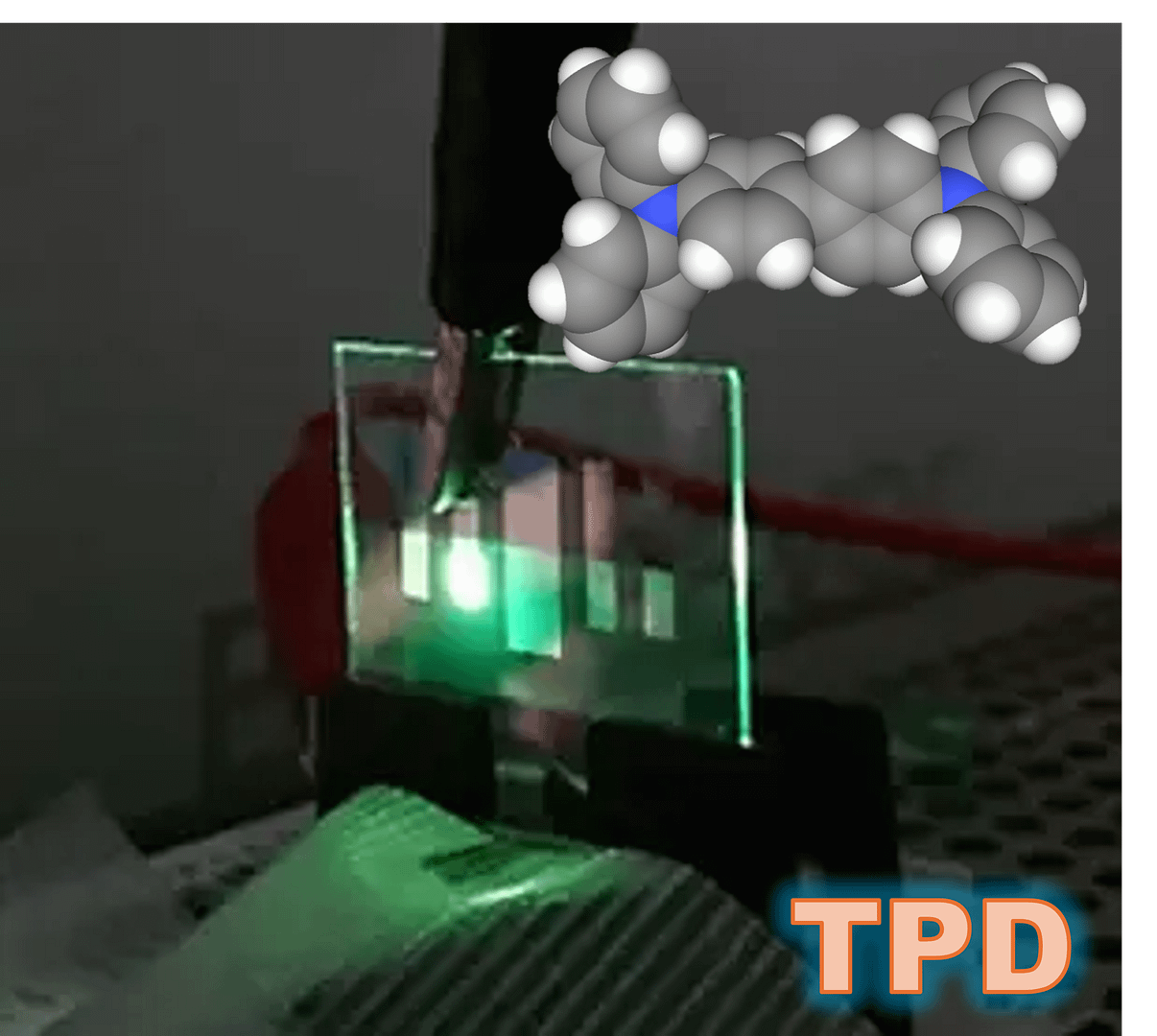
TPD / P-TPD
OLEDで正孔を運ぶ材料群として使われる有機半導体です。電荷の流れを整えることで、発光層の効率や色、安定性に影響します。
EN: TPD/P-TPD molecules or polymers act as hole-transporting organic semiconductors and influence charge balance, emission color, and device stability. -
正孔輸送 / Hole Transport
OLEDでは電子と正孔が出会って光を出します。正孔輸送が適切でないと、発光位置や効率が乱れ、明るさや寿命が低下します。
EN: OLEDs emit light when electrons and holes meet. Proper hole transport helps control where recombination occurs and improves brightness and lifetime. -
重水素化 / Deuteration
分子中の水素を重水素に置き換える設計です。振動による劣化を抑え、OLED材料の寿命や高輝度時の安定性改善に役立ちます。
EN: Deuteration replaces hydrogen with deuterium, suppressing vibrational degradation and improving OLED stability and lifetime. -
ハイパーフルオレッセンス / Hyperfluorescence
増感材料で励起子を集め、発光分子で色純度の高い光を出す方式です。深青色OLEDの高効率化と狭帯域発光に有効です。
EN: Hyperfluorescence uses a sensitizer to harvest excitons and a terminal emitter to produce narrow, color-pure light. -
カーボン量子ドット / Carbon Quantum Dots
ナノサイズの炭素系発光材料です。P-TPD層へ混ぜることで電子輸送や発光色を変え、白色や青色OLED設計に使えます。
EN: Carbon quantum dots are nanoscale carbon emitters that can tune charge transport and emission color when blended with P-TPD.
採用した3本 / Three Selected Papers
-
Nature Photonics(2025 JIF: 38.1)
Deuterated compounds for organic light-emitting diodes
DOI: 10.1038/s41566-026-01917-z -
Advanced Optical Materials(2025 JIF: 7.2)
Low Roll-Off Deep-Blue Hyperfluorescence OLEDs With Sterically Engineered Emitter
DOI: 10.1002/adom.71368 -
Journal of Materials Science: Materials in Electronics(2025 JIF: 3.2)
Charge carrier transport in a P-TPD:carbon quantum dots layer and electroluminescence of the related OLED
DOI: 10.1007/s10854-026-17726-7
日本語版
1. 重水素化でOLEDの効率・寿命・高輝度安定性を改善する
論文: Deuterated compounds for organic light-emitting diodes
掲載誌: Nature Photonics
DOI: 10.1038/s41566-026-01917-z
- この総説は、OLED材料を「重水素化」することで、効率や寿命、明るく光らせたときの安定性を改善する研究動向を整理しています。
- OLEDはスマートフォンやテレビなどで広く使われていますが、高輝度での効率低下や材料劣化はまだ重要な課題です。
- 重水素化とは、分子中の水素を重水素に置き換える分子設計です。
- 水素より重い重水素は、分子振動を変えるため、発光中に起こる劣化反応を抑えられる可能性があります。
- 蛍光材料やリン光材料、ホスト材料、発光材料など、さまざまなOLED材料で効果が検討されています。
- 実用化には、重水素化材料の合成コスト、大量生産、既存デバイス構造との相性などの課題もあります。
- TPDそのものを扱う論文ではありませんが、正孔輸送層を含むOLED全体の寿命設計を考えるうえで重要な背景になります。
- 一般向けに言えば、「発光材料の水素を少し重い原子に置き換えることで、OLEDを長持ちさせる」考え方です。
2. 分子の立体設計で、深青色OLEDの効率低下を抑える
論文: Low Roll-Off Deep-Blue Hyperfluorescence OLEDs With Sterically Engineered Emitter
掲載誌: Advanced Optical Materials
DOI: 10.1002/adom.71368
- この研究は、深青色OLEDで問題になりやすい「高輝度時の効率低下」を抑えるための分子設計を示しています。
- 深青色発光は、広色域ディスプレイやBT.2020規格に近づくために重要ですが、高効率と低ロールオフの両立が難しい領域です。
- 研究では、pICz-2TPという多重共鳴型発光体を、z軸方向の立体設計によって調整しています。
- この構造により、長距離のFörsterエネルギー移動を促し、短距離のDexterエネルギー移動を抑えることを狙っています。
- 発光体は、441 nm付近の深青色、半値幅23 nmの狭帯域発光、CIE座標(0.15, 0.05)を示しました。
- ハイパーフルオレッセンスOLEDでは、最大外部量子効率28.0%を示し、1000 cd m⁻²でも16.6%の効率を維持しました。
- TPDを直接扱う研究ではありませんが、OLED内の電荷・励起子の流れをどう制御するかという点で、正孔輸送材料設計とも関係します。
- 一般向けに言えば、「分子の形を工夫して、青く鋭く光り、明るくしても効率が落ちにくいOLEDを作る」研究です。
3. P-TPDとカーボン量子ドットで、電荷輸送と発光色を制御する
論文: Charge carrier transport in a P-TPD:carbon quantum dots layer and electroluminescence of the related OLED
掲載誌: Journal of Materials Science: Materials in Electronics
DOI: 10.1007/s10854-026-17726-7
- この研究は、P-TPDという正孔輸送性ポリマーに、カーボン量子ドット(CQDs)を混ぜた発光層をもつOLEDを調べています。
- CQDsは、クエン酸とL-フェニルアラニンを原料に、水熱合成で作られました。
- P-TPDだけでは正孔輸送が中心になりやすい一方、CQDsを入れることで電子輸送が大きく改善されました。
- CQDs濃度25 wt%では、電子移動度が正孔移動度より2桁高くなることが示されています。
- CQDsの量を変えることで、OLEDの発光色も変化しました。
- 12 wt%のCQDsを入れたデバイスでは、CIE座標(0.42, 0.39)、相関色温度3200 K、最大輝度184 cd m⁻²の暖白色発光が得られました。
- 25 wt%のCQDsでは、CIE座標(0.25, 0.28)、相関色温度14300 Kの青色発光が得られました。
- 一般向けに言えば、「P-TPDの中に光るナノ粒子を混ぜることで、電気の流れと光の色を同時に調整する」研究です。
まとめ
今回の3本は、OLED TPDというファイル名を起点に、OLEDの性能を左右する材料設計を3つの角度から示しています。重水素化は、OLED全体の寿命と高輝度安定性を支える分子設計です。深青色ハイパーフルオレッセンスは、励起子の流れを制御して高効率・高色純度を実現する発光層設計です。P-TPDとカーボン量子ドットの研究は、TPD系材料に直接関係し、正孔輸送材料にナノ発光材料を組み合わせることで、電荷輸送と発光色を調整できることを示しています。
English Version
1. Deuteration improves OLED efficiency, lifetime, and high-brightness stability
Paper: Deuterated compounds for organic light-emitting diodes
Journal: Nature Photonics
DOI: 10.1038/s41566-026-01917-z
- This review summarizes how deuterated OLED materials can improve efficiency, operational lifetime, and stability at high brightness.
- OLEDs are widely used in premium displays, but efficiency roll-off and material degradation remain important challenges.
- Deuteration replaces hydrogen atoms in a molecule with deuterium.
- Because deuterium is heavier than hydrogen, it changes molecular vibrations and can suppress degradation pathways during light emission.
- The review covers fluorescent materials, phosphorescent materials, host materials, and emitters.
- Practical challenges include synthesis cost, large-scale production, and compatibility with existing OLED device architectures.
- Although this review is not specifically about TPD, it provides an important background for designing long-lived OLED stacks that include hole-transport layers.
- In simple terms, this approach makes OLED materials more durable by replacing hydrogen with a heavier isotope.
2. Steric molecular design suppresses efficiency loss in deep-blue OLEDs
Paper: Low Roll-Off Deep-Blue Hyperfluorescence OLEDs With Sterically Engineered Emitter
Journal: Advanced Optical Materials
DOI: 10.1002/adom.71368
- This study addresses efficiency roll-off in deep-blue OLEDs, especially under high brightness.
- Deep-blue emission is important for wide-color-gamut displays and for approaching the BT.2020 color standard.
- The researchers design a multi-resonance emitter, pICz-2TP, using z-axis steric engineering.
- The molecular structure promotes long-range Förster energy transfer while suppressing short-range Dexter energy transfer.
- The emitter provides narrowband deep-blue emission around 441 nm, with a 23 nm FWHM and CIE coordinates of (0.15, 0.05).
- A hyperfluorescence OLED using this emitter reaches a peak external quantum efficiency of 28.0% and maintains 16.6% EQE at 1000 cd m⁻².
- This paper is not directly focused on TPD, but it is relevant to OLED layer design because it shows how controlling exciton flow improves efficiency and color purity.
- In simple terms, the study shapes the molecule so an OLED can emit pure deep-blue light while losing less efficiency at high brightness.
3. P-TPD and carbon quantum dots control charge transport and emission color
Paper: Charge carrier transport in a P-TPD:carbon quantum dots layer and electroluminescence of the related OLED
Journal: Journal of Materials Science: Materials in Electronics
DOI: 10.1007/s10854-026-17726-7
- This study directly examines an OLED emitting layer made from P-TPD mixed with carbon quantum dots.
- The carbon quantum dots are synthesized hydrothermally from citric acid and L-phenylalanine.
- Adding carbon quantum dots to the P-TPD matrix improves electron transport.
- At 25 wt% CQDs, the electron mobility becomes two orders of magnitude higher than the hole mobility.
- Changing the CQD concentration also changes the OLED emission color.
- With 12 wt% CQDs, the device emits warm white light with CIE coordinates of (0.42, 0.39), a correlated color temperature of 3200 K, and a maximum luminance of 184 cd m⁻².
- With 25 wt% CQDs, the device emits blue light with CIE coordinates of (0.25, 0.28) and a correlated color temperature of 14300 K.
- In simple terms, this work mixes light-emitting nanoparticles into P-TPD to tune both electric charge flow and emitted color.
Overall Takeaway
Starting from the file theme OLED TPD, the selected papers show three complementary views of OLED materials design. Deuteration improves material durability and device stability. Deep-blue hyperfluorescence controls exciton transfer to achieve high efficiency and color purity. The P-TPD/CQD study directly demonstrates how a TPD-based polymer layer can be modified to tune charge transport and emission color. Together, they illustrate how OLED performance depends not only on one molecule, but on the careful design of the whole material stack.
文献 / References
- Jansen-van Vuuren, R. D.; Yao, J.; Wang, S.-F.; Kwon, O.; Vardeny, Z. V.; Chou, P.-T.; Dong, S.-C. Deuterated compounds for organic light-emitting diodes. Nature Photonics (2026). DOI: 10.1038/s41566-026-01917-z.
- Qiu, L.; Zhang, X.; Li, H.; Wu, Z.; Lin, J.; Huang, J.; Wang, G. Low Roll-Off Deep-Blue Hyperfluorescence OLEDs With Sterically Engineered Emitter. Advanced Optical Materials (2026). DOI: 10.1002/adom.71368.
- Sayarov, I.; Borodina, A.; Kostromin, S.; Tameev, A.; Bronnikov, S. Charge carrier transport in a P-TPD:carbon quantum dots layer and electroluminescence of the related OLED. Journal of Materials Science: Materials in Electronics 37 (2026), 1322. DOI: 10.1007/s10854-026-17726-7.
選定メモ / Selection Note
- Nature Photonics:2025 JIF 38.1。
- Advanced Optical Materials:2025 JIF 7.2。
- Journal of Materials Science: Materials in Electronics:2025 JIF 3.2。
- 添付ファイル内の3件を、掲載誌のJIFが高い順に並べました。TPD/P-TPDへ直接関係する論文は3本目ですが、1本目と2本目もOLED材料・発光層・安定性設計としてファイル内の情報に基づき掲載しています。