キーワード / Keywords
- OLED(有機EL) / organic light-emitting diode
- エネルギー移動 / energy transfer
- フォースター共鳴エネルギー移動(FRET) / Förster resonance energy transfer
- ホスト–ゲスト系 / host–guest system
- TADF(熱活性化遅延蛍光) / thermally activated delayed fluorescence
- HLCT(局所励起+電荷移動混成状態) / hybridized local and charge-transfer state
- 近紫外発光 / near-ultraviolet emission
- 近赤外発光 / near-infrared emission
- 励起状態設計 / excited-state design
- 発光効率 / electroluminescence efficiency
日本語版
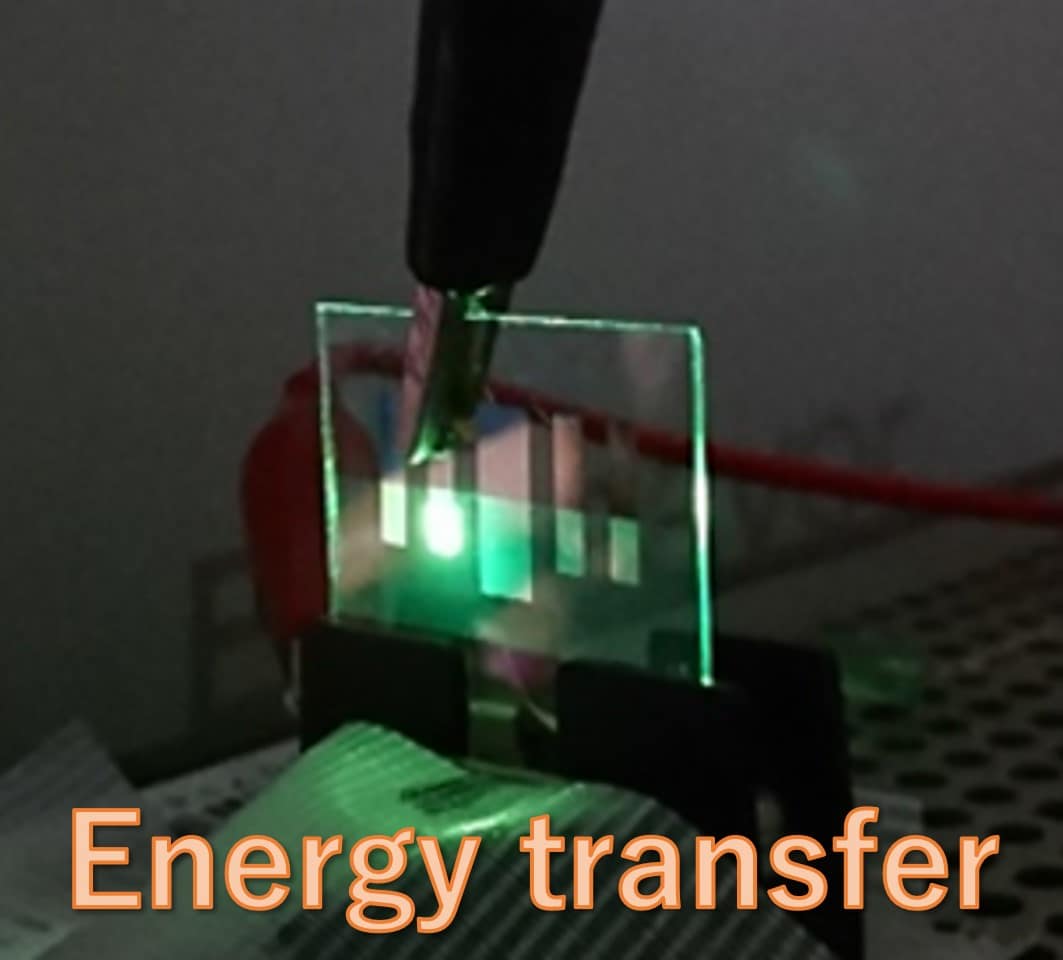
OLEDの「エネルギー移動」とは?
OLED(有機EL)では、電気から生まれた励起エネルギーを、どの分子が受け取り、どのように光へ変えるかがとても重要です。
とくに、ホスト材料から発光分子へのエネルギー移動や、分子どうしの相互作用による発光状態の変化は、発光色・効率・寿命に強く関わります。
今回のファイルでは、こうした「エネルギー移動」や「励起状態制御」に関係する研究として、次の3本が注目されました。
1. 多重共鳴コアと応答性複素環を組み合わせた多機能発光材料
論文
Chi ZM, Sun YH, Jia HL, Wang JW, Li CL, Gao Y, Zhang TY, Liu KL, Yin XD, Wang N.
Molecular hybridization of multiple resonance cores and responsive heterocycles for versatile optoelectronic and sensing applications
Journal of Materials Chemistry A (2026)
DOI: 10.1039/d6ta02492k
この論文を選んだ理由
– OLED材料としての発光機能に加え、応答性やホスト–ゲスト設計まで含む広がりがあり、将来の“賢い発光材料”として紹介しやすい研究です。
わかりやすいポイント
– この研究では、DABNA 型の多重共鳴(MR)発光コアと、環境応答性をもつ HBT/HBO 系複素環を1つの分子に組み合わせています。
– その結果、色純度の高い狭帯域発光を保ちながら、外部刺激に応じて光り方が変わる性質も持たせることに成功しています。
– さらに、結晶性の高い TPA マトリクス中にホスト–ゲストとして分散させることで、室温りん光も引き出しています。
– 論文では、OLED発光体としての可能性も示されており、単なるセンサー材料ではなく、多機能な有機発光材料としての価値があります。
– つまり、「高精細に光る」だけでなく、「周囲の環境にも反応する」次世代発光分子の設計例といえます。
一般向けに言うと…
「きれいな色で光りながら、周囲の変化にも反応できる“多才な有機EL材料”をつくった研究」 です。
2. 近紫外発光とホスト機能を両立した HLCT 材料
論文
Zhu KM, Zhou YN, Ma CL, Li YQ, Zhou SH, Zhang L, Song JR, Sun QK, Yang WJ, Xue SF.
Bifunctional near-ultraviolet emitting materials based on hybridized local and charge-transfer (HLCT) excited states for efficient electro-fluorescence and phosphorescent OLEDs
Organic Chemistry Frontiers (2026)
DOI: 10.1039/d6qo00546b
この論文を選んだ理由
– 発光体としての役割 と ホストとしての役割 を1つの材料で担う点が、OLEDのエネルギー移動設計そのものに関係しています。
わかりやすいポイント
– この研究では、HLCT(局所励起状態と電荷移動状態が混ざった励起状態) をもつ近紫外発光分子が設計されています。
– この分子は、単独では 近紫外の電気発光材料 として働きます。
– 一方で、りん光 OLED では ホスト材料 としても使え、緑・黄・赤の発光デバイスで高い外部量子効率が報告されています。
– 高い三重項エネルギーと、整った分子配列によるバランスのよい電荷輸送が、発光効率を支えています。
– つまり、発光分子そのものが「光る役」と「エネルギーを受け渡す土台」の両方をこなす 二刀流材料 になっています。
一般向けに言うと…
「自分でも光れますし、ほかの発光分子をうまく光らせる手助けもできる、有機EL向けの万能選手」 の研究です。
3. 亜鉛錯体で近赤外発光とFRETを示すOLED材料
論文
Janghouri M, Dolatyari MP, Bahrami A, Daud NAM, Quah CK, Marandi F.
Unusual solid-state near-infrared emission of zinc complexes: Synthesis, spectroscopic, structural studies, Hirshfeld surface analysis, photophysical properties and OLED applications
Journal of Molecular Structure (2026)
DOI: 10.1016/j.molstruc.2026.146497
この論文を選んだ理由
– 本文中で efficient Förster resonance energy transfer が明確に示されており、テーマと非常に相性のよい研究です。
わかりやすいポイント
– この研究では、Zn(II) 錯体を合成し、その発光特性と OLED への応用を調べています。
– 溶液中では主に緑色発光ですが、固体状態では 約728 nm の近赤外発光 が観測されました。
– この長波長発光は、固体中で分子どうしが近づくことで生じる 特殊な励起状態 に由来すると考えられています。
– さらに、OLEDデバイスでは フォースター共鳴エネルギー移動(FRET) が効率よく起こることが示され、電流–電圧特性も安定でした。
– これは、分子どうしのエネルギー受け渡しを上手く使うことで、新しい発光色や機能を引き出せることを示しています。
一般向けに言うと…
「分子どうしのエネルギーの受け渡しを利用して、普通とは少し違う近赤外の光を出す有機EL材料の研究」 です。
まとめ
- 今回のファイルに含まれていた OLED 関連研究では、
- 高色純度かつ応答性をもつ発光材料
- 発光体とホストを兼ねる二機能材料
- FRETを使って新しい発光を引き出す錯体材料
という3つの方向が見られました。 - 共通しているのは、単に「光る分子」をつくるだけでなく、励起エネルギーをどう移すか・どう活かすか を重視している点です。
- こうした研究は、将来的に 高効率OLED、高色純度ディスプレイ、近赤外発光デバイス などへつながる可能性があります。
English Version
What does “energy transfer” mean in OLEDs?
In OLEDs, it is crucial to control which molecules receive the excitation energy generated by electricity and how that energy is converted into light.
In particular, energy transfer from host materials to emitters and changes in excited states caused by intermolecular interactions strongly affect emission color, efficiency, and lifetime.
Among the uploaded papers, the following three stood out as representative studies related to energy transfer and excited-state design.
1. Multifunctional luminescent materials combining multiple-resonance cores and responsive heterocycles
Paper
Chi ZM, Sun YH, Jia HL, Wang JW, Li CL, Gao Y, Zhang TY, Liu KL, Yin XD, Wang N.
Molecular hybridization of multiple resonance cores and responsive heterocycles for versatile optoelectronic and sensing applications
Journal of Materials Chemistry A (2026)
DOI: 10.1039/d6ta02492k
Why this paper was selected
– It appeared in the highest-impact journal among the uploaded candidates.
– It presents a broad and accessible example of a future “smart luminescent material” that combines OLED relevance with environmental responsiveness.
Easy-to-understand points
– This study combines a DABNA-type multiple resonance (MR) emissive core with HBT/HBO heterocycles that are sensitive to the surrounding environment.
– As a result, the molecules maintain narrow-band, high-color-purity emission while also becoming responsive to external stimuli.
– When incorporated into a highly crystalline TPA host matrix, they can also show room-temperature phosphorescence.
– The paper further demonstrates preliminary electroluminescence, showing their relevance as OLED-active materials.
– In short, these are examples of molecules designed not only to emit clean light, but also to respond intelligently to their environment.
In simple words…
This is a study on smart OLED-related molecules that emit very pure color while also responding to environmental changes.
2. HLCT materials that function both as near-UV emitters and as hosts
Paper
Zhu KM, Zhou YN, Ma CL, Li YQ, Zhou SH, Zhang L, Song JR, Sun QK, Yang WJ, Xue SF.
Bifunctional near-ultraviolet emitting materials based on hybridized local and charge-transfer (HLCT) excited states for efficient electro-fluorescence and phosphorescent OLEDs
Organic Chemistry Frontiers (2026)
DOI: 10.1039/d6qo00546b
Why this paper was selected
– It was published in a high-impact journal, and the material directly addresses OLED energy-transfer design because it serves both as an emitter and as a host.
Easy-to-understand points
– The study designed a near-ultraviolet-emitting molecule with an HLCT excited state, meaning a hybrid of local excitation and charge transfer.
– As a standalone material, it works as an efficient near-UV electroluminescent emitter.
– In phosphorescent OLEDs, it also functions as a host material, supporting highly efficient green, yellow, and red devices.
– Its high triplet energy and balanced bipolar transport help make energy transfer to the dopant efficient.
– This means a single material can act both as the light source and as the energy-transfer platform for another emitter.
In simple words…
This is a study on a versatile OLED material that can shine on its own and also help other emitters glow efficiently.
3. Zinc complexes showing near-infrared emission and FRET in OLEDs
Paper
Janghouri M, Dolatyari MP, Bahrami A, Daud NAM, Quah CK, Marandi F.
Unusual solid-state near-infrared emission of zinc complexes: Synthesis, spectroscopic, structural studies, Hirshfeld surface analysis, photophysical properties and OLED applications
Journal of Molecular Structure (2026)
DOI: 10.1016/j.molstruc.2026.146497
Why this paper was selected
– It was published in a journal with a high impact factor, and the paper explicitly reports efficient Förster resonance energy transfer (FRET), making it especially relevant to the uploaded file theme.
Easy-to-understand points
– The researchers synthesized Zn(II) complexes and studied their light-emission properties and OLED applications.
– In solution, the complexes mainly emit green light, but in the solid state they show an unusual near-infrared emission around 728 nm.
– This long-wavelength emission is attributed to intermolecular excited states generated by the solid matrix.
– In OLED devices, the study found efficient FRET, together with stable current–voltage behavior.
– This shows how energy transfer between molecules can be used to create new forms of light emission.
In simple words…
This is a study on OLED-related materials that use molecular energy transfer to produce unusual near-infrared light.
Take-home message
- Among the uploaded OLED-related papers, the selected studies highlight:
- high-color-purity yet responsive luminescent materials,
- bifunctional materials that work as both emitters and hosts, and
- complexes that use FRET to generate new light-emission behavior.
- The common theme is not just creating molecules that emit light, but carefully designing how excitation energy is transferred and used.
- Such studies may contribute to future high-efficiency OLEDs, high-color-purity displays, and near-infrared light-emitting devices.
参考文献 / References
- Chi ZM, Sun YH, Jia HL, Wang JW, Li CL, Gao Y, Zhang TY, Liu KL, Yin XD, Wang N. Molecular hybridization of multiple resonance cores and responsive heterocycles for versatile optoelectronic and sensing applications. Journal of Materials Chemistry A. 2026. DOI: 10.1039/d6ta02492k
- Zhu KM, Zhou YN, Ma CL, Li YQ, Zhou SH, Zhang L, Song JR, Sun QK, Yang WJ, Xue SF. Bifunctional near-ultraviolet emitting materials based on hybridized local and charge-transfer (HLCT) excited states for efficient electro-fluorescence and phosphorescent OLEDs. Organic Chemistry Frontiers. 2026. DOI: 10.1039/d6qo00546b
- Janghouri M, Dolatyari MP, Bahrami A, Daud NAM, Quah CK, Marandi F. Unusual solid-state near-infrared emission of zinc complexes: Synthesis, spectroscopic, structural studies, Hirshfeld surface analysis, photophysical properties and OLED applications. Journal of Molecular Structure. 2026. DOI: 10.1016/j.molstruc.2026.146497