キーワード / Keywords
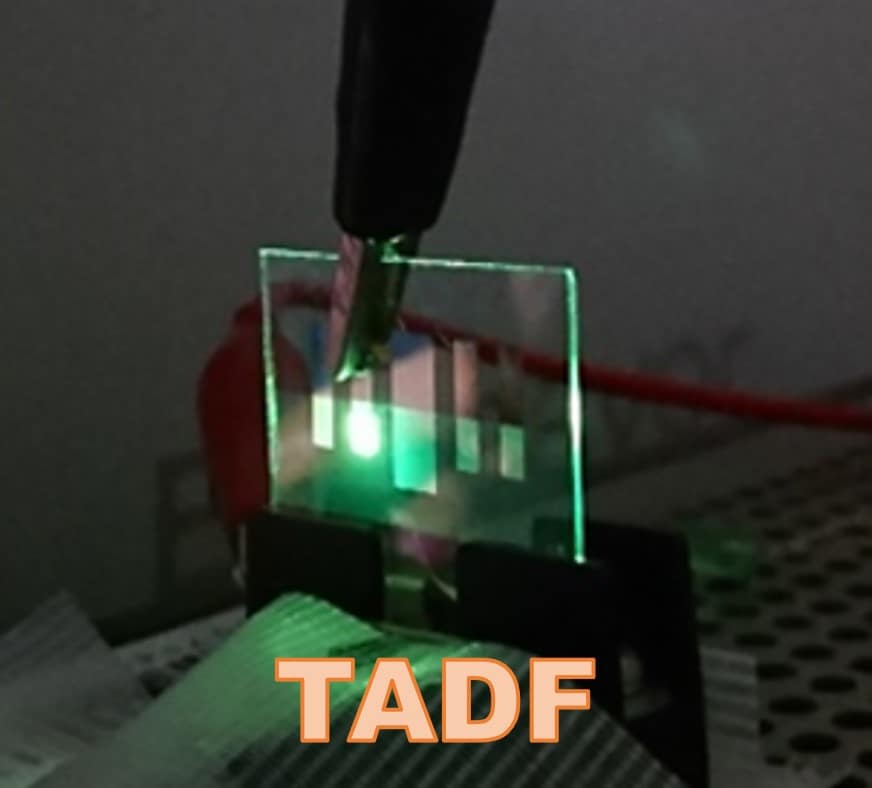
1. TADF(熱活性化遅延蛍光)
日本語:発光に使われにくい三重項励起子を、熱の助けで一重項へ戻して光に変える仕組みです。希少金属に頼らず高効率なOLEDを実現する技術として注目されています。
English: Thermally activated delayed fluorescence converts triplet excitons into emissive singlet states with thermal energy, enabling efficient OLED emission.
2. MR-TADF(多重共鳴型TADF)
日本語:分子内の電子分布を精密に制御し、狭い波長幅で鮮やかに発光するTADF材料です。高精細ディスプレイに必要な色純度と高効率の両立を目指します。
English: Multi-resonance TADF precisely controls electron distribution to produce narrowband, color-pure, and efficient emission.
3. 逆項間交差(Reverse Intersystem Crossing)
日本語:三重項励起状態を発光可能な一重項へ変換する過程です。この速度を高めると、励起エネルギーの滞留や損失を減らし、高輝度時の効率と安定性を改善できます。
English: Reverse intersystem crossing converts triplet excitons into emissive singlets, reducing energy loss and improving efficiency at high brightness.
4. 発光双極子配向(Emitting Dipole Orientation)
日本語:発光分子が光を放つ向きのそろい方です。分子を基板と平行に配向させると、素子内部に閉じ込められる光が減り、外部へ取り出しやすくなります。
English: The alignment of molecular emission dipoles, with horizontal orientation helping more generated light escape from an OLED.
5. 狭帯域発光(Narrowband Emission)
日本語:限られた波長範囲に光を集中させる発光です。赤・緑・青の色が混ざりにくくなるため、色再現性の高いディスプレイや広色域表示に役立ちます。
English: Emission concentrated within a narrow wavelength range, supporting high color purity and wide-gamut display reproduction.
日本語版
研究背景
OLEDでは、電気によって生じた電子と正孔が結びつき、励起子と呼ばれる高エネルギー状態を作ります。TADF材料は、通常の蛍光では利用しにくい三重項励起子を一重項へ戻し、発光に活用できることが特長です。なかでもMR-TADFは、発光スペクトルが狭く、鮮やかな色を得やすいため、次世代ディスプレイ材料として期待されています。
一方で、励起状態の変換が遅い、電荷輸送が偏る、熱や高輝度条件で性能が変化するといった課題があります。今回紹介する研究は、分子を平面化して光の向きを整える方法、セレンによって励起状態の変換を速める方法、ベンズイミダゾールによって電荷輸送と励起子利用を同時に改善する方法を示しています。
研究内容
1. 分子の平面化で青色OLEDの効率と寿命を向上
Spatial Planarization Controls Optical Anisotropy for Efficient and Stable Blue-Emitting OLEDs
- かさ高いカルバゾール部位をイリジウム錯体へ導入し、分子をより平面的で方向性のある形に固定しました。
- 平面化によって励起子を熱による解離から守り、発光までの時間も短縮しました。
- 発光双極子の約95%が水平方向に配向し、光を素子外へ取り出しやすくなりました。
- Hyper-OLEDでは配向効果がMR-TADF最終発光体へ伝わり、98%の水平配向を示しました。
- 470 nm、半値幅22 nmの狭帯域青色発光と、最大外部量子効率36.9%を達成しました。
- 1000 cd/m²での輝度半減寿命は446時間でした。
2. セレンを含む中心骨格で高速なTADF変換を実現
Selenophene π-Core Fusion for Simultaneous Fast Reverse Intersystem Crossing and Narrowband Long-Wavelength TADF
- MR-TADF骨格の中央ベンゼンを、セレンを含むジベンゾセレノフェン構造へ置き換えました。
- セレンによるスピン軌道相互作用の増強で、逆項間交差を高速化しました。
- 狭帯域発光を保ちながら、発光色を緑から赤の520~600 nmへ段階的に調整しました。
- 逆項間交差速度は最大10⁷ s⁻¹に達しました。
- 作製したOLEDは30%を超える外部量子効率を示しました。
- 高輝度での効率低下が抑えられ、動作寿命も改善しました。
3. 電荷輸送と励起子利用を一つの分子設計で整える
Benzimidazole functionalization enables efficient multi-resonance TADF with accelerated spin-flipping and balanced charge transport
- MR-TADF発光体へベンズイミダゾール部位を導入し、励起状態と電子輸送を同時に調整しました。
- 高い三重項状態とスピン軌道相互作用を変化させ、逆項間交差を速めました。
- 電子移動度を高め、電子と正孔の輸送差を小さくすることで、発光層内の再結合を整えました。
- 材料は狭帯域の緑色発光と、ほぼ100%のフォトルミネッセンス量子収率を示しました。
- 5~20 wt%の広いドーピング濃度範囲で安定した特性を維持しました。
- 最適化したOLEDは最大外部量子効率33.5%を達成し、高輝度での効率低下も軽減しました。
期待される応用
三つの研究は、TADF-OLEDの性能を高めるには、励起状態を光へ変える速さだけでなく、分子の向き、電荷の流れ、発光スペクトルの幅を一体的に設計する必要があることを示しています。水平配向は光取り出しを改善し、セレンを含む骨格は三重項励起子の回収を加速し、ベンズイミダゾール導入は電子と正孔のバランスを整えます。
こうした設計は、低消費電力で明るいディスプレイ、色再現性の高いテレビやモバイル端末、高輝度でも性能を保つOLEDへつながる可能性があります。今後は、大面積パネルでの分子配向と膜厚の均一性、長時間駆動時の劣化、材料合成と製造工程の再現性を検証することが重要です。
English Version
TADF for Next-Generation OLEDs: Molecular Design for Color Purity, Efficiency, and Stability
Research Background
In an OLED, injected electrons and holes combine to form excitons. TADF materials can convert normally underused triplet excitons into emissive singlet states. MR-TADF materials are particularly attractive for future displays because their narrow emission spectra provide high color purity.
Important challenges remain, including slow excited-state conversion, imbalanced charge transport, and performance changes under heat or high brightness. The studies below address these issues by planarizing molecules to control light emission, incorporating selenium to accelerate triplet harvesting, and adding benzimidazole units to improve both charge balance and exciton utilization.
Research Highlights
1. Molecular Planarization Improves Blue-OLED Efficiency and Lifetime
- Bulky carbazole units confined an iridium complex into a more planar and anisotropic molecular geometry.
- Planarization stabilized bound excitons and shortened the radiative lifetime.
- Approximately 95% horizontal emitting-dipole orientation improved intrinsic light extraction.
- In a hyper-OLED, alignment was transferred to the MR-TADF terminal emitter, producing 98% horizontal orientation.
- The optimized device achieved 470 nm emission with a 22 nm bandwidth and a maximum external quantum efficiency of 36.9%.
- Its LT50 lifetime reached 446 hours at 1000 cd/m².
2. A Selenium-Containing Core Accelerates TADF Conversion
- The central benzene of an MR-TADF scaffold was replaced with a selenium-containing dibenzoselenophene core.
- Enhanced spin-orbit coupling accelerated reverse intersystem crossing.
- Narrowband emission was retained while the color was tuned stepwise from green to red across 520–600 nm.
- Reverse intersystem crossing rates reached up to 10⁷ s⁻¹.
- The resulting OLEDs achieved external quantum efficiencies above 30%.
- Efficiency roll-off was suppressed and operational lifetime was prolonged.
3. Benzimidazole Functionalization Balances Charge and Exciton Use
- A benzimidazole fragment was incorporated into an MR-TADF emitter to tune excited states and electron transport simultaneously.
- Modified triplet states and enhanced spin-orbit coupling accelerated reverse intersystem crossing.
- Increased electron mobility reduced the mismatch between electron and hole transport.
- The emitters showed narrowband green emission and near-unity photoluminescence quantum yields.
- Stable performance was maintained across a broad 5–20 wt% doping range.
- The optimized OLED reached a maximum external quantum efficiency of 33.5% with reduced efficiency roll-off.
Potential Applications
Together, these studies show that TADF-OLED performance depends on coordinated control of excited-state conversion, molecular orientation, carrier transport, and emission bandwidth. Horizontal alignment improves light extraction, selenium-containing cores accelerate triplet harvesting, and benzimidazole functionalization balances electron and hole transport.
These strategies may support brighter and lower-power displays, televisions and mobile devices with improved color reproduction, and OLEDs that retain efficiency at practical brightness. Future development will require evaluation of molecular alignment and film uniformity over large areas, long-term degradation, and reproducibility in material synthesis and manufacturing.
References / 文献
- Wu, C.; Tong, K.-N.; Li, Y.; et al. Spatial Planarization Controls Optical Anisotropy for Efficient and Stable Blue-Emitting OLEDs. Advanced Materials (2026), Early Access. DOI: 10.1002/adma.74617
- Zhang, J.; Lee, J. H.; Liu, G.; Mori, T.; Yasuda, T. Selenophene π-Core Fusion for Simultaneous Fast Reverse Intersystem Crossing and Narrowband Long-Wavelength TADF. Angewandte Chemie International Edition (2026), Early Access. DOI: 10.1002/anie.2882594
- Tan, J.-H.; Chen, S.-W.; Li, X.-L.; et al. Benzimidazole functionalization enables efficient multi-resonance TADF with accelerated spin-flipping and balanced charge transport. Chemical Engineering Journal 547 (2026), 181047. DOI: 10.1016/j.cej.2026.181047