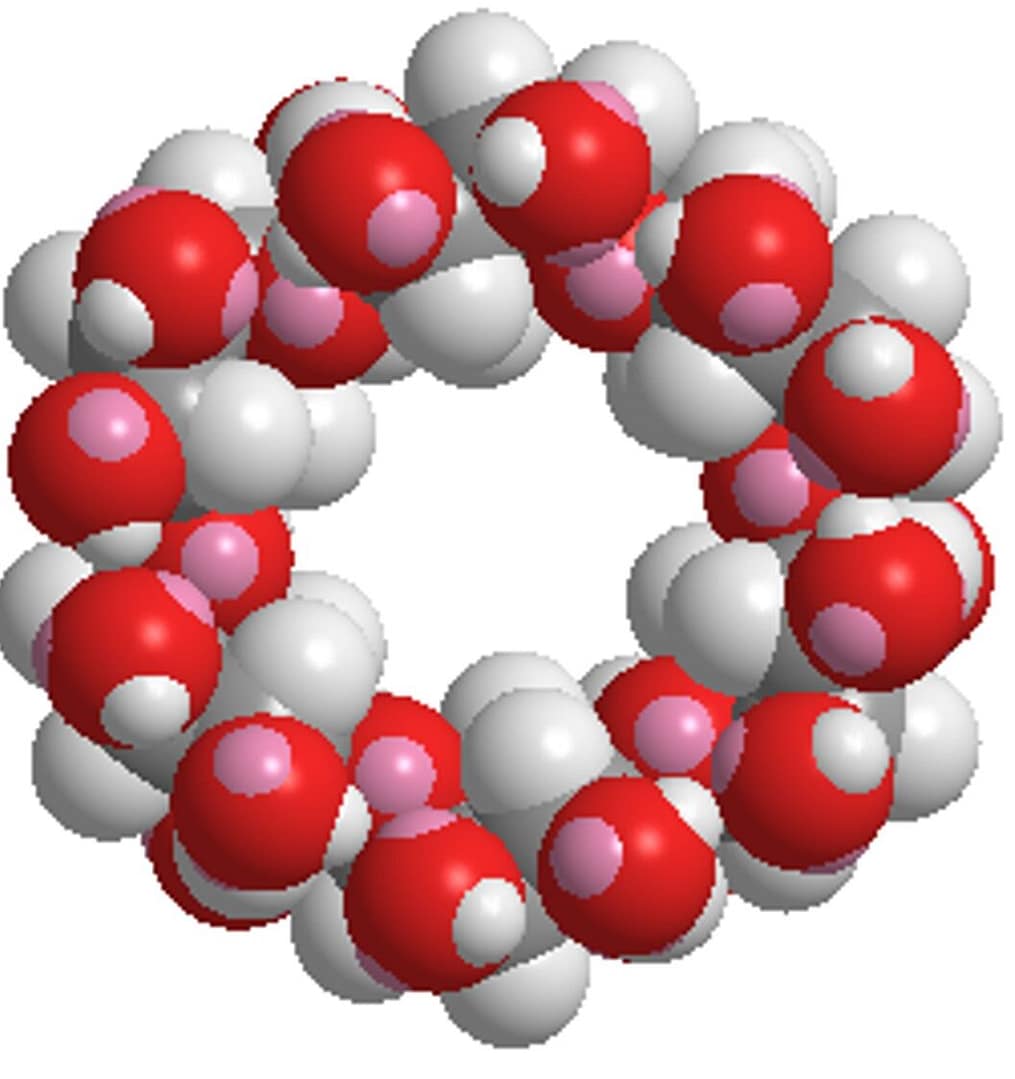
キーワード / Keywords
1. α-シクロデキストリン(α-Cyclodextrin)
日本語: デンプン由来の環状オリゴ糖で、分子を取り込む包接能を持ちます。食品、医薬、材料分野で幅広く利用されています。
English: A cyclic oligosaccharide capable of molecular encapsulation and widely used in food, pharmaceutical, and material sciences.
2. 包接複合体(Inclusion Complex)
日本語: αCDの空洞に機能性分子を取り込み、安定性や溶解性を向上させる技術です。
English: A host–guest structure that improves molecular stability and functionality.
3. ナノ粒子ドラッグデリバリー
日本語: 有効成分を目的部位へ効率的に届ける技術です。副作用低減と治療効果向上が期待されています。
English: Nanocarrier technology designed to improve targeted drug delivery and therapeutic outcomes.
4. 油水界面
日本語: 食品やエマルションの品質を左右する重要な境界面であり、分子の吸着挙動が機能に影響します。
English: A critical interface that governs emulsion stability and many food-material properties.
5. 機能性フラボノイド
日本語: 抗酸化活性などを持つ天然成分で、糖鎖修飾により利用性向上が期待されています。
English: Natural bioactive compounds whose usability can be improved through molecular modification.
日本語版
研究背景
α-シクロデキストリン(αCD)は、分子を選択的に取り込む包接能を持つ天然由来材料です。近年では食品科学だけでなく、医療、ドラッグデリバリー、機能性成分開発など幅広い分野で活用されています。今回紹介する研究は、界面科学、脳疾患治療、食品機能成分開発という異なる分野でのαCD活用例を示しています。
研究内容
1. 脳梗塞治療を目指したαCDナノ粒子
Targeting microglia-mediated neuroinflammation via pH-responsive lipid nanoparticle delivery of HDAC inhibitor RGFP966 in ischemic stroke
- αCDを利用したpH応答性脂質ナノ粒子を開発。
- 血液脳関門通過を促進する設計を導入。
- 脳梗塞部位で薬剤放出を誘導。
- 炎症反応を抑制し神経機能改善を示した。
- 脳疾患治療の新しい薬物送達戦略として期待される。
2. αCDを利用した機能性フラボノイド生産
Selective Enrichment of α-Glucosylated Trilobatin via Cascade Enzymatic Glycosylation-Hydrolysis in Polysaccharide-Based Aqueous Reaction Systems
- αCDを利用した酵素反応システムを構築。
- フラボノイドの糖鎖修飾効率を向上。
- 高い変換率と選択性を実現。
- 機能性食品や健康素材開発への応用が期待される。
3. αCDの油水界面での吸着挙動解析
Multiscale characterization of the adsorption behavior of α-cyclodextrin, sucrose fatty acid ester, and sodium caseinate at the oil-water interface
- αCDの油水界面での振る舞いを多角的に解析。
- 他の食品由来界面材料との違いを比較。
- 界面への均一な分布特性を確認。
- エマルション設計や食品加工技術への知見を提供した。
期待される応用
これらの研究は、αCDが食品添加材料にとどまらず、医療、高機能食品、先端材料設計を支える基盤技術であることを示しています。今後は脳疾患治療、食品機能向上、安定なエマルション設計など幅広い応用が期待されます。
English Version
α-Cyclodextrin for Food Interfaces, Neurotherapeutics, and Functional Ingredient Development
Research Background
Alpha-cyclodextrin is a naturally derived cyclic oligosaccharide with unique molecular encapsulation capability. Recent studies have expanded its applications from food science to targeted drug delivery and functional ingredient engineering.
Research Highlights
1. Alpha-CD Nanoparticles for Ischemic Stroke Therapy
- Developed pH-responsive lipid nanoparticles incorporating alpha-CD.
- Improved brain targeting and controlled drug release.
- Reduced neuroinflammation and improved neurological outcomes.
2. Production of Functional Flavonoid Derivatives
- Established an alpha-CD-assisted enzymatic glycosylation system.
- Enhanced conversion efficiency and selectivity.
- Supports development of functional food ingredients.
3. Interfacial Adsorption of Alpha-CD
- Investigated adsorption behavior at oil-water interfaces.
- Compared alpha-CD with other food-grade interfacial materials.
- Provided insights for emulsion and food formulation design.
Overall Significance
Together, these studies demonstrate the versatility of alpha-cyclodextrin in medicine, food science, and molecular engineering. Its ability to interact selectively with molecules makes it a promising platform for future healthcare and food technologies.
References / 文献
- Liu Y. et al. Targeting microglia-mediated neuroinflammation via pH-responsive lipid nanoparticle delivery of HDAC inhibitor RGFP966 in ischemic stroke. Science and Technology of Advanced Materials, 2026. DOI: 10.1080/14686996.2026.2699624
- Liu X. et al. Selective Enrichment of α-Glucosylated Trilobatin via Cascade Enzymatic Glycosylation-Hydrolysis in Polysaccharide-Based Aqueous Reaction Systems. Journal of Agricultural and Food Chemistry, 2026. DOI: 10.1021/acs.jafc.6c06400
- Chen L. et al. Multiscale characterization of the adsorption behavior of α-cyclodextrin, sucrose fatty acid ester, and sodium caseinate at the oil-water interface. Colloids and Surfaces A, 2026. DOI: 10.1016/j.colsurfa.2026.141608