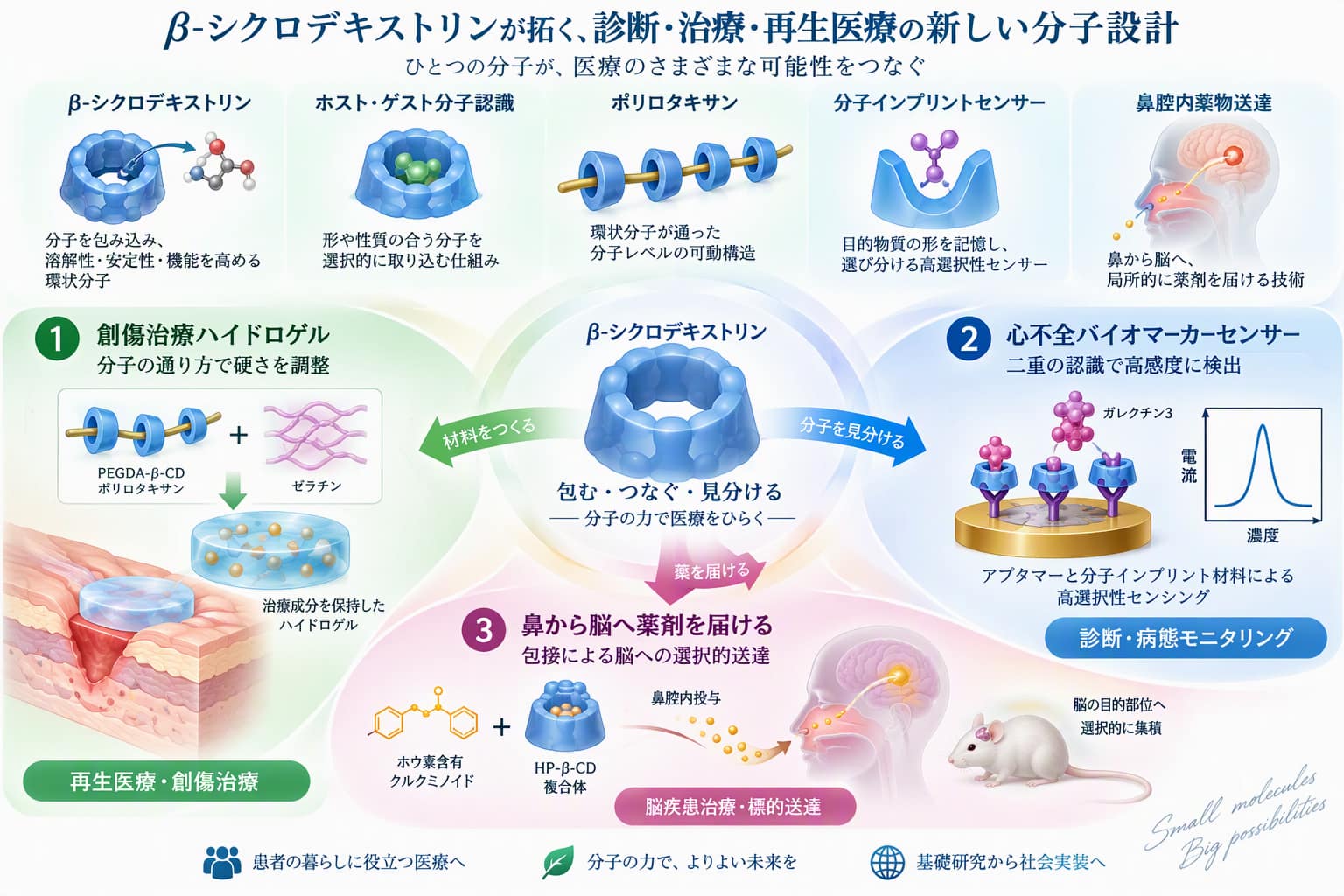
キーワード / Keywords
1. β-シクロデキストリン(β-Cyclodextrin)
日本語:デンプン由来の環状分子で、中央の空洞にさまざまな分子を取り込めます。薬物の溶けやすさや安定性を高め、材料の機能を調整する用途に使われます。
English: A starch-derived cyclic molecule with a cavity that can host other molecules, improving their solubility, stability, and functional performance.
2. ホスト・ゲスト分子認識(Host–Guest Molecular Recognition)
日本語:大きな分子の空間に、形や性質の合う小さな分子が選択的に収まる仕組みです。薬物送達、センサー、自己組織化材料の設計を支えます。
English: A selective interaction in which a guest molecule fits into a host cavity, supporting drug delivery, sensing, and self-assembled materials.
3. ポリロタキサン(Polyrotaxane)
日本語:ひも状の高分子に環状分子が通された、分子レベルの可動構造です。環の数や動き方を変えることで、ゲルの弾性や衝撃吸収性を調整できます。
English: A mechanically interlocked structure in which cyclic molecules are threaded onto a polymer chain, enabling tunable mechanical behavior.
4. 分子インプリントセンサー(Molecularly Imprinted Sensor)
日本語:測りたい物質の形を材料に記憶させ、鍵穴のように選び分けるセンサーです。目的物質を高い選択性で検出するために利用されます。
English: A sensor containing recognition sites molded around a target molecule, allowing selective detection through a lock-and-key-like mechanism.
5. 鼻腔内薬物送達(Nose-to-Brain Delivery)
日本語:薬剤を鼻から投与し、脳への移行を目指す方法です。全身への広がりを抑えながら、脳内の目的部位へ届ける技術として研究されています。
English: A delivery route designed to transport therapeutics from the nasal cavity toward the brain while limiting systemic exposure.
日本語版
研究背景
β-シクロデキストリンは、分子を包み込む空洞を持つ環状オリゴ糖です。この小さな空間は、薬剤を水になじみやすくするだけでなく、材料同士をつなぐ接点や、特定の物質を見分ける認識部位としても働きます。近年の研究では、この「取り込む」「つなぐ」「見分ける」という性質を組み合わせ、医療材料、診断センサー、脳への薬物送達へ応用する試みが進んでいます。
研究内容
1. 分子の通り方で硬さを調整できる創傷用ハイドロゲル
Mechanical Programming of PEGDA-β-CD Polyrotaxane-Based Hydrogels via Host-Guest Molecular Recognition
- PEG鎖にβ-シクロデキストリンを通したポリロタキサンとゼラチンから、治療成分を保持できるハイドロゲルを構築しました。
- β-シクロデキストリンの通る量を増やすと、ゲル内部は不規則な多孔構造から整った層状構造へ変化しました。
- 通る量が少ないゲルは弾力性と回復性に優れ、多いゲルはエネルギーを吸収しやすく、靭性や弾性率も向上しました。
- 動物試験では、力学特性と抗炎症性を備えたゲルが創傷治癒を支える可能性を示しました。
2. 心不全の指標を二重に見分ける高感度センサー
Highly sensitive galectin-3 electrochemical sensor based on a dual-recognition interface of cyclodextrin-integrated molecularly imprinted polymers (MIPs) and an aptamer
- 心不全の進行把握に利用されるガレクチン3を測定する電気化学センサーが開発されました。
- β-シクロデキストリンを組み込んだ分子インプリント材料と、標的に結合するアプタマーを組み合わせています。
- 二つの認識機構を使うことで選択性を高め、0.1~80 ng/mLの範囲で測定し、検出限界は0.1 ng/mLでした。
- 血清を模した試料でも妨害を抑えて検出でき、病状評価や経過観察を支える分析技術としての可能性を示しました。
3. 鼻から脳へ薬剤候補を届ける包接システム
Nose-to-brain delivery of a novel boronated curcuminoid via cyclodextrins: Biodistribution toward potential BNCT applications in Alzheimer’s disease
- 水に溶けにくいホウ素含有クルクミノイドを、HP-β-シクロデキストリンなどと複合化し、溶解性を高めました。
- 鼻腔内投与では、静脈内投与より全身への曝露を抑えながら、脳への移行が確認されました。
- アルツハイマー病モデルマウスでは、HP-β-シクロデキストリン複合体がアミロイドの多い脳領域へ選択的に集積しました。
- 神経変性疾患における標的送達と、ホウ素中性子捕捉療法につながる基礎的な可能性が示されました。
期待される応用
三つの研究に共通するのは、β-シクロデキストリンを単なる溶解補助剤ではなく、材料構造と生体機能を結ぶ「分子の接点」として利用していることです。環の通し方によるゲルの力学制御、二重認識によるバイオマーカー検出、包接による脳への送達は、それぞれ異なる課題に同じ分子特性を活用しています。今後、患者の部位や状態に合わせた創傷被覆材、迅速な病態モニタリング、局所性の高い薬物送達などへ発展することが期待されます。一方、臨床利用には、長期的な安全性、実試料での再現性、投与量や製造条件の最適化をさらに検証する必要があります。
English Version
β-Cyclodextrin as a Molecular Platform for Diagnostics, Therapy, and Regenerative Medicine
Research Background
β-Cyclodextrin is a cyclic oligosaccharide with a molecular cavity capable of hosting selected guest molecules. Beyond improving drug solubility, this cavity can serve as a connecting point in soft materials and as a recognition site in analytical devices. Recent studies use these functions to engineer mechanically tunable hydrogels, sensitive biosensors, and brain-targeted delivery systems.
Research Highlights
1. Mechanically Programmable Hydrogels for Wound Care
- Hydrogels were constructed from PEGDA–β-CD polyrotaxanes and gelatin, with curcumin used as a model therapeutic compound.
- Increasing the number of threaded β-CD units changed the internal structure from disordered pores to ordered layers.
- Low threading density favored elasticity and recovery, while higher density increased damping, toughness, and modulus.
- In vivo results indicated promising wound-healing performance associated with suitable mechanics and anti-inflammatory properties.
2. Dual-Recognition Sensing of a Heart-Failure Biomarker
- An electrochemical sensor was developed for galectin-3, a biomarker associated with heart-failure progression.
- The platform combined a β-CD-integrated molecularly imprinted polymer with an aptamer-based signal probe.
- It measured galectin-3 over 0.1–80 ng/mL and achieved a detection limit of 0.1 ng/mL.
- Successful analysis in serum-like samples suggested potential use in prognosis assessment and patient monitoring.
3. Nose-to-Brain Delivery of a Boronated Curcuminoid
- A poorly water-soluble boronated curcuminoid was complexed with β-CD derivatives to improve solubility.
- Intranasal administration promoted brain targeting while reducing systemic exposure compared with intravenous delivery.
- In an Alzheimer’s disease mouse model, the HP-β-CD complex selectively accumulated in amyloid-rich brain regions.
- The findings support further investigation of targeted delivery for neurodegenerative disease and potential boron neutron capture therapy.
Potential Applications
Together, these studies position β-cyclodextrin as more than a solubilizing excipient. It acts as a molecular interface linking material architecture, selective recognition, and biological delivery. This versatility may support personalized wound dressings, sensitive disease monitoring, and localized therapies. Further validation of long-term safety, reproducibility in clinical samples, dosing, and manufacturing conditions will be essential before clinical translation.
References / 文献
- Chen, S.; Xing, X.; Su, H.; et al. Mechanical Programming of PEGDA-β-CD Polyrotaxane-Based Hydrogels via Host-Guest Molecular Recognition. Advanced Functional Materials (2026). DOI: 10.1002/adfm.77853
- Alberti, D.; Micocci, S.; Lanfranco, A.; et al. Nose-to-brain delivery of a novel boronated curcuminoid via cyclodextrins: Biodistribution toward potential BNCT applications in Alzheimer’s disease. Journal of Controlled Release 398 (2026), Article 115270. DOI: 10.1016/j.jconrel.2026.115270
- Longsompurana, P.; Poo-arporn, Y.; Rungrotmongkol, T.; Wolschann, P.; Poo-arporn, R. P. Highly sensitive galectin-3 electrochemical sensor based on a dual-recognition interface of cyclodextrin-integrated molecularly imprinted polymers (MIPs) and an aptamer. Biosensors and Bioelectronics 313 (2026), Article 119157. DOI: 10.1016/j.bios.2026.119157