キーワード / Keywords
1. シクロデキストリンポリマー(Cyclodextrin Polymer)
日本語: 分子を取り込む環状構造を高分子材料へ組み込んだ機能性素材です。吸着、分離、酵素保持、イオン輸送など、用途に応じた働きを設計できます。
English: A functional polymer incorporating cyclodextrin cavities, enabling tunable adsorption, separation, enzyme retention, and ion transport.
2. ホスト・ゲスト相互作用(Host–Guest Interaction)
日本語: シクロデキストリンの空洞が、形や性質の合う分子を選択的に取り込む仕組みです。汚染物質の捕捉や有効成分の保持に利用されます。
English: A selective interaction in which a cyclodextrin cavity captures compatible guest molecules for pollutant removal or molecular retention.
3. 医薬品由来汚染物質(Pharmaceutical Contaminants)
日本語: 使用後に排水へ流入する医薬品成分です。低濃度でも残留しやすく、従来の水処理だけでは十分に除去できない場合があります。
English: Drug-derived compounds entering wastewater after use, some of which persist at low concentrations and resist conventional treatment.
4. 固体亜鉛イオン電池(Solid-State Zinc-Ion Battery)
日本語: 固体電解質を通して亜鉛イオンを移動させる蓄電池です。安全性や資源面で期待されますが、イオン輸送と樹枝状析出の抑制が課題です。
English: A battery using a solid electrolyte for zinc-ion transport, with challenges including conductivity and suppression of dendritic zinc growth.
5. 階層的多孔構造(Hierarchical Porous Structure)
日本語: 大きさの異なる孔を組み合わせた構造です。大きな孔が水の流路となり、小さな孔が広い吸着面をつくることで処理速度を高めます。
English: A structure combining pores of different sizes, where larger channels support flow and smaller pores provide abundant adsorption surfaces.
日本語版
研究背景
シクロデキストリンは、中央に分子サイズの空洞を持つ環状オリゴ糖です。この空洞は特定の有機分子を取り込む一方、外側は高分子や無機材料と組み合わせることができます。そこで近年は、シクロデキストリンを高分子化し、分子の捕捉だけでなく、微生物や酵素の固定、イオンの移動、立体的な流路形成まで担わせる研究が進んでいます。
今回紹介する研究は、下水中の医薬品成分を微生物とともに分解する材料、固体亜鉛イオン電池のイオン輸送を支える電解質、水中の微量有機物を素早く吸着する3D造形体を扱っています。用途は異なりますが、いずれもシクロデキストリンポリマーの「取り込む空洞」と「設計できる高分子構造」を組み合わせています。
研究内容
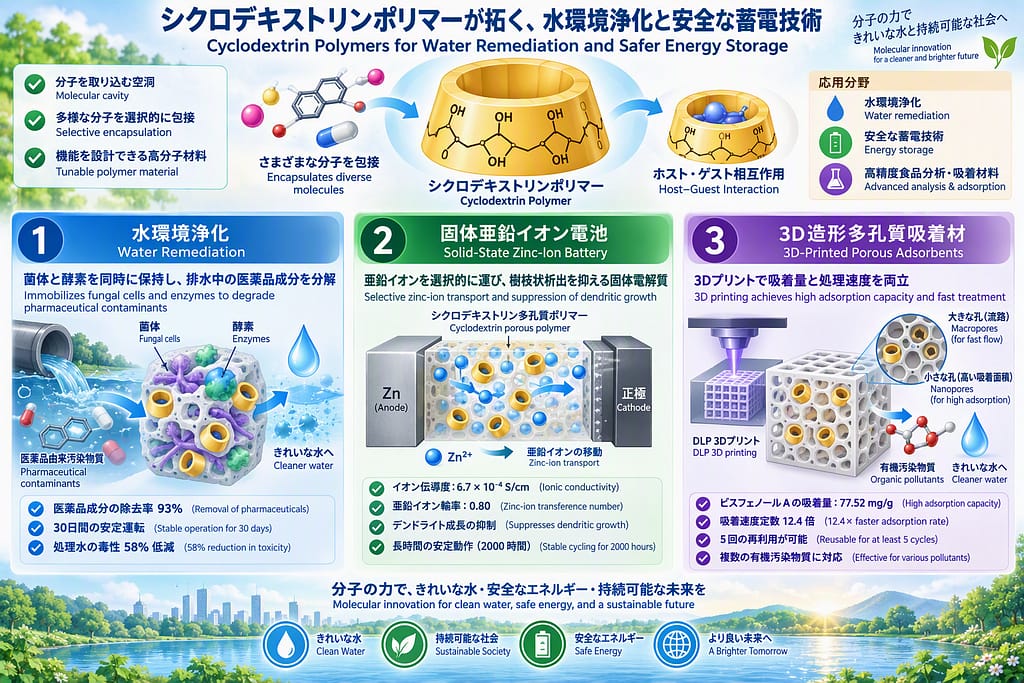
1. 菌体と酵素を同時に保持し、排水中の医薬品成分を分解
Immobilization of fungal cells on positively charged cyclodextrin-based carriers: Enhanced PhAC degradation and multi-omics implications
- 白色腐朽菌 Trametes versicolor を、正に帯電した多孔質シクロデキストリンポリマーへ固定しました。
- 材料は菌体を保持するだけでなく、菌が分泌するラッカーゼも内部にとどめ、菌と酵素が協力する界面を形成しました。
- 下水二次処理水を用いた連続流試験で、医薬品由来汚染物質の除去率は93%に達しました。
- 30日間の運転性能を維持し、処理水の毒性を58%低減しました。
- 多層的な生物解析から、酸化還元酵素に関係する305種類のタンパク質が増え、関連する分解経路が活性化したことが示されました。
2. 亜鉛イオンを選択的に運び、樹枝状析出を抑える固体電解質
Cyclodextrin-derived porous polymer enables efficient zinc-ion conduction toward stable solid-state zinc-ion batteries
- β-シクロデキストリンとテトラフルオロテレフタロニトリルから、三次元多孔質ポリマーCN-CDPを合成しました。
- CN-CDPをPVDFへ混合し、固体高分子電解質として用いました。
- 電解質は亜鉛イオンの移動障壁を下げ、室温で6.7 × 10⁻⁴ S/cmのイオン伝導度と0.80の亜鉛イオン輸率を示しました。
- 亜鉛を特定の結晶面に沿って均一に析出させ、短絡の原因となるデンドライト成長を抑えました。
- 対称電池は2 mA/cm²で2000時間、5 mA/cm²で1400時間の安定した充放電を示しました。
3. 3Dプリントで吸着量と処理速度を両立
DLP Printing of β-Cyclodextrin-Functionalized Hierarchically Porous Polymer Monoliths for Efficient Micropollutant Removal
- DLP方式の3Dプリント、重合誘起相分離、β-シクロデキストリンの後修飾を組み合わせ、多孔質の一体型吸着材を作製しました。
- ナノ・サブミクロンの孔が広い吸着面を提供し、3D設計した大きな流路が水と汚染物質の移動を促しました。
- ビスフェノールAの平衡吸着量は77.52 mg/gで、非多孔質の対照材料より37.5%高い値でした。
- 大きな流路を持つ構造では、流路を持たないナノ多孔体より吸着速度定数が12.4倍に増加しました。
- 5回の吸着・脱着後も再利用でき、複数の有機汚染物質に対応しました。
期待される応用
三つの研究は、シクロデキストリンポリマーが単なる吸着材ではなく、機能を組み合わせる材料基盤であることを示しています。排水処理では、汚染物質を集めながら菌体と酵素による分解を支えます。電池では、孔と官能基が亜鉛イオンの移動と析出方向を整えます。3D造形吸着材では、分子認識部位と水の流路を異なるスケールで設計できます。
将来は、連続運転型の高度水処理、再利用可能な浄化カートリッジ、安全性の高い定置用蓄電池などへの展開が考えられます。実用化には、複雑な実排水での長期性能、材料の製造コスト、劣化後の回収・再生、大型電池や大流量装置での均一性を検証することが重要です。
English Version
Cyclodextrin Polymers for Water Remediation and Safer Energy Storage
Introduction
Cyclodextrins are cyclic oligosaccharides containing molecular-scale cavities. These cavities can host selected organic molecules, while the outer surface can be integrated into polymers and composite materials. Polymerization therefore extends cyclodextrin function beyond molecular capture to cell and enzyme immobilization, ion transport, and engineered flow pathways.
The studies highlighted here address pharmaceutical contaminants in wastewater, solid-state zinc-ion batteries, and rapidly reusable adsorbents. Although their applications differ, each combines molecular recognition with a deliberately designed polymer architecture.
Research Highlights
1. A Positively Charged Carrier Retains Both Fungal Cells and Enzymes
- Trametes versicolor was immobilized on a positively charged, porous thienyl cyclodextrin polymer.
- The carrier retained fungal cells and secreted laccases, creating a cooperative fungus-enzyme interface.
- In continuous-flow treatment of secondary municipal effluent, pharmaceutical-contaminant removal reached 93%.
- Performance was sustained for 30 days, while effluent toxicity was reduced by 58%.
- Multi-omics analysis identified enrichment of 305 proteins associated with oxidoreductase activity and activation of related degradation pathways.
2. A Porous Polymer Electrolyte Guides Zinc-Ion Transport
- A three-dimensional porous polymer, CN-CDP, was synthesized from β-cyclodextrin and tetrafluoroterephthalonitrile.
- Incorporation into PVDF produced a solid polymer electrolyte for zinc-ion batteries.
- The electrolyte reached an ionic conductivity of 6.7 × 10⁻⁴ S/cm and a zinc-ion transference number of 0.80 at room temperature.
- It promoted uniform zinc deposition along a preferred crystal plane and suppressed dendritic growth.
- Symmetric cells operated stably for 2000 hours at 2 mA/cm² and 1400 hours at 5 mA/cm².
3. 3D-Printed Hierarchical Pores Improve Adsorption Capacity and Speed
- DLP 3D printing, polymerization-induced phase separation, and β-cyclodextrin post-functionalization were integrated to fabricate porous monoliths.
- Nanopores provided abundant adsorption surfaces, while designed macropores created rapid transport pathways.
- Bisphenol A uptake reached 77.52 mg/g, 37.5% higher than that of a β-cyclodextrin-modified nonporous control.
- Introducing macroporous flow channels increased the adsorption-rate constant by 12.4 times compared with the nanoporous monolith without macropores.
- The monolith remained reusable over five adsorption-desorption cycles and removed a broad range of organic pollutants.
Overall Significance
Together, these studies show that cyclodextrin polymers are multifunctional material platforms rather than simple adsorbents. In wastewater treatment, they concentrate contaminants while supporting biological degradation. In batteries, their porous and chemical structure coordinates zinc-ion migration and deposition. In printed adsorbents, molecular binding sites and fluid pathways are designed across different length scales.
Potential applications include advanced continuous-flow wastewater treatment, reusable purification cartridges, and safer stationary energy-storage systems. Further development will require long-term testing in complex real-world water, evaluation of manufacturing cost and end-of-life recovery, and uniform scale-up in large treatment units and battery cells.
References / 文献
- Tu, Y.; Wu, Y.; Pan, Y.; et al. Immobilization of fungal cells on positively charged cyclodextrin-based carriers: Enhanced PhAC degradation and multi-omics implications. Journal of Hazardous Materials 516 (2026), 143407. DOI: 10.1016/j.jhazmat.2026.143407
- Li, Y.; Zhao, J.; Guo, H.; et al. Cyclodextrin-derived porous polymer enables efficient zinc-ion conduction toward stable solid-state zinc-ion batteries. Chemical Engineering Journal 547 (2026), 181226. DOI: 10.1016/j.cej.2026.181226
- Liu, Y.; Cao, Y.; Chen, X.; Li, Q.; Dong, Z. DLP Printing of β-Cyclodextrin-Functionalized Hierarchically Porous Polymer Monoliths for Efficient Micropollutant Removal. ACS Applied Polymer Materials (2026), Early Access. DOI: 10.1021/acsapm.6c02806