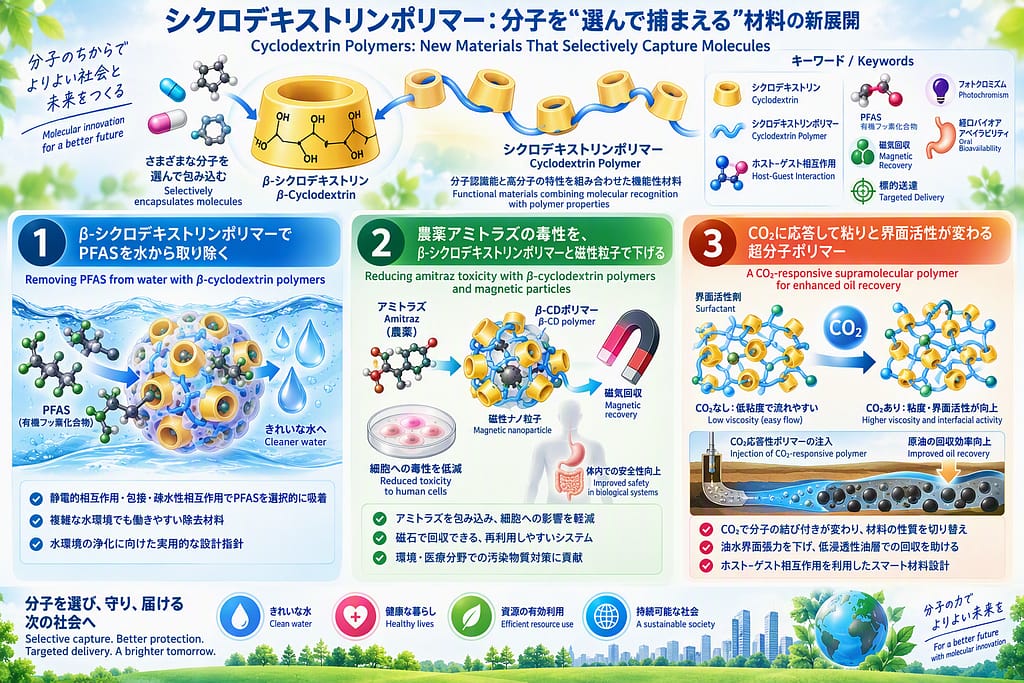
Cyclodextrin Polymers: New Materials That Selectively Capture Molecules
キーワード / Keywords
-
シクロデキストリン / Cyclodextrin
デンプン由来の環状分子で、内側に小さな空洞を持ちます。分子を包み込む性質を利用して、薬物、汚染物質、香り成分などを選んで扱えます。
EN: Cyclodextrins are ring-shaped molecules derived from starch. Their inner cavities can host small molecules, enabling selective capture and release. -
シクロデキストリンポリマー / Cyclodextrin Polymer
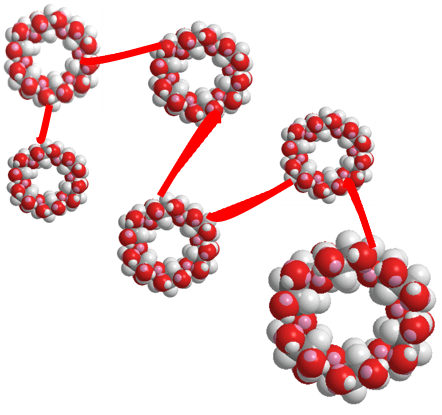
シクロデキストリンを高分子ネットワークに組み込んだ材料です。分子を包み込む力と、ポリマーの加工性・回収性を組み合わせられます。
EN: Cyclodextrin polymers combine molecular recognition by cyclodextrins with the processability and robustness of polymer networks. -
ホスト–ゲスト相互作用 / Host-Guest Interaction
“容器”のような分子が、別の分子を中に取り込む相互作用です。水処理、薬物送達、刺激応答材料などの設計で重要になります。
EN: Host-guest interaction describes molecular inclusion, where a host cavity captures a guest molecule selectively. -
PFAS / 有機フッ素化合物
水や油をはじく性質を持つ人工化学物質群です。環境中で分解されにくく、水処理材料による選択的な除去が大きな課題です。
EN: PFAS are persistent fluorinated chemicals. Their removal from water requires selective and durable adsorbent materials. -
磁気回収 / Magnetic Recovery
磁性ナノ粒子を使い、分子を捕まえた材料を磁石で集める方法です。処理後に材料を回収しやすく、環境・医療応用に役立ちます。
EN: Magnetic recovery uses magnetic nanoparticles to collect functional materials after they bind target molecules.
日本語版
1. β-シクロデキストリンポリマーでPFASを水から取り除く
論文: Synergistic and Complementary Electrostatic and Hydrophobic Interactions Drive Per- and Polyfluoroalkyl Substance (PFAS) Adsorption to Cationic β-Cyclodextrin Polymers
掲載誌: Environmental Science & Technology
DOI: 10.1021/acs.est.6c06781
- PFASは水中に残りやすく、一般的な処理では除去が難しい化学物質です。
- この研究では、スチレンで機能化したβ-シクロデキストリンポリマーを使い、6種類のPFASがどのように吸着されるかを調べています。
- PFASの捕捉には、静電的な結合、シクロデキストリン空洞への包接、疎水性相互作用が組み合わさって働きます。
- 初期段階では、イオン交換とホスト–ゲスト包接が特に重要です。
- 吸着が進むと、疎水性相互作用の寄与も大きくなります。
- 水中の無機イオンは一部の吸着を妨げますが、包接や疎水性相互作用は比較的影響を受けにくいことが示されています。
- 実用面では、複雑な水環境でも働きやすいPFAS除去材料を設計するための手がかりになります。
- 一般向けに言えば、「水中の厄介な汚染物質を、分子サイズの穴と電気的な力で選んでつかむポリマー」の研究です。
2. 農薬アミトラズの毒性を、β-シクロデキストリンポリマーと磁性粒子で下げる
論文: A novel approach against amitraz toxicity based on magnetic extraction using native β-cyclodextrin and β-cyclodextrin polymers attached to superparamagnetic nanoparticles for potential human cell protection
掲載誌: Chemico-Biological Interactions
DOI: 10.1016/j.cbi.2026.112270
- アミトラズは農業や養蜂で使われる農薬で、残留による人への曝露が問題になります。
- この研究では、β-シクロデキストリンやカチオン性β-シクロデキストリンポリマーでアミトラズを包み込み、細胞への影響を減らす方法を調べています。
- アミトラズは芳香族部分を通じてシクロデキストリン系材料と相互作用し、包接体を作ります。
- 包接により、ヒト神経芽細胞SH-SY5Yでみた急性毒性が低下し、細胞生存率が改善しました。
- さらに、鉄酸化物の磁性ナノ粒子に包接体を結合させることで、磁石による回収が可能になります。
- アミトラズ曝露後にシクロデキストリン材料を加えた場合でも、一定の保護効果が確認されています。
- 環境中や生体関連系で、汚染物質を捕まえて回収する簡便なプラットフォームとして期待されます。
- 一般向けに言えば、「毒性をもつ農薬を分子のカプセルで包み、磁石で回収しやすくする」研究です。
3. CO2に応答して粘りと界面活性が変わる超分子ポリマー
論文: CO2-Responsive Supramolecular Polymer-Surfactant System Enabled by Competitive Host-Guest Occupancy for Enhanced Oil Recovery in Low-Permeability Reservoirs
掲載誌: Journal of Polymer Science
DOI: 10.1002/pola.70286
- この研究では、β-シクロデキストリンを導入したポリアクリルアミドと、アダマンタン修飾キサンタンガムを組み合わせた超分子ポリマー系を設計しています。
- シクロデキストリンの空洞には、アダマンタンや応答性界面活性剤が入り、どの分子が入るかでネットワークの状態が変わります。
- CO2や酸性条件を与えると、競合していた分子が外れ、ポリマー同士の架橋が回復します。
- その結果、注入時は低粘度で流れやすく、刺激後は粘度や界面活性が高まるように設計されています。
- 油水界面張力を大きく下げられるため、低浸透性油層での石油回収効率向上に役立つ可能性があります。
- β-シクロデキストリンのホスト–ゲスト相互作用を、材料の“スイッチ”として利用している点が特徴です。
- 一般向けに言えば、「CO2を合図に、さらさらした液体から働きの強い回収材料へ変わるポリマー」の研究です。
まとめ
シクロデキストリンポリマーは、分子を包み込む“空洞”と、高分子材料としての扱いやすさを併せ持つ機能性材料です。PFASのような水中汚染物質を選択的に捕まえる材料、農薬の毒性を下げて磁気回収する材料、CO2で性質が変わる超分子ポリマーなど、環境・医療・資源利用へ応用が広がっています。共通する考え方は、分子をただ吸着するだけでなく、「どの分子を、どの力で、どのタイミングで捕まえるか」を設計することです。
English Version
1. Removing PFAS from water with β-cyclodextrin polymers
Paper: Synergistic and Complementary Electrostatic and Hydrophobic Interactions Drive Per- and Polyfluoroalkyl Substance (PFAS) Adsorption to Cationic β-Cyclodextrin Polymers
Journal: Environmental Science & Technology
DOI: 10.1021/acs.est.6c06781
- PFAS are persistent contaminants that are difficult to remove from water.
- This study examines how styrene-functionalized β-cyclodextrin polymers adsorb six types of PFAS.
- PFAS capture is driven by a combination of electrostatic binding, host-guest inclusion, and hydrophobic interactions.
- At lower surface saturation, ion exchange and cyclodextrin inclusion are especially important.
- At higher saturation, broader hydrophobic interactions become more significant.
- Inorganic ions can compete with some adsorption sites, but non-ionic binding mechanisms remain relatively resilient.
- The results provide design principles for PFAS adsorbents that work in complex water matrices.
- In simple terms, this work uses molecular cavities and electrostatic attraction to selectively capture difficult water pollutants.
2. Reducing amitraz toxicity with β-cyclodextrin polymers and magnetic particles
Paper: A novel approach against amitraz toxicity based on magnetic extraction using native β-cyclodextrin and β-cyclodextrin polymers attached to superparamagnetic nanoparticles for potential human cell protection
Journal: Chemico-Biological Interactions
DOI: 10.1016/j.cbi.2026.112270
- Amitraz is a pesticide used in agriculture and apiculture, and residues may increase human exposure risk.
- This study uses β-cyclodextrin and cationic β-cyclodextrin polymers to encapsulate amitraz and reduce its bioavailable fraction.
- The interaction occurs mainly through the aromatic region of amitraz, forming inclusion complexes.
- In human neuroblastoma SH-SY5Y cells, complexation improves cell viability compared with acute amitraz exposure.
- The inclusion complexes are also attached to iron oxide magnetic nanoparticles.
- This enables rapid magnetic collection of amitraz-bound materials.
- The approach suggests a simple platform for mitigating pesticide toxicity and extracting contaminants.
- In simple terms, the study places a toxic pesticide inside molecular capsules and makes the capsules magnetically recoverable.
3. A CO2-responsive supramolecular polymer for controlled flow and oil recovery
Paper: CO2-Responsive Supramolecular Polymer-Surfactant System Enabled by Competitive Host-Guest Occupancy for Enhanced Oil Recovery in Low-Permeability Reservoirs
Journal: Journal of Polymer Science
DOI: 10.1002/pola.70286
- This study designs a supramolecular polymer system using β-cyclodextrin-grafted polyacrylamide, adamantane-modified xanthan gum, and a responsive surfactant.
- β-Cyclodextrin cavities act as molecular binding sites that can be competitively occupied by different guest molecules.
- Before stimulation, the surfactant occupies the cyclodextrin cavities, keeping viscosity low for easier injection.
- When CO2 or acidification is applied, the surfactant is released and polymer crosslinking recovers.
- The material then becomes more effective for flow regulation and interfacial activity.
- The system can strongly lower oil-water interfacial tension under saline conditions.
- The work shows how host-guest chemistry can act as a switch for macroscopic material behavior.
- In simple terms, this is a polymer fluid that changes its function when triggered by CO2.
Overall Takeaway
Cyclodextrin polymers combine molecular recognition with the practical advantages of polymer materials. The selected studies show three different directions: selective removal of PFAS from water, magnetic capture of a toxic pesticide, and CO2-triggered reconstruction of a supramolecular polymer network. Across these examples, the key idea is not simply adsorption, but programmable molecular capture: choosing what to bind, how strongly to bind it, and when the material should change its function.
文献 / References
- Wang, J.; Lin, Z.; Dichtel, W. R.; Helbling, D. E. Synergistic and Complementary Electrostatic and Hydrophobic Interactions Drive Per- and Polyfluoroalkyl Substance (PFAS) Adsorption to Cationic β-Cyclodextrin Polymers. Environmental Science & Technology (2026). DOI: 10.1021/acs.est.6c06781.
- Franco-Campos, F.; Rodríguez-Carrasco, Y.; Riveros, A.; Alamos, C.; Guerrero, S.; Melo, F.; Sierpe, R.; Yutronic, N.; Oyarzún, S.; Denardin, J.; Ruiz, M. J.; Kogan, M. J.; Donoso-González, O. A novel approach against amitraz toxicity based on magnetic extraction using native β-cyclodextrin and β-cyclodextrin polymers attached to superparamagnetic nanoparticles for potential human cell protection. Chemico-Biological Interactions (2026). DOI: 10.1016/j.cbi.2026.112270.
- Liu, Z.; Zhang, Z. CO2-Responsive Supramolecular Polymer-Surfactant System Enabled by Competitive Host-Guest Occupancy for Enhanced Oil Recovery in Low-Permeability Reservoirs. Journal of Polymer Science (2026). DOI: 10.1002/pola.70286.