キーワード / Keywords
1. スピロピラン(Spiropyran)
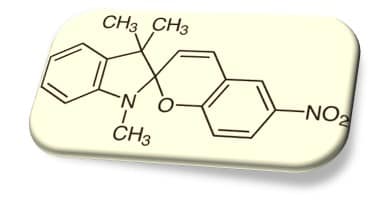
日本語: 光によって可逆的に構造が変化するフォトクロミック分子です。環境変化に応答しながら機能を発揮できるため、次世代材料として注目されています。
English: A photochromic molecule that reversibly changes structure under light, enabling adaptive material functions.
2. ペロブスカイト太陽電池
日本語: 高効率かつ低コスト化が期待される次世代太陽電池です。近年は耐久性向上が重要な研究課題となっています。
English: A next-generation solar-cell technology known for high efficiency and potential low manufacturing cost.
3. 欠陥パッシベーション
日本語: 材料内部に存在する欠陥を減らし、電荷損失を抑える技術です。発電効率と安定性の向上に欠かせません。
English: A strategy that suppresses charge-loss pathways by reducing defects within semiconductor materials.
4. 自己組織化単分子膜(SAM)
日本語: 分子が規則的に並ぶ超薄膜です。界面特性を改善し、デバイス性能向上に利用されます。
English: Molecularly ordered ultrathin films used to optimize interfaces in electronic devices.
5. 紫外線安定性
日本語: 紫外線照射下でも性能を維持する能力です。屋外利用される太陽電池の長寿命化に直結します。
English: The ability of a device to maintain performance under UV exposure, critical for real-world operation.
日本語版
研究背景
ペロブスカイト太陽電池は、従来型太陽電池に匹敵する高い発電性能を示す一方で、紫外線による劣化が大きな課題となっています。特に材料内部での欠陥増加と界面の劣化が同時に進行し、長期安定性を損なうことが知られています。
研究内容
Synergistic Interface Stabilization and Dynamic Defect Passivation for High-Performance Ultraviolet-Stable Perovskite Solar Cells
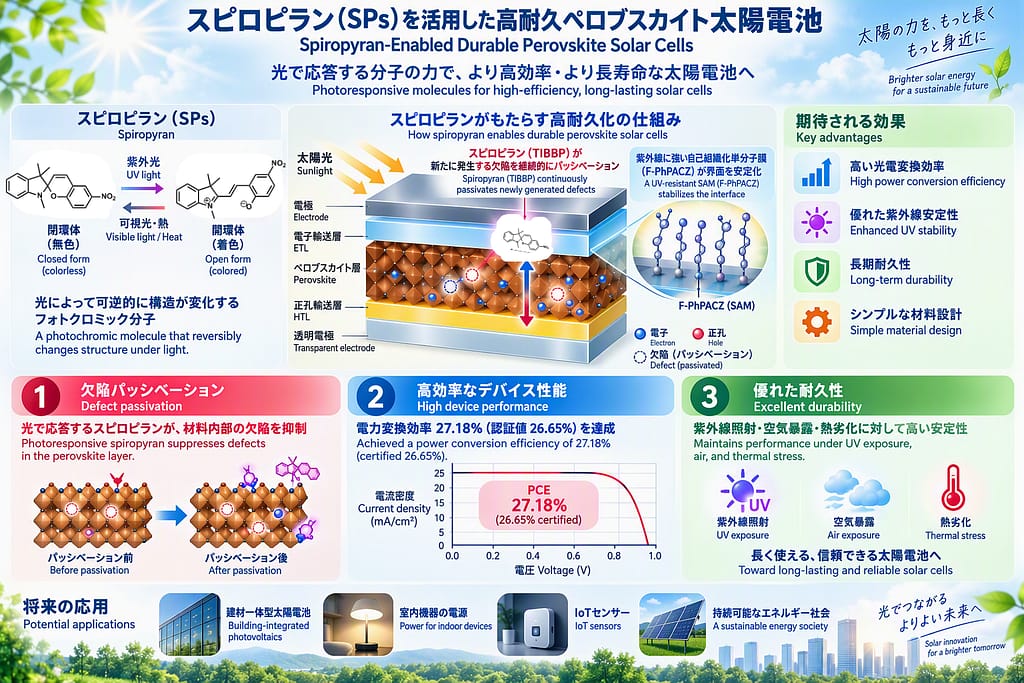
- 光応答性を持つスピロピラン誘導体(TIBBP)を導入。
- 光照射によって分子構造が変化し、新たに発生する欠陥を継続的に抑制。
- 初期の結晶形成から動作中まで機能する動的パッシベーションを実現。
- 紫外線に強い自己組織化単分子膜(F-PhPACZ)を設計し、界面の劣化を抑制。
- 材料内部と界面の両方を同時に安定化することで高い発電性能と耐久性を達成。
- 電力変換効率27.18%(認証値26.65%)を実現し、紫外線照射・空気暴露・熱劣化に対して優れた安定性を示した。
期待される応用
本研究は、光によって自ら状態を変化させながら欠陥を抑制するスピロピラン分子を活用し、ペロブスカイト太陽電池の弱点であった紫外線耐久性を改善した点が特徴です。将来的には高効率かつ長寿命な太陽光発電システムの実現に貢献すると期待されます。
English Version
Spiropyran-Enabled Durable Perovskite Solar Cells
Research Background
Perovskite solar cells have achieved remarkable efficiencies, but long-term durability under ultraviolet light remains a major challenge because material defects and interface degradation develop simultaneously.
Research Highlights
Synergistic Interface Stabilization and Dynamic Defect Passivation for High-Performance Ultraviolet-Stable Perovskite Solar Cells
- Introduced a photoisomerizable spiropyran-derived molecule (TIBBP).
- The molecule changes structure under illumination and continuously passivates newly generated defects.
- Provides defect control from film formation through device operation.
- Developed a UV-resistant self-assembled monolayer (F-PhPACZ) to stabilize buried interfaces.
- Combined bulk and interface stabilization strategies.
- Achieved a power conversion efficiency of 27.18% (certified 26.65%) with significantly improved UV, air, and thermal stability.
Overall Significance
This study demonstrates how photoresponsive spiropyran molecules can actively improve the stability of perovskite solar cells. The approach offers a promising pathway toward highly efficient and durable photovoltaic technologies suitable for long-term outdoor use.
References / 文献
- Zhang, Y. et al. Synergistic Interface Stabilization and Dynamic Defect Passivation for High-Performance Ultraviolet-Stable Perovskite Solar Cells. Advanced Materials (2026). DOI: 10.1002/adma.74582