キーワード / Keywords
1. エキシプレックス(Exciplex)
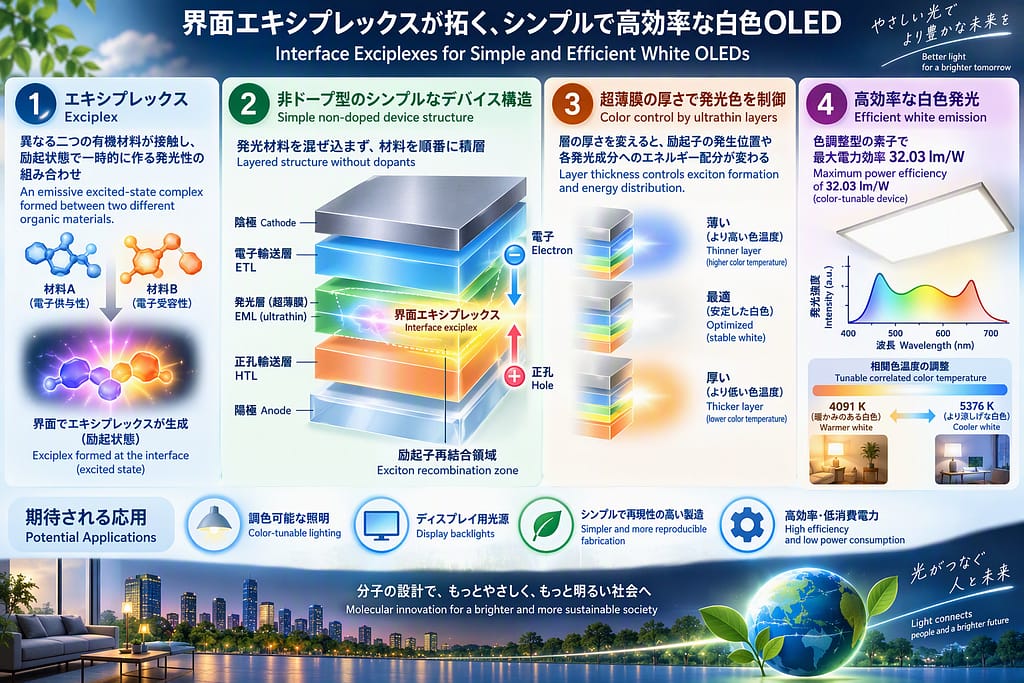
日本語:異なる二つの有機材料が接触し、励起状態で一時的に作る発光性の組み合わせです。材料界面で生じるため、OLEDの発光色やエネルギー移動を設計できます。
English: An emissive excited-state complex formed temporarily between two different organic materials, often at their interface.
2. 白色OLED(White OLED)
日本語:複数の発光成分を組み合わせ、人の目に白く見える光を作る有機発光デバイスです。照明やディスプレイ用光源として、効率と色安定性が求められます。
English: An organic light-emitting device that combines multiple emission components to produce light perceived as white.
3. 非ドープ型OLED(Non-Doped OLED)
日本語:発光層へ微量の発光材料を混ぜ込む工程を用いず、積層した材料そのものを発光に利用する方式です。構造が簡潔で、作製の再現性を高めやすい特徴があります。
English: An OLED architecture that uses the layered materials directly without dispersing a small amount of emitter into a host layer.
4. 超薄膜発光層(Ultrathin Emissive Layer)
日本語:非常に薄く形成した発光材料の層です。層の厚さを細かく変えることで、励起子が生まれる位置や各発光成分へのエネルギー配分を調整できます。
English: A very thin emitting layer whose thickness can control where excitons form and how excitation energy is distributed.
5. 励起子再結合領域(Exciton Recombination Zone)
日本語:OLED内部で電子と正孔が出会い、光のもとになる励起子を作る領域です。この位置が動くと、各発光層の寄与が変化し、発光色も変わります。
English: The region where electrons and holes meet to form excitons, with its position influencing emission balance and color.
日本語版
研究背景
OLEDで白色光を作るには、異なる色の発光を適切な割合で組み合わせる必要があります。一般的な高性能OLEDでは、ホスト材料に少量の発光材料を混ぜるドープ方式が使われますが、濃度の精密な管理が必要で、製造工程が複雑になりやすいという側面があります。これに対して非ドープ型OLEDは、材料を順番に積層して発光させるため、構造を簡潔にし、作製の再現性を高められる可能性があります。
ただし、非ドープ型は発光する場所やエネルギーの流れを細かく制御しにくく、性能向上が課題です。今回の研究では、異なる材料が接する界面にエキシプレックスを形成し、さらに超薄膜発光層の厚さを調整することで、高効率な白色OLEDと発光色の制御を目指しました。
研究内容
Efficient Non-Doped White Organic Light-Emitting Diodes Based on an Interface Exciplex Structure
- 超薄膜の発光層を組み合わせ、材料界面にエキシプレックスを形成する白色OLEDを設計しました。
- 発光材料をホストへ混ぜ込まない非ドープ型とすることで、比較的簡潔で再現性を得やすい素子構造を採用しました。
- 層と層の間に設ける中間層の厚さを変えることで、色が安定した白色発光と、色を調整できる白色発光の両方を実現しました。
- 色調整型の素子は、最大電力効率32.03 lm/Wを示しました。
- 相関色温度は4091 Kから5376 Kまで変化し、暖かみのある白色から、より涼しげな白色まで調整できました。
- 発光スペクトルの変化は、主にOLED内部で励起子が作られる再結合領域の移動によって生じると説明されました。
- 界面構造と層厚の制御が、発光効率と色の調整を両立する重要な手段であることを示しました。
期待される応用
この研究は、複雑なドーピング工程に頼らず、材料界面と薄膜の厚さによって白色OLEDの性能を調整できる可能性を示しています。界面エキシプレックスは、異なる材料間で生じる励起状態を発光に活用する仕組みです。そこへ超薄膜発光層を組み合わせることで、励起子再結合領域を動かし、複数の発光成分の割合を変えられます。
この考え方は、用途に合わせて白色の色温度を調整する照明、構造が比較的単純な面発光デバイス、製造ばらつきを抑えたOLED設計へつながる可能性があります。また、同じ基本構造から色安定型と色調整型を作り分けられる点は、製品設計の柔軟性にも役立ちます。今後は、長時間駆動時の色安定性と寿命、大面積化した場合の膜厚均一性、実際の製造工程での再現性を検証することが重要です。
English Version
Interface Exciplexes for Simple and Efficient White OLEDs
Research Background
White OLEDs require a carefully balanced combination of different emission colors. Many high-performance devices use doped emitting layers, in which a small amount of emitter is dispersed within a host material. This approach can be effective, but it requires precise concentration control and may complicate fabrication. Non-doped OLEDs instead use directly stacked materials, offering a potentially simpler structure and favorable reproducibility.
The challenge is to control where excitons form and how their energy is distributed among the emitting components. The featured study addressed this problem by forming an exciplex at a material interface and adjusting the thickness of ultrathin emitting and interlayers.
Research Highlights
Efficient Non-Doped White Organic Light-Emitting Diodes Based on an Interface Exciplex Structure
- A white OLED was designed using ultrathin emitting layers and an interface exciplex structure.
- The non-doped architecture avoided dispersing an emitter within a host and used a comparatively simple layered device structure.
- Adjusting the interlayer thickness produced both color-stable and color-tunable white OLEDs.
- The color-tunable device achieved a maximum power efficiency of 32.03 lm/W.
- Its correlated color temperature was adjustable from 4091 K to 5376 K, covering warmer and cooler white-light appearances.
- Spectral changes were mainly attributed to movement of the principal exciton recombination zone within the device.
- The results show that interface design and nanoscale thickness control can jointly regulate efficiency and emission color.
Potential Applications
This study demonstrates a route to tuning white-OLED performance through material interfaces and layer thickness rather than a complex doping process. The interface exciplex uses an excited state formed between neighboring materials, while ultrathin layers shift the exciton recombination zone and alter the contribution of each emission component.
The approach may support color-temperature-adjustable lighting, comparatively simple surface-emitting devices, and OLED structures designed for improved fabrication reproducibility. The ability to obtain either stable or tunable white emission from related device architectures may also provide flexibility in product design. Further work should evaluate long-term color stability and lifetime, thickness uniformity over large areas, and reproducibility under practical manufacturing conditions.
References / 文献
- Zhao, Q.; Chen, P.; Zhang, T. Efficient Non-Doped White Organic Light-Emitting Diodes Based on an Interface Exciplex Structure. Micromachines 17(8) (2026), 940. DOI: 10.3390/mi17080940