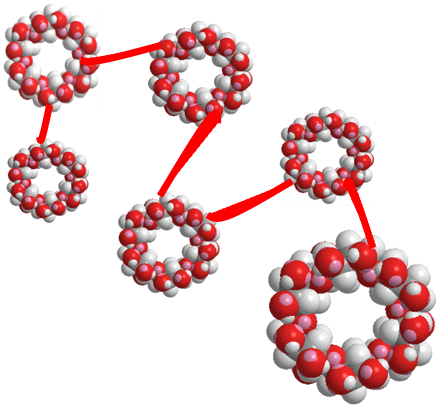
キーワード / Keywords
1. シクロデキストリンポリマー(Cyclodextrin Polymer)
日本語: 分子を取り込む環状構造を高分子や多孔質材料へ組み込んだ機能性素材です。分子の保持、選択的吸着、放出制御、触媒反応などに活用できます。
English: A functional material that integrates cyclodextrin cavities into polymers or porous structures for molecular capture, release, separation, and catalysis.
2. ホスト・ゲスト相互作用(Host–Guest Interaction)
日本語: シクロデキストリンの空洞が、形や性質の合う分子を選択的に取り込む仕組みです。色素の安定化や水中汚染物質の除去を支える基本原理です。
English: A selective interaction in which a cyclodextrin cavity accommodates a compatible guest molecule, supporting stabilization and pollutant capture.
3. CD-MOF
日本語: シクロデキストリンと金属イオンなどから構築される多孔質材料です。内部の空間へ機能性分子を保持し、外部刺激への応答や放出を調整できます。
English: A porous framework built from cyclodextrin and metal components that can confine functional molecules and regulate their response or release.
4. 擬似酵素触媒(Pseudo-Enzymatic Catalysis)
日本語: 天然酵素ではない分子が、基質の取り込みや反応部位の再生を通じて酵素のように働く仕組みです。穏やかな高分子合成への応用が期待されます。
English: Enzyme-like catalysis by a non-enzyme molecule through substrate recognition, selective reaction, and regeneration of active sites.
5. 循環型水処理(Circular Water Treatment)
日本語: 汚染物質を除くだけでなく、吸着材の回収・再利用や廃棄物削減まで考える水処理です。耐久性、連続運転、再生工程の評価が重要になります。
English: Water treatment that considers pollutant removal together with adsorbent recovery, reuse, waste reduction, durability, and continuous operation.
日本語版
導入
シクロデキストリンは、中央に分子サイズの空洞を持つ環状オリゴ糖です。この空洞へ特定の分子を取り込む性質を高分子や多孔質骨格と組み合わせると、天然色素を安定化する食品包装、水中汚染物質を選択的に除く吸着材、環状モノマーの反応を助ける触媒へ展開できます。
今回紹介する研究は、鮭の鮮度を色で知らせるフィルム、β-シクロデキストリン複合材による水処理の最新動向、シクロデキストリンが酵素のように働く開環反応を扱っています。用途は異なりますが、いずれも「分子を取り込み、適切な場所で反応や移動を制御する」という共通の考え方に基づいています。
研究内容
1. 天然色素を安定化し、鮭の鮮度を色で知らせる
pH-responsive colorimetric indicator films based on plasma-modified starch/PVA incorporating ovalbumin-sodium alginate-coated γ-cyclodextrin-MOF nanocomposites for salmon freshness monitoring
- アントシアニンをγ-シクロデキストリンMOFの孔へ取り込みました。
- さらに卵白アルブミンとアルギン酸ナトリウムの殻で覆い、色素の早すぎる流出を抑えました。
- ナノ複合体を、プラズマ処理したトウモロコシデンプンとPVAのフィルムへ組み込みました。
- フィルムはpHとアンモニアに応答して明瞭に色が変化し、鮭の保存中に生じる塩基性揮発成分と強い相関を示しました。
- DPPHラジカル消去活性は74.8%で、生分解性と細胞適合性も確認されました。
- 画像分類モデルEfficientNet-B0は、管理された実験環境で96.7%の分類精度を示しました。
- 実際の流通・家庭環境での汎用性については、追加の外部検証が必要です。
2. β-シクロデキストリン複合材による水処理を体系化
β-Cyclodextrin-based composites for wastewater treatment: Recent advances, challenges, and future perspectives
- 2021~2026年に報告されたβ-シクロデキストリン系水処理材料を総合的に整理しました。
- 対象には医薬品、染料、農薬、重金属、PFASなどの新興汚染物質が含まれます。
- 遊離β-シクロデキストリンの回収性や安定性の弱点を、架橋、高分子固定化、磁性粒子、炭素材料、MOF、COF、光触媒、膜との複合化で補う考え方を比較しました。
- 除去機構として、包接、界面相互作用、吸着、光分解、膜分離を取り上げました。
- 密度汎関数法、分子動力学、分子ドッキング、人工知能による性能予測と工程最適化も検討されています。
- 実用化には、試験方法の標準化、連続流と実排水での検証、成分溶出、再生廃液、製造費、ライフサイクル評価が課題と整理されました。
3. シクロデキストリンの二つの縁が開環反応を協働制御
Cooperative β-cyclodextrin/TBD acylation/deacylation in the ring-opening of ε-caprolactone: a ¹H NMR and MALDI MS kinetic study
- ε-カプロラクトンの開環オリゴマー化を、シクロデキストリンと有機触媒TBDの存在下で解析しました。
- ¹H NMRとMALDI質量分析を組み合わせ、モノマー、中間体、オリゴマーの変化を追跡しました。
- 反応は、シクロデキストリンへのアシル化で中間体を作り、その後の脱アシル化でオリゴエステルを生じる経路で進みました。
- シクロデキストリンの広い側にあるC2、C3水酸基は、選択的に反応する触媒面として働きました。
- 狭い側のC6水酸基は、分子内アシル移動を通じて中間体を安定化し、反応部位の再生に関与しました。
- この移動を妨げると、活性部位の再生とポリマー形成が抑えられました。
- 糖質分子を基盤とする擬似酵素触媒の設計原理を示しています。
研究全体の意義
三つの研究は、シクロデキストリンポリマーや関連骨格が、単なる分子容器ではなく、分子の安定化、選択的な分離、反応場の形成を担うことを示しています。食品包装では色素を守りながら鮮度情報へ変換し、水処理では孔構造と界面を組み合わせて多様な汚染物質に対応します。触媒反応では、シクロデキストリンの異なる水酸基領域が協働し、反応部位を再生します。
今後は、実環境での長期安定性、連続運転、材料の回収・再利用、量産性、安全性、ライフサイクル全体の環境負荷を評価することが重要です。分子認識と高分子設計を一体化する考え方は、スマート包装、循環型水処理、より穏やかな高分子合成へ広がる可能性があります。
English Version
Cyclodextrin Polymers for Food Sensing, Water Remediation, and Green Catalysis
Introduction
Cyclodextrins are cyclic oligosaccharides containing molecular-scale cavities. Integrating these cavities into polymers and porous frameworks enables stabilization of natural pigments, selective capture of water contaminants, and control of ring-opening reactions.
The studies highlighted here address a color-changing salmon-freshness film, recent progress in β-cyclodextrin composite materials for water treatment, and enzyme-like control of cyclic-ester ring opening. Each application relies on the same fundamental principle: capturing molecules and controlling their reaction or transport within a designed environment.
Research Highlights
1. Stabilizing Natural Pigments for Salmon-Freshness Monitoring
- Anthocyanins were loaded into the pores of γ-cyclodextrin metal-organic frameworks.
- An ovalbumin-sodium alginate shell was added to reduce premature pigment migration.
- The nanocomposites were embedded in a plasma-modified corn-starch/PVA film.
- The film showed clear responses to pH and ammonia, and its color evolution correlated strongly with volatile basic nitrogen during salmon storage.
- DPPH radical-scavenging activity reached 74.8%, while biodegradability and cytocompatibility were also reported.
- EfficientNet-B0 achieved 96.7% classification accuracy under controlled laboratory conditions.
- Generalization to real-world distribution and household conditions still requires external validation.
2. Mapping β-Cyclodextrin Composites for Water Treatment
- The review synthesized progress in β-cyclodextrin-based water-treatment materials reported from 2021 to 2026.
- Target contaminants included pharmaceuticals, dyes, pesticides, heavy metals, PFAS, and other emerging pollutants.
- Immobilization, crosslinking, and hybridization with polymers, biomass, carbon materials, magnetic particles, MOFs, COFs, photocatalysts, and membranes were compared as routes to improve recoverability and durability.
- Removal mechanisms included host-guest inclusion, complementary interfacial interactions, adsorption, photocatalytic degradation, and membrane separation.
- Density-functional theory, molecular dynamics, molecular docking, and artificial intelligence were discussed for mechanism interpretation and process optimization.
- Remaining barriers included nonstandard testing, limited continuous-flow and real-wastewater validation, component leaching, regeneration waste, synthesis cost, scalability, and insufficient life-cycle assessment.
3. Cooperative Cyclodextrin Catalysis in ε-Caprolactone Ring Opening
- Ring-opening oligomerization of ε-caprolactone was investigated in the presence of cyclodextrin and the organocatalyst TBD.
- ¹H NMR and MALDI mass spectrometry tracked monomers, intermediates, and oligomer products over time.
- The reaction proceeded through cyclodextrin acylation, formation of cyclodextrin-oligocaprolactone intermediates, and subsequent deacylation to homooligoesters.
- Hydroxyl groups at the wider C2/C3 rim acted as the reactive catalytic face.
- The primary C6 rim served as a stabilization site through intramolecular acyl migration and helped regenerate reactive hydroxyl groups.
- Blocking this migration suppressed active-site regeneration and polymer formation.
- The findings provide mechanistic principles for designing carbohydrate-based pseudo-enzymatic catalysts.
Overall Significance
Together, these studies show that cyclodextrin polymers and related frameworks are more than passive molecular containers. They stabilize functional molecules, create selective separation environments, and organize catalytic reaction pathways. In food packaging, molecular confinement converts pigment behavior into freshness information. In water treatment, engineered pores and interfaces address diverse contaminants. In catalysis, distinct hydroxyl regions cooperate to regenerate reactive sites.
Future development should evaluate long-term performance in realistic environments, continuous operation, recovery and reuse, scalable manufacturing, safety, and environmental impact across the complete life cycle. Integrating molecular recognition with polymer engineering may support smart packaging, circular water treatment, and milder polymer-synthesis processes.
References / 文献
- Balan-Porcarasu, M.; Blaj, D.-A.; Peptu, C. Cooperative β-cyclodextrin/TBD acylation/deacylation in the ring-opening of ε-caprolactone: a ¹H NMR and MALDI MS kinetic study. Carbohydrate Polymers 391 (2026), 125837. DOI: 10.1016/j.carbpol.2026.125837
- Rezania, S.; Cho, J.; Beygisangchin, M.; Ghasemlou, M.; Park, J.; Mojiri, A.; Behroozi, A. H. β-Cyclodextrin-based composites for wastewater treatment: Recent advances, challenges, and future perspectives. Carbohydrate Polymers 391 (2026), 125811. DOI: 10.1016/j.carbpol.2026.125811
- Zou, F.; Yang, M.; Wang, W.; Wu, J.; Zuo, Y.; Wang, H. pH-responsive colorimetric indicator films based on plasma-modified starch/PVA incorporating ovalbumin-sodium alginate-coated γ-cyclodextrin-MOF nanocomposites for salmon freshness monitoring. Carbohydrate Polymers 391 (2026), 125793. DOI: 10.1016/j.carbpol.2026.125793