伸びても光るOLEDへ:TADFポリロタキサンが両立する発光効率と柔軟性
キーワード / Keywords
-
熱活性化遅延蛍光(TADF) / Thermally activated delayed fluorescence
日本語: 分子内の励起エネルギーを熱の助けで再利用し、発光に結び付ける仕組みです。電気で生じた励起状態を有効活用し、高効率OLEDを目指す技術として研究されています。
English: TADF uses thermal energy to recycle excited states into light-emitting states, helping OLED materials make more effective use of electrically generated excitation energy. -
ポリロタキサン / Polyrotaxane
日本語: ひも状の分子に多数の環状分子を通し、環が抜けないようにした構造です。環が軸に沿って動けるため、引っ張りによる力を分散できる分子材料として注目されています。
English: A polyrotaxane consists of many molecular rings threaded onto polymer chains and prevented from slipping off. Ring motion along the chains can help dissipate mechanical stress. -
機械的インターロック / Mechanical interlocking
日本語: 分子同士を通常の共有結合だけで固定せず、輪と軸を組み合わせた形そのものでつなぐ設計です。分子の動きを残しながら、構造を一体化できます。
English: Mechanical interlocking connects molecular components through their ring-and-axle topology rather than relying only on conventional covalent bonds, preserving controlled molecular motion. -
外部量子効率(EQE) / External quantum efficiency
日本語: OLEDへ流した電子に対し、外部へ取り出せた光子の割合を示す代表的な性能指標です。発光材料の効率だけでなく、デバイス内の電荷利用や光取り出しにも左右されます。
English: EQE is the proportion of injected electrical charges converted into photons emitted from the device. It reflects charge use, light generation, and light extraction. -
本質的伸縮性 / Intrinsic stretchability
日本語: 硬い発光層に伸縮性部材を後付けするのではなく、発光材料そのものが伸び縮みに耐える性質です。変形可能な表示・照明デバイスの基盤になります。
English: Intrinsic stretchability means that the light-emitting material itself tolerates deformation, rather than depending only on added elastic supports or specially shaped device structures.
はじめに
折り曲げられるだけでなく、引っ張っても発光を保つOLEDを実現するには、相反しやすい二つの性能を両立する必要があります。材料を柔らかくすると分子の並びが乱れ、電荷が流れにくくなる場合があります。一方、発光効率を重視して分子を密に並べると、材料が硬くなり、変形に弱くなることがあります。
今回の研究は、高効率なTADF発光機能と、輪状分子が軸上を動けるポリロタキサン構造を分子レベルで一体化しました。引っ張りによる力を逃がしながら、電荷の通り道を保つという設計によって、伸縮性とOLED性能の両立を目指しています。
1. 発光する「輪」を柔らかな「軸」に通す
研究チームは、TADF機能を備えた環状分子を車輪、柔軟なポリウレタン鎖を軸として、新しい伸縮性TADFポリロタキサン群を構築しました。
- 研究の目的: 変形しやすさと発光・電荷輸送性能のどちらかを犠牲にせず、伸縮可能なOLED材料を設計することを目指しました。
- 材料の構成: 高効率に発光するTADF大環状分子を環状部品として、柔軟なポリウレタン鎖へ通しました。
- 設計の特徴: 環状分子と高分子鎖を機械的にかみ合わせることで、発光機能と可動性を同じ分子構造の中へ組み込みました。
- 従来の課題への対応: 単に柔らかい成分を混ぜるのではなく、力を逃がす機構と電荷を運ぶ機構を、ポリロタキサンの構造そのものに持たせました。
2. 環の移動で力を逃がし、発光分子の連なりで電荷を運ぶ
この材料では、ポリロタキサン特有の分子運動が機械的な変形を受け止め、TADF環状分子の連続した配置が電荷輸送を支えます。
- 応力の分散: 材料が引っ張られると、環状分子がポリウレタン軸に沿って滑り、局所的に集中する変形応力を分散します。
- 電荷の通り道: TADF大環状分子が連続的に集まることで、電子や正孔が移動するネットワークを形成します。
- 両立の考え方: 「動ける環」が柔軟性を支え、「連なる発光環」が光電子機能を支えるため、同じ構造内で役割を分担できます。
- 材料レベルの結果: 破断時伸び39%を示しながら、フォトルミネッセンス量子収率73%を維持しました。
- 研究の意義: 分子を単に柔らかくするのではなく、動き方と並び方を設計することが、伸縮性発光材料の有効な方針になり得ます。
3. OLEDとして高効率に発光し、繰り返し変形にも耐える
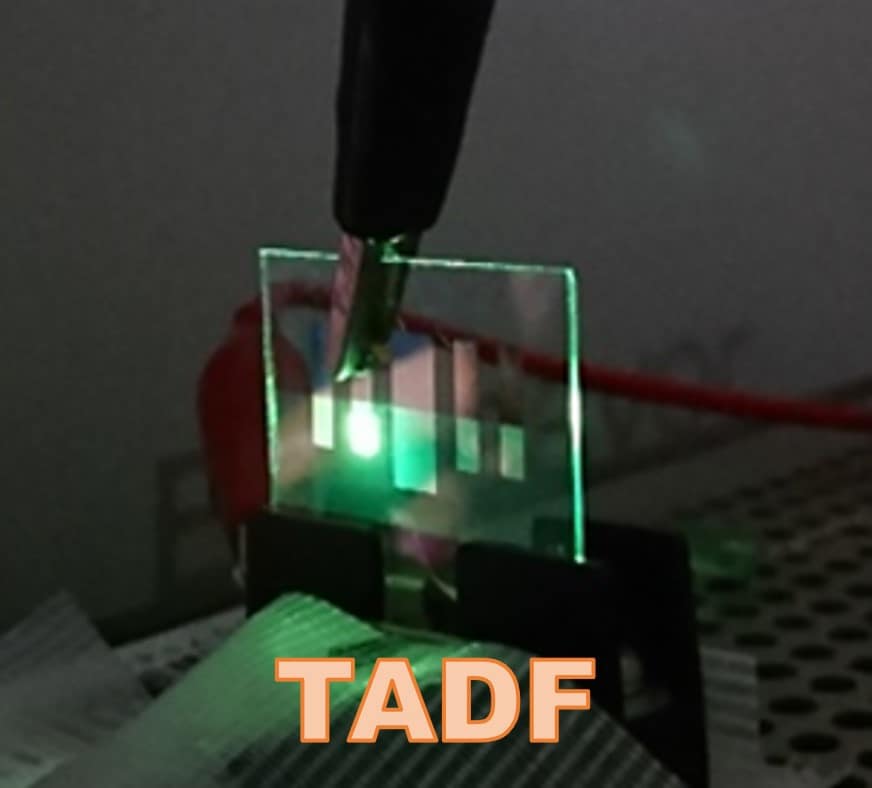
作製したTADFポリロタキサンをOLEDへ用い、発光性能と変形耐久性が評価されました。
- OLEDの効率: 最大外部量子効率は23.5%に達しました。
- 明るさ: 最高輝度は12,587 cd/m²でした。これは、単位面積当たりの画面の明るさを表す値です。
- 繰り返し試験: ROX30BNを用いた柔軟デバイスは、曲げまたは伸縮を100回繰り返した後も、初期輝度の90%超を維持しました。
- 性能の意味: 発光効率、明るさ、伸び、繰り返し変形への耐性が、一つの分子設計によって同時に示されました。
- 今後の可能性: 体や衣服の動きに追従する表示、変形可能な照明、柔らかな光電子デバイスに向けた材料設計の基礎になります。
研究全体から見えること
この研究の中心は、発光材料に伸縮性を「追加する」のではなく、TADF発光環と可動するポリロタキサン構造を統合し、材料そのものに発光と変形対応の両機能を持たせた点にあります。環状分子が滑ることで力を逃がしながら、環同士の連続的な配置が電荷輸送経路を保ちます。
得られた性能は、柔らかさと高効率発光が必ずしも単純な二者択一ではないことを示しています。分子の化学構造だけでなく、輪と軸のような「つながり方」や、変形時の分子運動まで設計対象にすることが、次世代の伸縮性OLED材料を考える重要な視点になります。
Stretchable OLEDs That Keep Emitting: TADF Polyrotaxanes Combining Light Efficiency and Mechanical Compliance
Keywords
- Thermally activated delayed fluorescence (TADF): TADF uses thermal energy to recycle excited states into light-emitting states, helping OLED materials use electrically generated excitation energy more effectively.
- Polyrotaxane: A polyrotaxane consists of many molecular rings threaded onto polymer chains and prevented from slipping off. Ring motion along the chains can dissipate mechanical stress.
- Mechanical interlocking: Molecular components are connected through ring-and-axle topology rather than relying only on conventional covalent bonds, preserving controlled molecular mobility.
- External quantum efficiency (EQE): EQE is the proportion of injected electrical charges converted into photons emitted from a device, reflecting charge use, light generation, and extraction.
- Intrinsic stretchability: The light-emitting material itself tolerates deformation instead of depending only on added elastic supports or specially patterned device structures.
Introduction
OLEDs that can not only bend but also stretch must reconcile two properties that often conflict. Softer materials may lose the organized molecular packing needed for efficient charge movement. Dense arrangements that support high optoelectronic performance, meanwhile, can make a material mechanically rigid and vulnerable to deformation.
This study integrated efficient TADF emission with a polyrotaxane structure in which molecular rings can move along flexible polymer axles. The design aims to dissipate stress during stretching while preserving pathways for charge transport and light emission.
1. Threading Emissive “Wheels” onto Flexible “Axles”
The researchers constructed a family of stretchable TADF polyrotaxanes using TADF-active macrocycles as functional wheels and flexible polyurethane chains as axles.
- Aim: To create a stretchable OLED material without sacrificing either mechanical compliance or optoelectronic efficiency.
- Material construction: Highly emissive TADF macrocycles were threaded onto flexible polyurethane chains.
- Design feature: Mechanical interlocking integrated light-emitting function and molecular mobility within the same architecture.
- Response to the conventional trade-off: Instead of merely blending an emitter with a soft component, the molecular topology itself was designed to manage both stress and charge transport.
2. Sliding Rings Dissipate Stress While Packed Emitters Transport Charge
The structure assigns complementary roles to molecular mobility and continuous packing of the TADF macrocycles.
- Stress dissipation: During stretching, the macrocycles slide along the polyurethane axles, redistributing localized deformation stress.
- Charge-transport pathway: Continuous packing of the TADF macrocycles establishes a network through which charge carriers can move.
- Integrated mechanism: Mobile rings support mechanical deformation, while connected emissive rings preserve optoelectronic function.
- Material performance: The polyrotaxane maintained a photoluminescence quantum yield of 73% together with an elongation at break of 39%.
- Importance: Designing how molecules move and pack may be more effective than simply making an emitting material softer.
3. Efficient OLED Operation and Resistance to Repeated Deformation
The TADF polyrotaxane was incorporated into OLED devices and evaluated for light-emitting performance and deformation durability.
- OLED efficiency: The maximum external quantum efficiency reached 23.5%.
- Brightness: The maximum luminance was 12,587 cd/m².
- Repeated deformation: A flexible device based on ROX30BN retained more than 90% of its initial luminance after 100 repeated bending or stretching cycles.
- Meaning of the results: High efficiency, brightness, elongation, and resistance to repeated deformation were demonstrated within one molecular design.
- Potential: The approach provides a basis for materials used in body-conforming displays, deformable lighting, and other soft optoelectronic devices.
Overall Significance
Rather than adding stretchability to a conventional emitter, this work integrated TADF-emitting rings with a mobile polyrotaxane topology so that light emission and mechanical adaptability were intrinsic to the material. Sliding rings dissipated stress, while the continuous arrangement of macrocycles maintained charge-transport pathways.
The results indicate that softness and efficient emission need not be a simple either-or choice. Molecular connectivity, ring-and-axle topology, and motion during deformation can all become design parameters for the next generation of stretchable OLED materials.
文献 / Reference
- Jiang, J.; Qian, Y.; Xu, T.; Feng, S.; Ren, Y.; Zou, S.; Shi, W.; Zhou, H.; Ban, X. “Mechanical Interlocking Integrated TADF Polyrotaxane With Intrinsic Stretchability for Deformable Organic Light-Emitting Diodes.” Advanced Functional Materials, 2026, Early Access. DOI: 10.1002/adfm.78632.